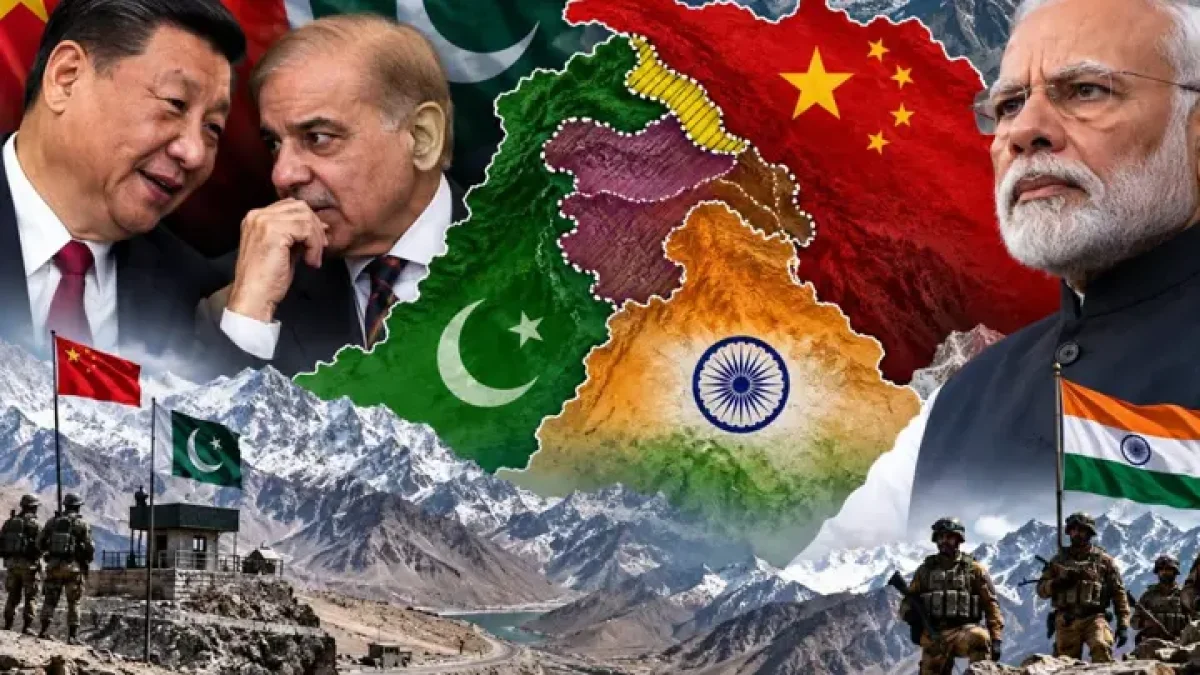
Pakistan and China have formally moved to demarcate their boundary in a disputed area of the Himalayas. The two countries signed an agreement last week forming a Pakistan-China joint boundary commission. India has responded sharply.
For many decades India has refused to recognise the Pakistan-China border in that area. Delhi claims the territory is part of India, and so India does not recognise any border between Pakistan and China.
Pakistan has described the agreement as an important milestone. In its view, cooperation between Pakistan and China on border management, trade and communication will now deepen.
India’s foreign ministry spokesman Randhir Jaiswal said: “There is no border between Pakistan and China. We reject the so-called joint commission, which has no legal basis.”
The announcement has come at a particularly sensitive moment. Military tension has run for several years around the Line of Actual Control (LAC), the disputed line separating Indian and Chinese troops along much of the Himalayan frontier. The two countries have recently been trying to stabilise relations. In the midst of that, Beijing and Islamabad are increasing cooperation in a border area that India also claims.
The joint commission covers the Shaksgam Valley, an area of about 5,180 square kilometres that Pakistan transferred to China in 1963. India claims it as part of its own territory in Ladakh.
Delhi says the Shaksgam Valley was part of the former princely state of Jammu and Kashmir, and that Pakistan transferred the area to China after occupying it illegally. The Indian government has never recognised that 1963 agreement, which in Delhi’s view is illegal and void.
India’s foreign ministry said: “Pakistan has no right to take any measure regarding Indian territory which it holds through illegality and the use of force.”
Pakistan’s position is different. It says Jammu and Kashmir is still a disputed area, and that India is therefore not in a position to question the 1963 border agreement with China. Pakistan considers that agreement valid.
Jabin T Jacob, professor in the department of international relations and governance studies at Shiv Nadar University in Delhi, said the latest development is another expression of a long-standing hostility between the two sides, and not something entirely new.
He said the 1963 China-Pakistan agreement itself spoke of a joint boundary commission. The question now, he said, is why this arrangement has been brought into effect at this time.
In Jacob’s view there may be more than one reason behind it, including China’s wider effort at boundary demarcation. There may also be an interest in giving institutional form to communication and movement on this border, even amid conflict and instability on Pakistan’s other frontiers.
Jacob said India ought to be concerned by this development. More importantly, in his view, the step appears to disregard one clause of the 1963 agreement. Under article 6 of that agreement, he said, the agreement was to be renegotiated with whichever country finally gained control of the territory after the settlement of the Kashmir dispute.
For India, Jacob said, the matter is also complicated in terms of presenting information internationally. China has a comparative advantage in international media and information, he said. Its presence through CGTN, CRI and social media gives it the opportunity to put forward its own narrative and maps on a global scale. India, by contrast, is often confined to responses that other capitals may ignore.
The scale of this concern is somewhat different, however, from what is actually happening on the ground at the border. Pakistan and China already have extensive infrastructure and communication in the area, including the China-Pakistan Economic Corridor (CPEC) and the Karakoram Highway.
Husain Haqqani, Pakistan’s former ambassador to the United States and now a senior fellow at the Anwar Gargash Diplomatic Academy and the Hudson Institute, said the new commission is both practical and political.
Haqqani said it is a mechanism for strengthening border and boundary cooperation, preventing illegal crossings and protecting strategic infrastructure connected with CPEC.
In his view the step also sends a message to India: that Beijing still sees the Kashmir question in the light of Pakistan’s perspective.
Haqqani said China has never accepted India’s position on Kashmir. It views Gilgit-Baltistan too from Pakistan’s standpoint rather than India’s. That region of Pakistan-administered Kashmir shares a border with China, and India claims it as part of its own territory.
Pakistan’s position has also changed since recent changes in Indian-administered Kashmir, in Haqqani’s view. He said Pakistan still considers the final status of Jammu and Kashmir undetermined. But now that India has made internal changes in the part of Kashmir it controls, such as revoking article 370, Pakistan sees no problem in giving institutional form to something that has remained undeclared with China since 1963.
For Beijing too, Haqqani believes, the arrangement is consistent with a wider strategy of using relations with neighbouring countries to signal its position to India. In his view, reassuring Pakistan on the Kashmir issue is important to China both strategically and geostrategically. It deepens China’s relationship with Pakistan while reminding India of the risk of a two-front threat from China and Pakistan.
Experts say the timing of the announcement is also significant. Haqqani said China generally plans its decisions months, even years, in advance, so the decision to activate the joint boundary commission may have been taken long ago.
In his view the timing of the disclosure was set for after President Xi Jinping’s recent visit to the BRICS summit. The purpose may be to reassure Pakistan about the strategic partnership and to remind India that multilateral engagement has brought no change in China’s view of South Asia.
Jabin T Jacob cautioned, however, that every aspect of this should not be seen as a direct military step against India. In his view there is no likelihood of any immediate or visible effect on the LAC at this moment.
This suggests that the significance of last week’s announcement may lie not in any immediate change at the disputed Himalayan border, but in the gradual institutionalisation of arrangements that India has consistently rejected.
India’s foreign ministry spokesman Randhir Jaiswal said India’s position is clear and consistent. In Delhi’s view, any attempt to legitimise Indian territory illegally occupied by Pakistan is unacceptable, and it will have no effect on India’s sovereignty.
Haqqani believes the dispute is not confined to the legal question of the border. In his view the main disagreement between India and China over borders and boundaries is geostrategic rather than merely cartographic. There are therefore limits to what can be achieved in border talks and in border management on the ground.
Haqqani added that Pakistan remains China’s second-tier deterrent against India, and that Beijing’s engagement with Islamabad will continue to convey that message to Delhi.