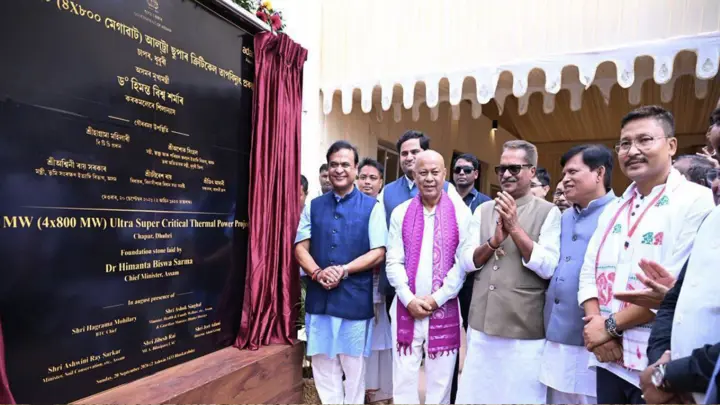
A grim picture of the present condition of India’s Muslim minority has been exposed again in the Dhubri district of Assam. The state’s chief minister, Himanta Biswa Sarma, recently laid the foundation stone of a 3,200 megawatt thermal power project by Adani Power Limited there. Behind this so-called development, however, lies the weeping of thousands of people.
On the very land where this project was launched, the Assam government in July 2025 evicted 1,400 Bengali Muslim families and demolished their homes. The site of the power project has been marked out in the villages of Charuabakhra, Chirakuta 1 and 2 and Santoshpur, within the Chapar revenue circle. About 1,157 acres of government land was first cleared of Muslim residents and handed to the state-owned Assam Power Distribution Company Limited, and subsequently passed on to Adani Power Limited.
The eviction drive left about 10,000 Bengali Muslims who had lived in the area for at least three to four decades entirely homeless and displaced. Local residents said many of those evicted had earlier been victims of erosion by the Brahmaputra, and had come to take shelter there after losing their own homesteads.
At the foundation-stone ceremony, meanwhile, the chief minister claimed this was the largest power project in Assam’s history and would meet the state’s entire electricity demand. He said it was the realisation of a 50,000 crore rupee investment proposal made by the Adani Group at a business summit held in the state in February this year. The Adani Group has claimed the project will create work for about 20,000 people during construction and about 5,000 more once it is running.
The most striking aspect is the legal validity of the eviction and the process of obtaining environmental clearance. On July 14 an expert appraisal committee (EAC) of the central environment ministry recommended environmental clearance for the proposed coal-based thermal power project. Remarkably, the application for environmental clearance told the ministry on Adani’s behalf that there was no settlement or habitation on the project site and that there was therefore no claim or liability in respect of rehabilitation. Displaced local residents have challenged that claim as entirely baseless and false. According to the minutes of a district-level land advisory meeting, the district administration submitted a proposal on March 30, 2025 to use for the power project a piece of government land reserved as grazing ground for livestock; eviction notices were issued after that and the homes demolished.
An evicted resident, Abdur Rashid Sheikh, said that as a result of the Assam government clearing the land through a forcible eviction drive, 1,400 families are living in extreme hardship without any rehabilitation at all. He said that besides the 3,500 bighas of khas land taken by force, about 1,700 bighas of land for which ordinary people held valid ownership documents or pattas was also seized. Although all the papers were accepted, at least 50 percent of the patta-holding landowners have still received no compensation. In the name of rehabilitating those affected, the district administration allotted only 300 bighas of land in Baizar Alga village and announced a one-off payment of 50,000 rupees to move belongings. But local residents were unwilling to go there, because that land is a low-lying and severely flood-prone area right beside the Brahmaputra.
State deprivation and aggression of this kind against Muslims in Assam is not an isolated matter. Since the BJP came to power in Assam in 2016, the great majority of the eviction drives carried out in phases across districts of the state have taken place in Bengali-speaking Muslim-majority areas. At least eight Muslim residents have been killed in police firing during those successive eviction drives since 2016. On one side, investment worth thousands of crores of rupees to protect corporate interests; on the other, several thousand Bengali Muslims made refugees in their own country despite holding valid papers — this picture points sharply to the real condition and insecurity of Muslims in India today.