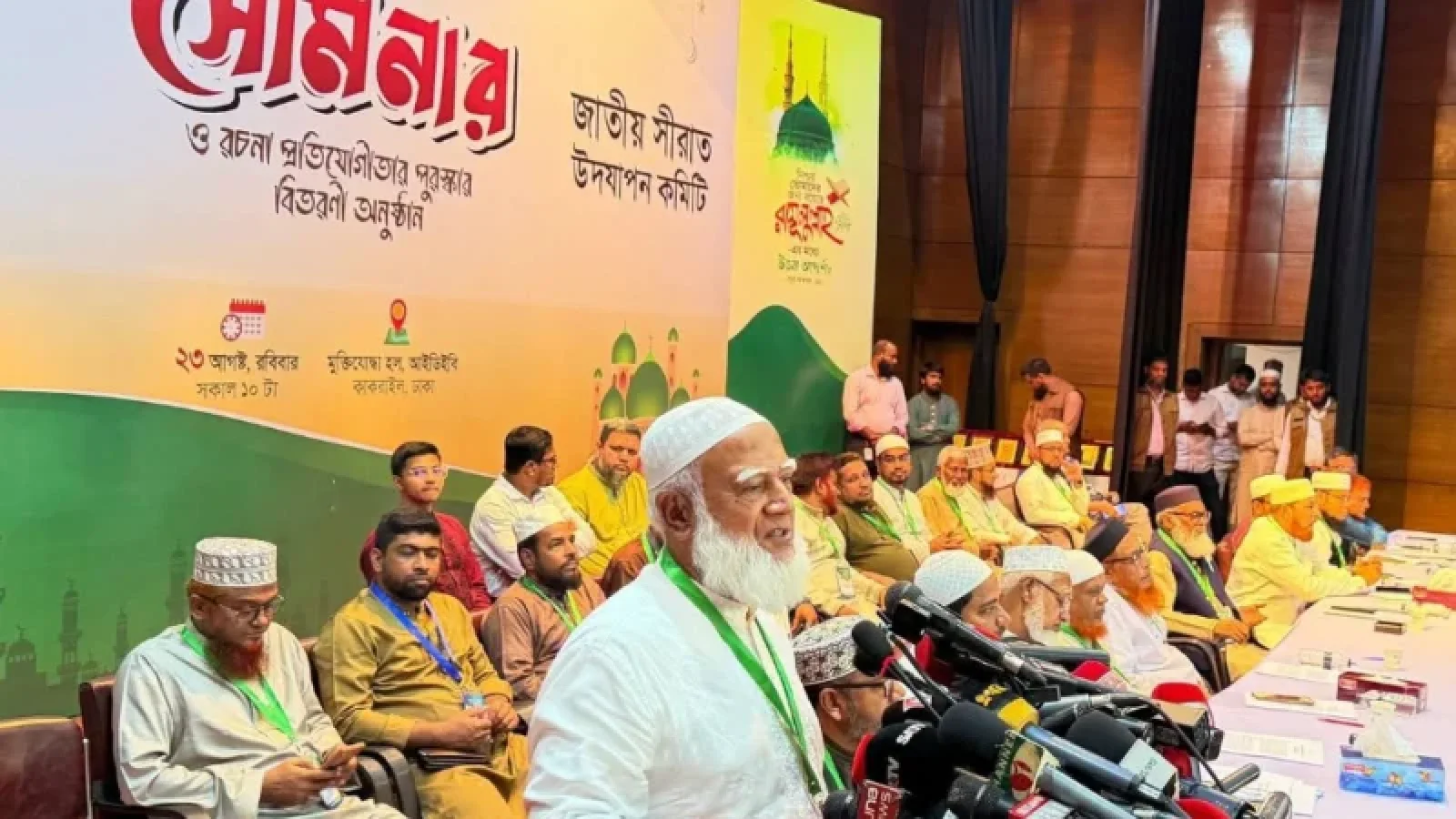
Bangladesh Jamaat-e-Islami Ameer and Leader of the Opposition Dr. Shafiqur Rahman has said there is no basis for viewing the 2024 movement as the final war. It was, he said, preparation or a rehearsal for the final war. The people who awakened during the 2024 movement, he said, remain alert to confront any form of fascism.
He made the remarks as chief guest at a Seerat-un-Nabi (peace be upon him) seminar and essay-competition prize-giving ceremony, held Sunday, August 23, at the auditorium of the Institution of Diploma Engineers, Bangladesh (IDEB) in the capital’s Kakrail.
Dr. Shafiqur Rahman said the people who awoke in 2024 have not all died, nor have they gone back to sleep. They are watching everything with alert eyes, he said. Before the main battle, he said, a force has to be built, has to drill, has to rehearse. These people should not think of 2024 as the final war, he said.
“This was a rehearsal for the final war,” he said. “After 2024, I had hoped the ‘filth, dirt and garbage’ of fascism, built up over a long period, would be cleared away. But that hasn’t happened; if anything, the amount of garbage has grown further.”
The Jamaat ameer said fascism is a contagious disease. It spreads from one place to another, he said; whoever this virus latches onto becomes fascist. “We can see,” he said, “that the current government is walking the same road the fascist government walked for 15 years. This road needs to change. This is the road of fascists, the road of the ‘Aynaghar’ [secret detention centers], the road of killing countless people without trial. The people of Bangladesh will not let anyone walk that path.”
On the removal of important historical material from the July Museum, the opposition leader said he believes every conscious citizen should visit the museum. Unfortunately, he said, the nation’s sorrowful events had been documented there during the interim government’s tenure, but many of its elements have since been made to “disappear” to please a specific country and state. The museum had featured pioneering figures from many political and cultural changes going back to 1946 and 1947, he said, much of which has now vanished. When a museum passes into the hands of an elected government, he said, it should include the mementos and photographs of many persecuted people as well.
He further alleged that the memories of people from one particular party have been kept while the rest have been erased. He cited the example of Delwar Hossain, then-central president of Islami Chhatra Shibir, who he said was kept in remand for nearly 200 days and subjected to torture during that period. Their late prime minister, Begum Khaleda Zia, had expressed regret over his name, he said, adding that a memento related to him had also been erased. He also cited the killing of Felani, inhumanely left hanging at the border, saying that memory too had been erased.
Dr. Shafiqur Rahman said this is not a good sign. Whoever comes to power, he said, immediately claims history was distorted before them. But Bangladesh’s history so far shows, he said, that everyone has been a protagonist of history’s distortion; no one has managed to break free of this practice.
The Jamaat ameer also spoke about Bangladesh’s international image and the strength of its passport. Five decades after independence, he said, Bangladesh has not progressed as expected. The strength of a passport, he said, is one measure of the respect a country’s people command in the eyes of the world, and Bangladesh’s passport ranking is disappointing, he said.
The event was presided over by Professor Dr. A N M Rafiqur Rahman Madani, chairman of the Islamic Studies department at Bangladesh Islami University. Other speakers included Dr. A F M Khalid Hossain, former religious affairs adviser to the interim government; opposition whip Maulana Rafiqul Islam Khan; Md Nurul Islam Bulbul; Dr. Shafiqul Islam Masud; and other leaders.
বাংলায় মূল প্রতিবেদন পড়ুন · Read the original Bengali report