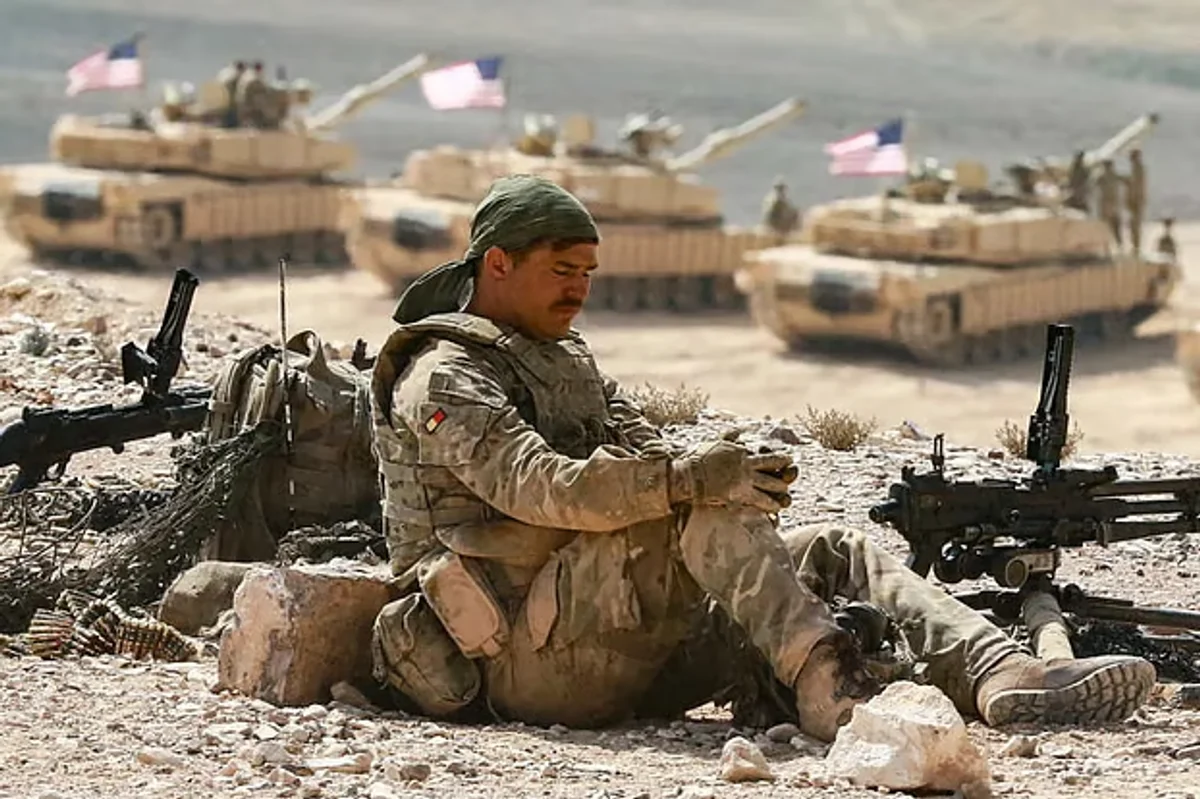
For nearly three decades Jordan has been used as an important base for US military operations in the Middle East. After the United States and Israel’s aggression against Iran, Jordan is now paying a heavy price for that. Iran has recently stepped up attacks on the country, targeting US military bases in Jordan.
But although sirens sound regularly in Jordan’s skies, the country is taking no steps to limit the American presence. Analysts say Jordan cannot scale back those military activities because of its dependence on the United States.
US officials say that while some other American allies in the region imposed restrictions during the war with Iran on Washington’s ability to build troop bases on their territory and to fly over it, Jordan is not in a position to impose any such limits.
Yom said that no one else could provide the kind of support Jordan has been receiving from the United States since the 1950s.
After the United States and Israel began their aggression against Iran late last February, Iran retaliated by striking US allies in the Middle East. In the first months of the war Iran mainly targeted Israel and US allies in the Gulf, but it also fired hundreds of drones and missiles towards Jordan.
Jordan in danger from Iran’s strikes
Now, with the US-Iran ceasefire collapsing, both sides have stepped up their attacks and Iran has widened the range of its targets. Jordan’s military said that last Sunday Jordan’s air defences shot down three Iranian missiles. A fourth missile fell in an uninhabited area.
The director of the Center for Strategic Studies, a research institution that advises the Jordanian government on national security, Hassan Almomani, said: “The aim of this Iranian strategic escalation of striking neighbours is to create pressure on those neighbours, whose main purpose is to create pressure on the United States.”
In an Iranian strike on the Muwaffaq Salti base on Friday, two US soldiers were killed and a third went missing. In three other attacks on US forces in Jordan earlier in the week, about a dozen US soldiers were wounded and several Black Hawk helicopters were damaged.
Jordanian officials have described the US troop presence in the country as part of a defence agreement.
US forces have long conducted their operations from Jordan’s air bases. The country was a base for US military activities such as the fight against the Islamic State, the training of rebel fighters during the Syrian civil war, and the invasion of Iraq. According to a parliamentary report, there are currently about four thousand US military personnel in the country.
Muwaffaq Salti and other bases have been adapted to ensure a permanent US presence. A former Middle East adviser at the Pentagon and now a senior fellow at the Washington Institute for Near East Policy, Grant Rumley, said that from the US point of view Jordan’s infrastructure is strong enough; he compared it to a land-based aircraft carrier.
Rumley said Muwaffaq Salti is relatively remote, which allows US forces to operate without attracting unnecessary attention. And because Jordan is further from Iran than the Gulf countries, US forces in Jordan get more time to respond to missile and drone attacks.
A safe haven for the United States in the Middle East
US officials said that in the run-up to the war with Iran and in its early stages, the US military moved some of its troops from several Gulf Arab countries to the comparatively safe locations of Jordan and neighbouring Israel.
Almomani said: “The war with Iran has revealed how important Jordan is to the United States.” Washington increased military aid to Jordan by 50 crore dollars this year, he said.
Jordanian officials often stress the strategic importance of their relationship with the United States. In a phone call with President Trump in April, King Abdullah II stressed Washington’s important role in the Middle East, particularly in the possibility of reducing the conflict with Iran.
According to Jordan’s state news agency Petra, earlier this month Jordan’s army chief, Major General Yousef Huneiti, and the US defence department’s assistant secretary for international security, Daniel Zimmerman, discussed further expanding military cooperation.
The Jordanian government rarely discusses the extensive US military presence publicly. Jordan has not publicly criticised the United States for carrying out air strikes on Iran or for starting the war alongside Israel — although analysts say the government was strongly opposed to the conflict from the beginning.
Jordanian officials have repeatedly condemned Iran’s attacks on their territory in strong terms, and last week Foreign Minister Ayman Safadi said Iran’s pretext for the attacks — that there are US bases in Jordan — is false.
বাংলায় মূল প্রতিবেদন পড়ুন · Read the original Bengali report