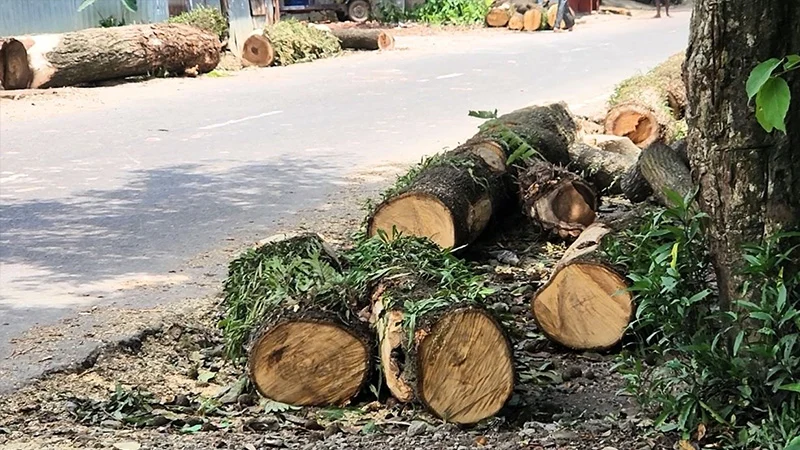
Work has begun to cut down 4,500 trees along a roughly 19-kilometer stretch of the Sunamganj-Sachna road. The Forest Department is cutting the trees on this road, which falls under the Roads and Highways (RHD) Department. RHD, however, says no project has been undertaken to widen the road, and that it does not know the reason for the felling. It says the Forest Department has only given it a copy of the tender for the tree-cutting.
Meanwhile, local residents, environmental activists and people from various walks of life have grown angry over the tree-cutting. On Saturday, the Sunamganj District Haor and River Protection Movement organized a human chain at the Ichharchar area of the road. Speakers there demanded the tree-cutting be stopped immediately, warning that they would otherwise surround the forest office.
Local residents allege that although the felling is said to target foreign tree species, native fruit and shade trees along the roadside are also being cut down.
Manik Mia, a resident of Ichharchar village, pointed to a jam (Java plum) tree cut down in front of his house and said: “The land is government-owned, but I planted the jam tree. Local students and pedestrians used to get shade from it. During jam season, everyone would pick and eat fruit from the tree. When they came to cut it, everyone nearby tried to stop them. Still, they cut down two trees.”
Abul Hossain, from the same village, said hundreds of trees along the roadside are being cut down for no clear reason. He said he had heard a tender had been issued for cutting foreign species such as akashmoni and rain trees, but native trees are being cut as well. Even when people try to stop them, those carrying out the felling are not listening.
Leaders of the Haor and River Protection Movement said the value of roadside shade trees cannot be measured in money alone. These trees matter to pedestrians and local residents, they said. They allege that 4,468 trees were sold for 8.48 million taka, even though the market value of the timber from these trees could run into several crore taka. They allege this is causing the government itself financial loss as well.
The organization’s president, Raju Ahmed, and general secretary, Obaidul Hoque, said the forest office would be surrounded if the tree-cutting does not stop within 24 hours.
20,000 trees planted in 2004
Local residents said about 20,000 trees were planted along both sides of the Sunamganj-Sachna road in 2004 under a social forestry program. Local beneficiaries have been tending these trees ever since.
The Forest Department had earlier invited tenders in 2024 to cut about 3,000 trees on the same road. The trees were not cut at the time in the face of protests from local residents.
Raju Ahmed, president of the Haor and River Protection Movement, said that following a writ petition filed by Human Rights and Peace for Bangladesh (HRPB) in 2025, a High Court bench ordered that trees planted under the Social Forestry Rules, 2004, should not be cut, and directed that a provision be added to determine the trees’ market value and pay that amount to selected beneficiaries instead. The same ruling, he said, also required that cutting social forestry trees be approved by a seven-member committee led by the district commissioner.
Sunamganj District Forest Officer Riaz Uddin said Saturday that approval for the tree-cutting had come from the district committee.
However, Additional District Commissioner Motiur Rahman Khan said no such approval had been granted during the current district commissioner’s tenure — that is, over the past three to four months. If approval had been granted earlier, he said, the matter would need to be confirmed by examining the relevant documents and files.
Sajedur Rahman, sub-divisional engineer of the Roads and Highways Department, said no project has been undertaken to widen the Sunamganj-Sachna road. RHD has no information about the tree-cutting, he said, adding that the Forest Department has only sent it a copy of a tender for the felling.
The Forest Department’s response
Mohammad Abdur Rahman, Sylhet’s divisional forest officer, said about 4,500 trees planted under social forestry exist along the roadside. Under social forestry rules, he said, once a plantation turns 10 years old, the trees can be cut, with proceeds distributed among members, followed by new plantation on the same land.
He said the tree-cutting was undertaken following an application from social forestry members. Notices on the matter were published in national and local newspapers, he said, and the tender process was completed through the offices of the divisional commissioner, the district commissioner and other relevant departments.
Noting that akashmoni and various other foreign tree species exist along the roadside, he said that under the Forest Conservation Act, 2026, an initiative will be taken to plant new native-species trees in their place.
Asked about allegations that native tree species along the roadside are also being cut, Mohammad Abdur Rahman said native species will not be cut.
Asked about the court’s directive that the government compensate beneficiaries instead of cutting social forestry trees, he said the matter had been under discussion during the interim government’s tenure, but that the Forest Department has not yet received any gazette or final directive from the government on this. If the government issues such a directive, he said, the Forest Department will follow it.
বাংলায় মূল প্রতিবেদন পড়ুন · Read the original Bengali report