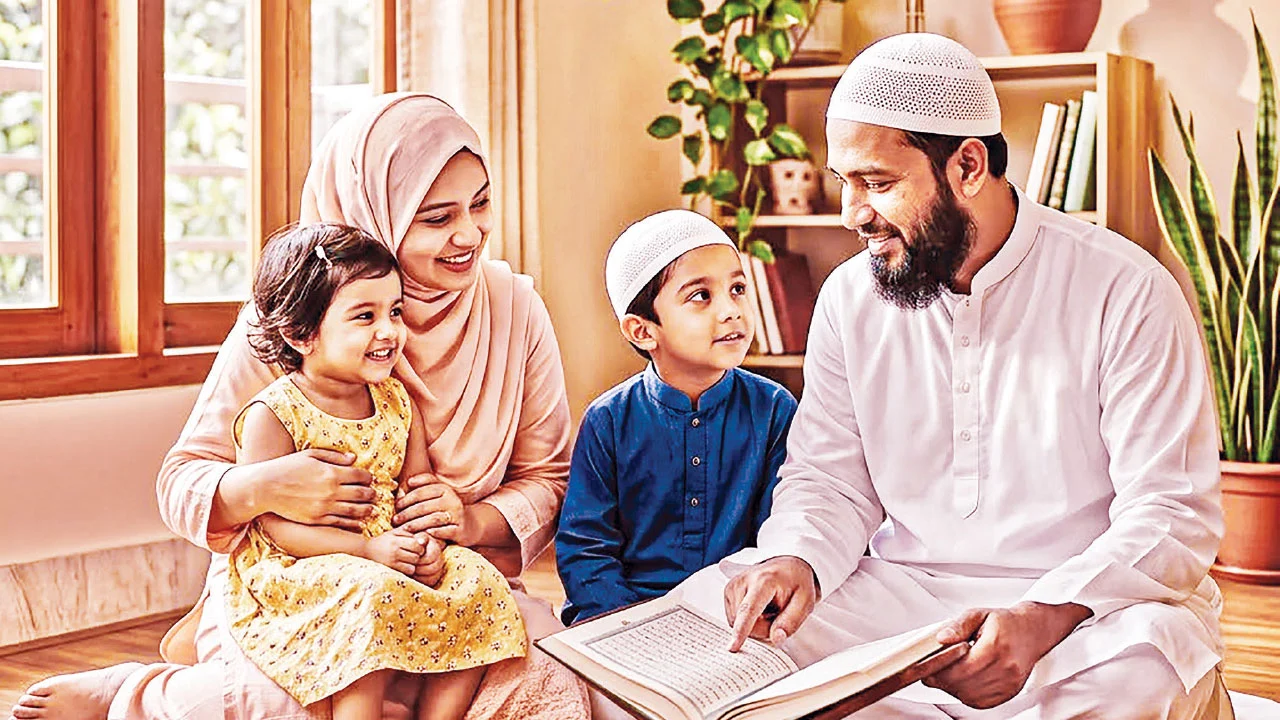
Islam is a complete way of life in which a child is regarded not merely as a member of the family but as a sacred trust (amanah) placed by Allah in the care of the parents. The Qur’an describes children as both an adornment of worldly life and a test for parents. So the responsibility for a child’s physical, mental, intellectual and moral development is not merely a matter of emotion but also a religious duty. Fulfilling it requires affection, love, mercy and wise instruction — and, where necessary, Islam also permits limited and just discipline. In this way Islam’s teaching, on the one hand, teaches gentleness and, on the other, gives guidance for responsible guardianship.
The Prophet (peace be upon him) was the finest example towards children. He loved them, took them in his lap, stroked their heads with affection, spoke to them with a smiling face and treated them sincerely. The hadith records that he would even greet children with salaam first as he walked. When a companion expressed surprise at seeing him kiss his grandsons Hasan and Husain, he said: “One who has no mercy in his heart is not shown mercy either.” A hadith also records that he prayed while carrying his granddaughter Umm Kulthum on his shoulder — proof of his forbearance and gentleness towards children. The Messenger of Allah (peace be upon him) said: “He who does not show affection to our young and respect to our elders is not one of us.” (Tirmidhi: 1921)
Children are by nature restless and curious. They will make mistakes, learn and gradually mature — this is the natural course of development. So the true teaching of Islam is not harshness in response to every mistake, but patience, explanation and encouragement. Islamic thinkers hold that a child’s mistake should be seen as a learning opportunity rather than through the lens of punishment, because a child who grows up in an environment of fear risks becoming unconfident and mentally weak.
Yet Islam does not deny the need for discipline. Timely instruction and correction are essential to raise a child into a responsible person. In this regard the Messenger of Allah (peace be upon him) said: “Instruct your children to pray at the age of seven, and discipline them for it at the age of ten if they do not pray.” (Abu Dawud: 495) The purpose of this hadith is in no way to legitimise abuse; rather, it permits corrective measures if needed even after long instruction and encouragement.
Islamic scholars note that discipline too should proceed step by step: first gentle advice, then mild reproach, then, if needed, a stern warning. If there is still no correction, discipline is permitted that is neither painful nor permanently harmful and whose sole aim is correction. Striking the face or sensitive parts of the body, beating in anger, or humiliating a child publicly is entirely forbidden in Islam. Jurists have even imposed specific conditions on the degree, place and purpose of any physical discipline, so that it remains educational rather than vengeful.
In the family or educational setting, various corrective methods can be adopted as alternatives to physical punishment — for example, temporarily limiting play, having a child stand in the classroom for a while, assigning extra practice, temporarily withholding a favourite activity, or seating the child in a calm setting for an advisory talk. Modern child psychology also supports these methods as effective, because they keep the child’s self-respect intact while creating room for correction.
Most importantly, wronging a child is a grave sin, because it concerns the rights of a fellow human. Although Allah is forgiving regarding His own rights, violating the rights of a person makes salvation difficult without the aggrieved person’s due being fulfilled or their forgiveness obtained. So whether guardian, teacher or any responsible person, acting towards a child out of anger, revenge or humiliation is not the teaching of Islam. Rather, at the heart of every decision must be a sincere desire for the child’s welfare and right guidance.
In today’s society, ensuring children’s mental health, moral development and family bonds requires us to return to the example of the Messenger of Allah (peace be upon him). Affection should be the foundation of instruction, mercy the beauty of the relationship, and discipline a means of wisdom, restraint and correction — not a tool of punishment or revenge. This balance can raise a child into a confident, moral and exemplary person, and plays an important role in establishing peace in the family and society.
বাংলায় মূল প্রতিবেদন পড়ুন · Read the original Bengali report