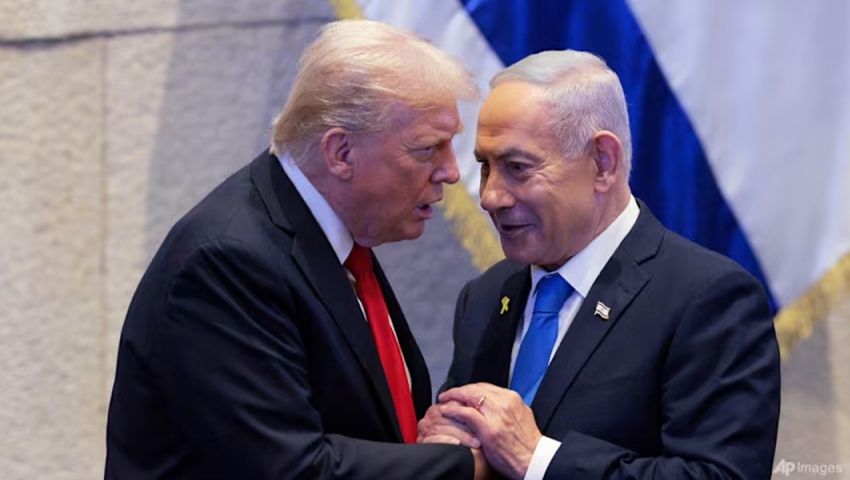
Israeli Prime Minister Benjamin Netanyahu’s grip on power has long been shaky. The signing of a memorandum of understanding between the United States and Iran has made his position even more difficult ahead of an upcoming national election at home.
Israel holds its national election in October this year. As recently as March, Netanyahu boasted, “We are changing the face of the Middle East.”
But long before Israel achieved that goal, US President Donald Trump decided to end the war with Iran and signed a memorandum of understanding. The memorandum also includes a halt to the war in Lebanon on terms accepted by Iran.
On February 28, Israel and the United States jointly launched strikes on Iran, and Iran responded in kind. In the midst of the war with Iran, Israel had in early March opened a fresh military operation in southern Lebanon.
Netanyahu’s boast at the time about reshaping the Middle East has, as the days have passed, increasingly turned into empty rhetoric.
Netanyahu was already facing criticism over corruption allegations, internal political disputes, and his failure to protect the public during the October 7, 2023 attack on Israel by the Palestinian armed group Hamas from Gaza.
Now he must also face voters’ judgment over his conduct of the war with Iran and his handling of relations with the United States, Israel’s most important ally.
Netanyahu, 76, has already announced he will run in the October election. He confirmed his candidacy last week.
According to opinion polls, Netanyahu’s right-wing coalition is on course for defeat in this election. But Netanyahu has wielded deep influence over Israel’s parliamentary system since the 1990s. So few Israelis believe it will be possible to form a new government that excludes him entirely.
Analysts say a rift has appeared in the affection between US President Donald Trump and Israeli Prime Minister Benjamin Netanyahu. File photo: Reuters
No lasting victory
Netanyahu is Israel’s longest-serving prime minister. Whatever the election result, he is the most influential leader in the country’s recent history. He was once known to supporters as “King Bibi.” At the same time, he is the target of boundless anger from his opponents.
Netanyahu’s Likud party casts him as a hardline security leader who has blocked demands for a Palestinian state while taking the side of strikes against Israel’s enemy Iran and its regional allied groups.
In 2025, Netanyahu said: “There will be no Palestinian state west of the Jordan River. For years, under enormous pressure, I have blocked the creation of that state.”
Although Netanyahu’s hardline image had already been damaged by the security failure before the Hamas attack, he has not accepted responsibility for it. While operations in Gaza and Lebanon brought him military success, he has not achieved a lasting victory.
Instead, his military operations have killed thousands of people in Israeli attacks on Gaza and Lebanon. Israel’s own military death toll has also reached its highest level in decades.
Critics at home have said Netanyahu took his focus off security along the Gaza border and did not treat Hamas as a real threat.
Most Israelis supported the war in Gaza. But many have opposed Netanyahu’s strategy for conducting it.
Several top generals and members of hostages’ families criticized Netanyahu, saying he had no clear strategic plan for the war.
Far-right Jewish groups in Israel celebrated the killings of Hezbollah leader Hassan Nasrallah and Iran’s supreme leader, Ayatollah Ali Khamenei. Even so, Hamas still controls a large part of Gaza, Iran’s system of government remains unchanged, and Hezbollah is still active in Lebanon.
Hamas, the Palestinian resistance organization, still controls about half of Gaza. File photo: Reuters
The memorandum of understanding Trump signed with Iran calls for an end to the war in Lebanon. As a result, Israel will now be forced to accept a ceasefire with Hezbollah.
Opposition leader Yair Lapid sharply criticized Netanyahu over this, saying: “Netanyahu has lost the war. Netanyahu has achieved nothing. At the final test, he fell apart.”
Netanyahu condemned such criticism, saying it was part of a campaign to belittle Israel’s achievements.
Warning of a potential nuclear threat from Iran, Netanyahu said: “If we had not acted in time and with great force, we would not be here today.”
বাংলায় মূল প্রতিবেদন পড়ুন · Read the original Bengali report