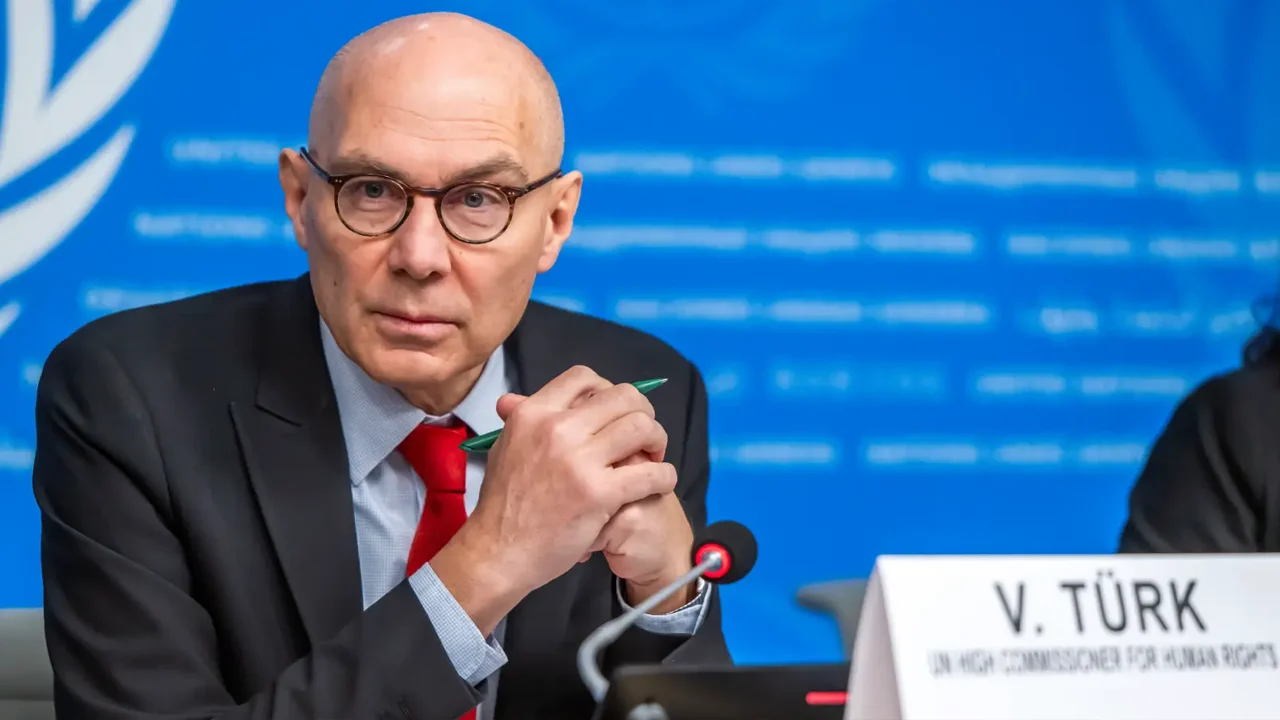
Despite strong objections from the United States, Russia and Israel, the UN General Assembly on Friday renewed Volker Türk’s term as High Commissioner for Human Rights for a further four years.
On the proposal of UN Secretary-General António Guterres, the General Assembly approved the renewal of Türk’s term with 144 countries in favour, 10 against and 13 abstaining. The new term will begin on 12 October 2026. The report is from the news agency AFP.
Russia had put forward an alternative proposal to extend Türk’s term by only a few months, until 31 December 2026. It was rejected by a large majority. A US request to postpone the vote was likewise not accepted.
The United States’ representative for management and reform at the UN, Ambassador Jeff Bartos, criticised the decision to extend the term by four years. He opposed the decision on both procedural and policy grounds and alleged that Guterres had rushed the whole process through.
Before the vote, Bartos warned: “Make no mistake: if this assembly accepts procedural excesses, secret understandings and the misuse of UN posts, there will be consequences to bear. The United States will immediately reconsider its engagement, participation and funding at the UN.”
He further alleged that Guterres had hastily brought the schedule forward in order to give his long-time friend the benefit of a four-year executive term.
France’s ambassador Jérôme Bonnafont, however, praised Volker Türk and called him a “voice of conscience.” He said Türk had discharged his duties in his first term “with firmness and impartiality.”
Volker Türk, an Austrian national and a lawyer, has served as the UN High Commissioner for Human Rights since October 2022. He has stressed the universality of human rights and the equal application of international law to all.
During his term he has spoken out on Russia’s aggression against Ukraine, the war in Gaza, and the human-rights situations in Afghanistan, Sudan, Bangladesh, Myanmar and Nicaragua.
He has also faced criticism, however, for not using the word “genocide” directly in relation to Cuba, the situation of Uyghur Muslims in China’s Xinjiang region, and Gaza. Several UN experts and rapporteurs had used that word in those cases.
Because of Türk’s positions he has faced sharp criticism from the governments of several countries, including Russia and Israel.
On Friday the ambassadors of Russia and Israel opposed the renewal of his term. Their argument was that, since Secretary-General Guterres’s own term ends at the close of this year, the choice of the human rights commissioner should have been left to his successor.
বাংলায় মূল প্রতিবেদন পড়ুন · Read the original Bengali report