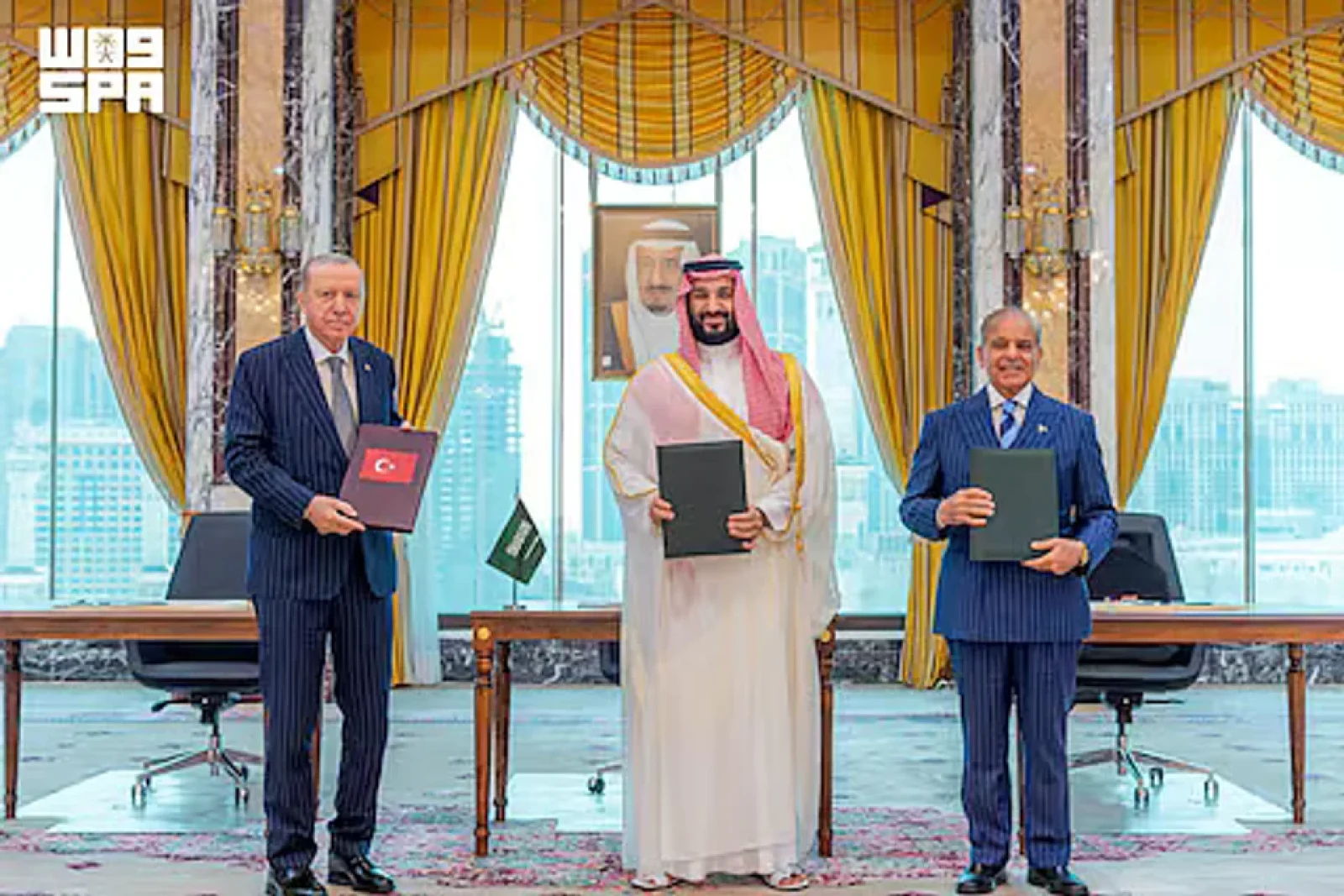
An armed attack on any one member state will be treated as an attack on the entire alliance, this mutual-defense commitment recalls NATO’s famous Article 5. That is precisely the pledge made in the “Mecca Joint Defense Pact,” signed by Saudi Arabia, Turkey, and Pakistan in Mecca on August 7.
That clause has led some international analysts to start calling the pact a “Muslim NATO.” But is such an alliance really taking shape through this deal?
The historic pact, finalized after a year of negotiations, was signed by Saudi Crown Prince Mohammed bin Salman, Turkish President Recep Tayyip Erdogan, and Pakistani Prime Minister Shehbaz Sharif. Its central goal is to strengthen the three countries’ collective deterrence capability.
The pact’s signing in Islam’s holiest city carries both strategic weight and enormous symbolic significance. Understanding how far it will reshape the military balance across the Middle East and the wider Muslim world requires unpacking the calculations behind it.
A pact born in the shadow of war
On February 28, Iran launched drone and missile strikes on US military bases and oil infrastructure across the Middle East, in what it described as a response to US and Israeli aggression. That sharply reduced shipping through the Strait of Hormuz, one of the world’s most critical trade routes.
To manage the fallout, Riyadh was forced to rely more heavily on Red Sea ports as an alternative route. As a result, Saudi oil exports through the port of Yanbu jumped from 120,000 barrels a day to roughly 3.5 million barrels a day.
It was precisely that sensitive route that Iran-backed Houthi rebels then targeted. On July 20, they declared a naval blockade against Saudi Arabia. Two days after the pact was signed, on August 9, the Iran-backed Houthis claimed a drone strike on a Saudi Aramco refinery in Jazan.
Given all this, the pact is not a response to some hypothetical future threat. It was forged amid rising regional conflict and security risk.
Deep frustration with US protection
One of the key drivers behind the pact is Riyadh’s frustration with US security guarantees. According to an analysis by Al Jazeera, the push for alternative defense arrangements grew once it became clear that Washington’s security umbrella could not protect Saudi Arabia’s oil infrastructure from drone and missile attacks.
Some analysts see this effort to build direct security cooperation among regional powers, reducing reliance on Washington, as the Gulf’s “Plan B.” Washington was previously the Gulf states’ main security guarantor. Now, that reliance is diminishing as Ankara, Riyadh, and Islamabad attempt to build direct security partnerships among themselves.
Even so, while many are calling it a “Muslim NATO,” no rigid, NATO-style military alliance is taking shape just yet, since, unlike NATO, there is no single common enemy here. Saudi Arabia’s chief concern is Iran; Turkey’s main priorities are Syria and the eastern Mediterranean; Egypt is focused on Gaza and the Red Sea; and Pakistan’s principal rival is India.
Dr Andreas Krieg, associate professor in the Defence Studies department at King’s College London and a security analyst, believes that with no single common enemy, a new, flexible “hub and spoke” model is more likely to emerge than a rigid structure like NATO’s.
Under that model, a strong three-way understanding among Saudi Arabia, Pakistan, and Turkey would function as the central “hub,” in place of the United States. Smaller Gulf states such as Kuwait, Bahrain, and Qatar, meanwhile, would connect to that powerful hub as “spokes,” through separate, specialized bilateral agreements, without taking on any major direct military commitment themselves.
Is the target only Iran
After the pact was signed, Erdogan said it was not directed against any specific country. Pakistan’s foreign minister likewise said the framework is open to everyone. Analysts, however, tell a different story.
A report by German outlet Deutsche Welle said excluding Iran from the pact points to a security calculus built around Tehran. Iran, for its part, is also viewing this new security framework with concern. A senior Iranian official warned that the pact would not provide any long-term guarantee of Saudi security.
A similar picture has emerged in the Red Sea. On July 30, a 14-nation Saudi-led naval defense coalition was formed, which Bangladesh has joined, but Oman and the United Arab Emirates did not sign on. Iran, too, has been kept out. Although the two initiatives appear, on paper, to have different aims, Houthi attacks and regional security concerns are the dominant factor driving both.
Concern deepens in Delhi
The pact has also raised fresh questions over South Asia’s geopolitical calculus. An analysis by the Hong Kong-based South China Morning Post noted that if Saudi-funded, Turkish-built advanced military technology reaches Pakistan’s hands, it could increase pressure on India’s military capabilities in South Asia.
Turkey’s consistent backing of Pakistan on the Kashmir issue is another major source of concern for Delhi. Saudi Arabia’s new military alignment with Turkey and Pakistan could also create fresh geopolitical obstacles to implementing the India-Middle East-Europe Economic Corridor.
Indian Ministry of External Affairs spokesperson Randhir Jaiswal said New Delhi is reviewing the pact’s impact on national security and regional stability.
Earlier, on August 6, Israeli Prime Minister Benjamin Netanyahu called Indian Prime Minister Narendra Modi. The two leaders reviewed progress in the India-Israel special strategic partnership and discussed the situation in West Asia.
Pakistan’s dilemma
However strong the pact may look on paper, applying it in practice will be extremely difficult. An analysis by Middle East Monitor laid out the reasons behind Pakistan’s historic dilemma. Although Pakistan has close military ties with Saudi Arabia, its long border with Iran and its significant Shia population are also important domestic security considerations for Islamabad.
Direct military conflict with Iran could pose a major risk to Pakistan’s internal peace and security. The clearest evidence of this came in 2015, when Riyadh sought troops and air support during the war in Yemen, and Pakistan’s parliament unanimously voted to remain “neutral.”
The Mecca pact’s “collective defense” commitment, a pledge as binding as NATO’s Article 5, now puts Pakistan through a new trial by fire. If Saudi oil infrastructure is attacked in the future, will Pakistan enter direct war against Iran, or will it stick to its 2015-style policy of neutrality? The answer to that question will ultimately prove decisive in determining the Mecca pact’s effectiveness, and its limits.
বাংলায় মূল প্রতিবেদন পড়ুন · Read the original Bengali report