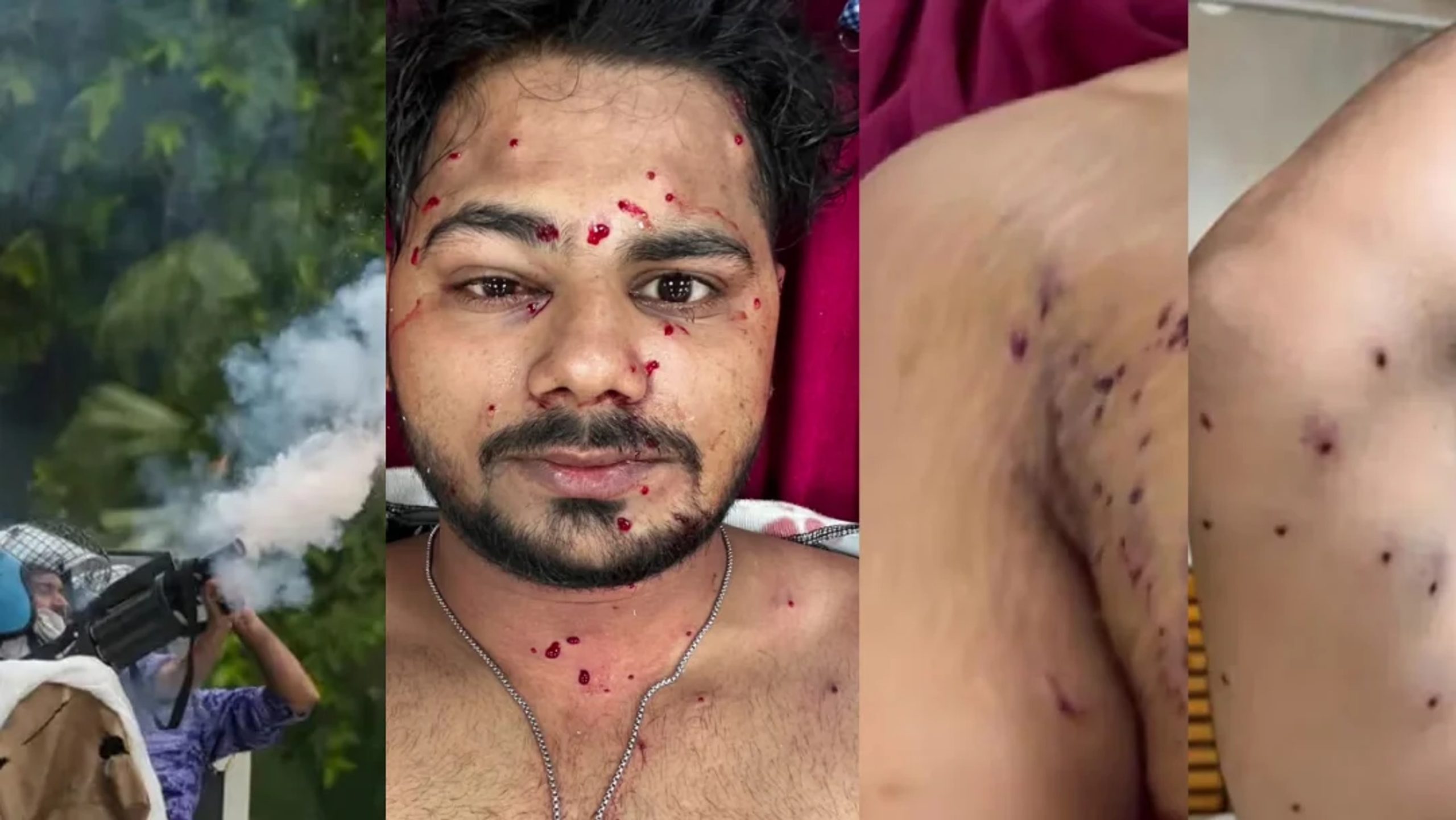
Fresh controversy has arisen over a protest organised by the Cockroach Janata Party (CJP) at Jantar Mantar in the Indian capital, New Delhi. Protesters claim that law-enforcement used pellet guns to break up the demonstration. In support of the claim, a government hospital’s medical records note pellet injuries on the bodies of several injured people. Delhi Police, however, have dismissed the allegation as baseless.
A report by the Indian outlet NDTV on Friday, July 24, said the CJP marched towards parliament on July 20 demanding the resignation of Union Education Minister Dharmendra Pradhan over the NEET paper leak. The party alleges that police used excessive force to stop the protesters’ advance.
According to the report, the medical records of Delhi’s Safdarjung Hospital note pellet injuries to the right elbow and back of a 28-year-old protester. They say the skin around the wounds has darkened, there is pain, and pellet fragments are lodged inside the body. The person was admitted to hospital at about 4 p.m. on July 20.
Delhi Police, on the other hand, say the claim that pellet guns were used on peaceful protesters is completely false and misleading.
The NDTV report also said the Rapid Action Force (RAF), used for riot control and a special unit of the Central Reserve Police Force (CRPF), uses pellet guns and shock batons when needed. On the day of the protest, the RAF was deployed at the scene alongside Delhi Police. The CRPF has not commented on the use of pellet guns in the incident.
In India, pellet guns were first used in 2010 to suppress violence in Kashmir. Their use was later stopped, but the weapon was used again in the protests that began after the death of Hizbul Mujahideen leader Burhan Wani in 2016.
In a pellet gun, hundreds of small metal or rubber pellets spread out at high speed from a single cartridge. Guidelines generally call for its use from a safe distance and aimed below the waist.
Meanwhile, in a video message late on Thursday night, Prime Minister Narendra Modi said a bill providing strict punishment against paper leaks would be placed in parliament next week.
On Friday, Congress president Mallikarjun Kharge said the government should first apologise to the students and, if pellets were indeed ordered used, take action against those responsible.
In an article in The Hindu, the chairperson of the Congress parliamentary party, Sonia Gandhi, alleged that the central government had shown unreasonable harshness in suppressing a peaceful student movement. She called the events of July 20 an attack on democratic rights and a “shameful chapter.” The report said many people were injured that day from baton charges and tear gas used to control the protest.
Among those injured in the protest, a teenager is alleged to have been struck in the right eye by a pellet. According to Delhi Police, his name is on the list of 60 injured. NDTV said surgery had been performed on his eye and another operation might be needed. He was first taken to Lady Hardinge Medical College, then to Safdarjung Hospital and finally to the AIIMS Trauma Centre.
The news agency PTI reported that the teenager has multiple pellet injuries to his face, throat, chest, right shoulder and hand. A medical source claimed one pellet caused serious damage to the cornea of his right eye, and another was found in the tissue around his right lung and heart.
In addition, 25-year-old Sheikh Mansuri of Gurugram is alleged to have been injured. He was struck by seven pellets in all, on his nose, forehead, both eyes and cheeks. He was admitted to Lady Hardinge Medical College, where his initial surgery has been completed.
বাংলায় মূল প্রতিবেদন পড়ুন · Read the original Bengali report