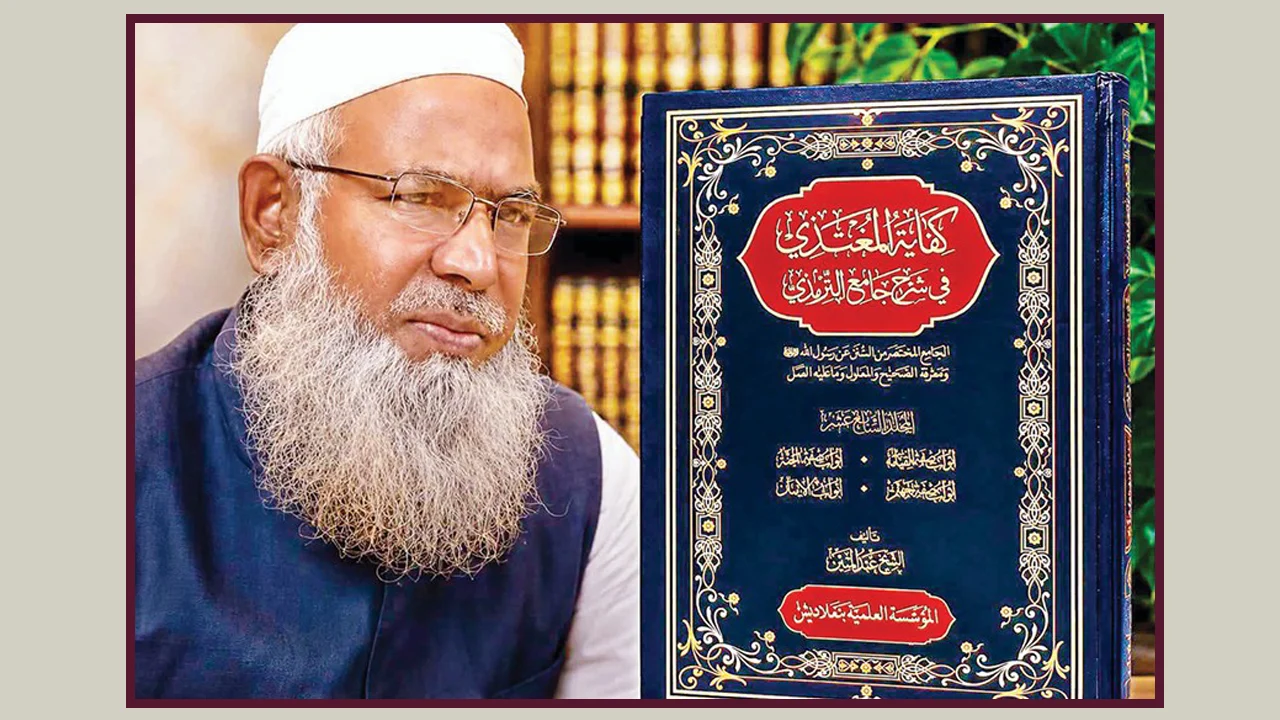
The preservation of hadith is a distinctive feature of the Muslim world. Although hadith were recorded in writing from the time of the Prophet Muhammad (peace be upon him), the great wave of compilation into books came in the third century of the Islamic calendar. It was in that century that the Kutub as-Sittah, the six canonical collections widely known as the Sihah Sittah, were assembled. Among them, Jami at-Tirmidhi holds a place of particular distinction. Compiled by Imam Abu Isa Muhammad bin Isa bin Sawra al-Tirmidhi (209-279 AH), it has been widely admired and studied since it was written.
Despite several existing commentaries, scholars had long felt the need for a fuller and more rigorous one. After a long wait, the Bangladeshi scholar and hadith specialist Maulana Abdul Matin, born in 1964, completed a 17-volume Arabic commentary on Jami at-Tirmidhi over 25 years of work. Titled Kifayatul Mughtazi fi Sharhi Jamiit Tirmidhi, it is published by Muassasa Ilmiyya Bangladesh and was completed this year.
It was formally launched on Aug 5 at the Krishibid Institution in Dhaka at a ceremony attended by leading scholars from Bangladesh and abroad, among them Maulana Abul Qasem Nomani, muhtamim of Darul Uloom Deoband in India, and Maulana Abdul Malek, khatib of the national mosque Baitul Mukarram. Hadith researchers in the Arab world and internationally have described the work, which combines early manuscripts with modern research, as a landmark addition to the field.
Speaking as chief guest, Maulana Mufti Abul Qasem Nomani, muhtamim and shaykhul hadith of Darul Uloom Deoband, said: “In his Jami at-Tirmidhi, Imam Tirmidhi did not merely compile hadith; he also presented the differences among jurists, the analysis of evidence and juristic discussion in a distinctive way. Through long research Maulana Abdul Matin has enriched that tradition further. Combining early manuscripts, reliable sources and modern research methods, he has produced a commentary of high quality.”
Presiding over the ceremony, Shaykhul Hadith Maulana Abul Bashar Muhammad Saiful Islam said: “Kifayatul Mughtazi is not only a commentary; it is a complete model for teaching hadith, for research and for conducting lessons.” He said the work would open new horizons for a coming generation of young scholars.
Maulana Abdul Malek, khatib of Baitul Mukarram and a noted hadith scholar and jurist, said: “Many commentaries on Tirmidhi Sharif have been left incomplete at various points in history. But Kifayatul Mughtazi presents a continuous and analytical commentary on every hadith from beginning to end. At the same time it presents the methodology of the pious predecessors, the etiquette of disagreement and a balance in research very beautifully.” He said the work would fill a long-standing gap in hadith scholarship.
Maulana Tahmidul Maula, director of the publisher Muassasa Ilmiyya Bangladesh, said demand had come from abroad after the first four volumes appeared, with orders from South Africa, the United States, Australia, the United Kingdom and other countries.
বাংলায় মূল প্রতিবেদন পড়ুন · Read the original Bengali report