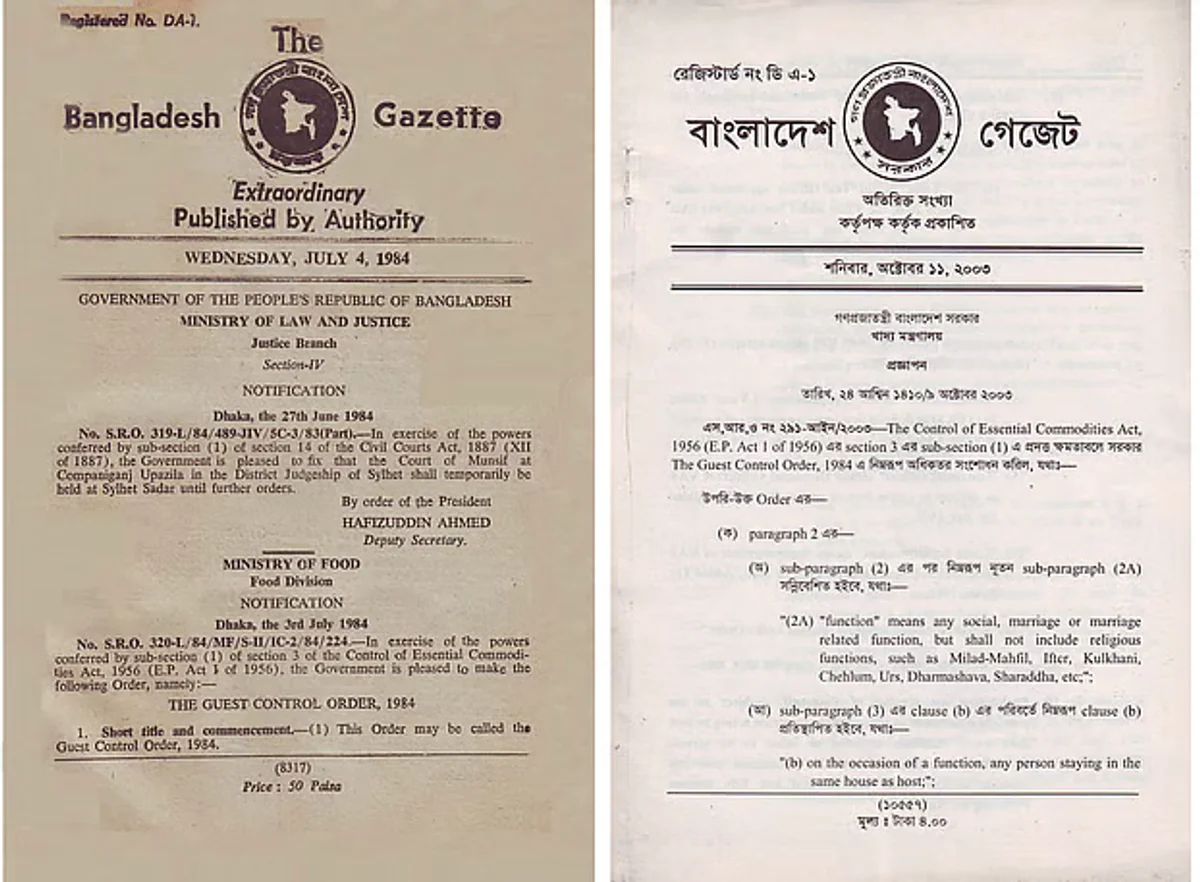
The country has many laws and orders that go unenforced in practice. The “Guest Control Order” issued in 1984 is one such. The order, meant to curb excess waste and control guest numbers at social and family events, has been brought back into discussion by BNP MP Shahadat Hossain Selim.
To curb excess waste and control guest numbers at various social and family events, the “Guest Control Order, 1984” was issued in 1984. The order was issued in view of the country’s overall food situation and to prevent the waste of essential goods. In continuity with the British era, and under the power given by Section 3(1) of the 1956 “Control of Essential Commodities Act,” the food ministry issued this special order on 3 July 1984.
The order has been brought back into discussion by BNP MP Shahadat Hossain Selim. Taking part in the budget discussion in the National Parliament on 22 June, he called for enforcing the “Guest Control law” of the past to curb excess pomp and waste at weddings and gaye-holud events.
What does the “Guest Control Order” actually say? — Main provisions and rules:
No more than 100 guests: The order’s main condition was that no person or organiser could serve any food made of rice or wheat to more than 100 guests (excluding the host’s family) at a wedding, birthday, aqiqah or any social, religious or family event.
Special permission and revenue: If, for a special reason, more than 100 guests had to be fed at an event, prior permission from the relevant deputy commissioner or upazila nirbahi officer through “Form-A” was mandatory. Moreover, for each guest above 100, a fee of Tk 25 (originally Tk 10) per head had to be deposited in the government treasury through a treasury challan.
Powers of monitoring and search: To monitor whether the rules were being followed, food directorate inspectors, gazetted police officers, or any government officer nominated by the deputy commissioner or UNO were given legal power to enter and search the event venue.
Punishment: Under the 1956 parent law, defying the order was a punishable offence. Breaking the rules carried a provision for fines and, in some cases, imprisonment, for both the event’s organiser and the owner of the venue (such as a community centre or convention hall).
Amendment: An amendment was made to the order in 2003, exempting purely religious events such as milad mahfil, iftar parties, kulkhani, chehlam, urs and shraddha from the guest restriction and extra fee.
Current situation: Although the order has not been formally repealed, it is now almost inactive due to a lack of proper enforcement and monitoring. Even as events are held with thousands of people in restaurants, community centres or convention centres, the rule of obtaining permission or paying a fee is no longer practised.
বাংলায় মূল প্রতিবেদন পড়ুন · Read the original Bengali report