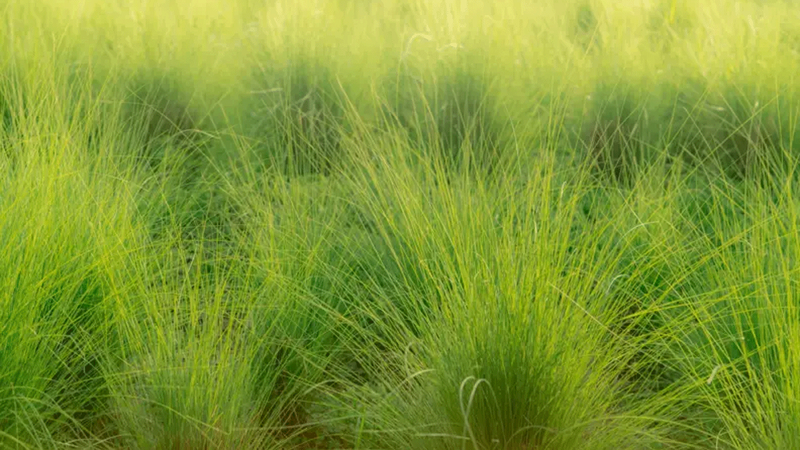
A tall grass can often be seen growing in Bangladesh’s fields and on fallow land. In Bengali, it is called “binna ghash.” The government of Bangladesh has now taken an initiative to make wider use of this grass, which grows scattered across abandoned plots of land.
In various countries, this vetiver grass is planted on hillside slopes primarily to prevent soil erosion and landslides.
To review which projects the grass could be used in, the government formed a technical committee on Monday.
Professor Mohammad Shariful Islam, a teacher and researcher in the Department of Civil Engineering at the Bangladesh University of Engineering and Technology (BUET), has been researching this grass for nearly two decades.
Because of that expertise, Professor Islam has also been included on the committee the government formed to assess the grass’s usefulness.
Mohammad Shariful Islam said: “This grass’s long roots penetrate deep into the soil very quickly and hold it firmly in place. That’s why, in engineering, this grass is used to protect roads, prevent landslides, and control river erosion.”
For that reason, the current government has also ordered that a guideline be prepared on which sectors could use this grass.
In line with its election pledge, the current government has launched a nationwide canal-excavation program.
Experts say these canals will silt up again during the rainy season. That is why vetiver grass could serve as an affordable and sustainable option for protecting embankments and preventing canals from silting up.
They also say the Roads and Highways Department and the Water Development Board are discussing the scientific use of this grass to protect against landslides.
Plant scientists, however, note that this grass, often left growing on roadsides and fallow land, also has other uses — its roots and other parts are used to make valuable fragrances.
What is vetiver grass (binna ghash)?
This shrub-like grass can be seen along roadsides, on abandoned land, or in riverine char areas across rural Bangladesh. Its English name is vetiver, though in Bangladesh it is also known as “binna ghash.”
In some rural areas, it also goes by the names “benna ghash,” “khaskhas,” or “chhon.” It is a perennial plant.
Vetiver grows with long, narrow leaves in a dense, bush-like clump. It typically grows one and a half to three meters tall. But its most notable feature is its roots.
Drawing on nearly two decades of research, BUET professor Mohammad Shariful Islam said: “This grass’s roots are extremely long and strong. They can penetrate the soil to a depth of two to three meters, sometimes even four meters.”
The grass’s long, narrow leaves grow in a bush-like clump along roadsides or on fallow land.
Mohammad Abdur Rahim, principal experimental officer in the Department of Plant Science at Jahangirnagar University, said: “This grass may look ordinary, but its capabilities are extraordinary. Its roots don’t just hold the soil in place — they bind the layers of earth together like a natural net.”
According to researchers, because the roots spread through the soil like a net, the plant plays an important role in preventing soil, hill, and land erosion. That is why experts consider this grass entirely distinct from other grasses found in Bangladesh.
Researchers say vetiver grass has more than just technical applications — it also has natural medicinal properties. In particular, a fragrant oil is extracted from its roots. This grass is used in perfumes, cosmetics, and various other fragrance products.
When grass becomes a technology for erosion control
According to researchers, vetiver grass is used in various countries around the world to prevent soil erosion, landslides, and riverbank erosion.
In Thailand, India, Indonesia, China, Brazil, Vietnam, and African countries, this grass plays an important role in preventing landslides, protecting road-embankment slopes, conserving riverbanks, and protecting farmland.
Researchers say that within four to six months of planting, the grass’s roots reach deep into the soil and spread out like a net. After that, the grass is ready to help prevent erosion on slopes, embankments, or soil.
Researchers and plant scientists also believe the grass has a remarkable ability to adapt to any environment, whether freezing cold or scorching heat.
According to researchers, when water runs down a slope, embankment, or roadside during the rains, having this kind of grass or shrub present plays an important role in preventing soil erosion.
Professor Shariful Islam himself has worked on the use of this grass in projects in various countries around the world.
He said: “In our country, embankments have often been protected using rods, cement, geo-bags, or other materials at various times. But this grass’s roots are so strong that they can play an even more effective role in protecting embankments.”
However, he said, this grass cannot be used to prevent soil erosion or protect embankments in every situation or every location.
Explaining why, he said: “Say you need to protect the embankment of a fast-flowing river. In that case, planting this grass wouldn’t be of any use. But if you plant it to prevent erosion on hillsides, or along the sides of roads and highways, it would work quite well for preventing soil erosion.”
Researchers highlight two major benefits of this grass. The first is that it is affordable, and the second is that it is environmentally friendly.
Giving an example, Professor Islam said: “Say you use rod, cement, or concrete to protect an embankment, and it costs you Tk 100. By comparison, if you use vetiver grass properly, you could do it for just Tk 10.”
Even so, he said, this grass cannot be used everywhere to prevent erosion or landslides. In some locations, embankments will still need to be protected using geo-bags, cement blocks, or rods.
Why the sudden discussion in Bangladesh
In Bangladesh, particularly the hilly regions of Chattogram, Bandarban, Rangamati, and Cox’s Bazar, and the areas along the banks of the Padma, Jamuna, and Meghna rivers, remain at risk of landslides and erosion throughout the year.
Ahead of the national parliamentary election last February, BNP had made several development pledges if it won the election. One of these was canal excavation.
That is why the government launched its canal-excavation program soon after the election. Prime Minister Tareque Rahman has also been traveling to various parts of the country to inaugurate canal-excavation programs.
Amid this, discussions have taken place on what can be done to protect these embankments and canals’ navigability at low cost and in an environmentally friendly way.
In particular, the government has taken the initiative to use vetiver grass along riverbanks and canal banks, embankments, hilly flood-prone areas, and haor regions, after several meetings on how the grass could help maintain environmental balance while increasing infrastructure durability.
A meeting on the matter was held in Dhaka last week, where Water Resources Minister Shahid Uddin Chowdhury Annie said vetiver grass could serve as an effective, environmentally friendly, and low-cost natural solution for preventing river erosion, land erosion, and soil loss.
Subsequently, at a meeting at the Secretariat last Monday, a technical committee was formed to assess the feasibility of using vetiver grass in various projects in Bangladesh, following the example of other countries around the world.
Professor Mohammad Shariful Islam, a member of that committee, said: “After several meetings, the prime minister has directed that the feasibility of using vetiver grass be assessed across various sectors and locations.”
He said the grass could be used to protect canal banks, prevent soil erosion along major roads, or protect development work carried out in hilly areas.
Mohammad Shariful Islam said: “Which sectors we can use it in, and how extensively, will be determined after discussions with everyone involved. In particular, directions have been given to use it at the Local Government Engineering Department (LGED), the Water Development Board, and in the government’s agriculture sector. For now, the grass will be used in these areas.”
বাংলায় মূল প্রতিবেদন পড়ুন · Read the original Bengali report