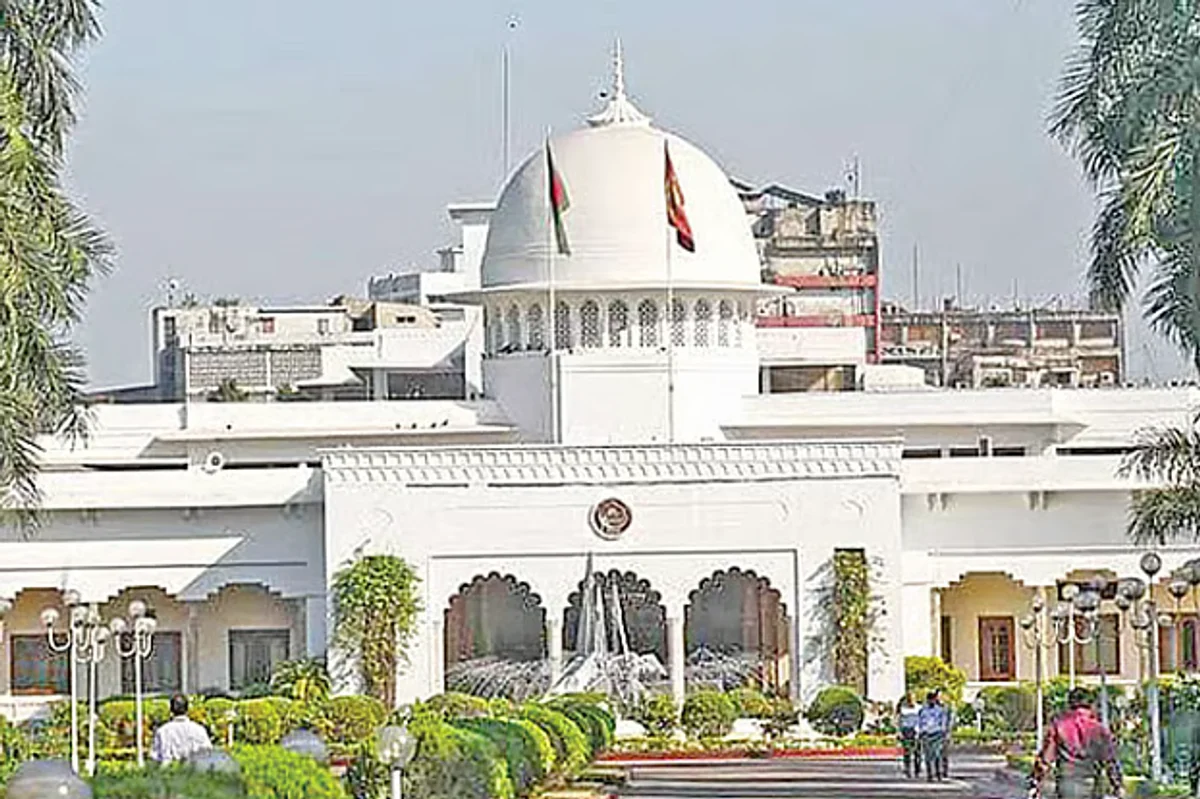
Bangladesh’s presidential election was held through a direct vote in the national parliament for the first time in roughly 35 years. In the election held Thursday, August 20, BNP candidate Mirza Fakhrul Islam Alamgir was elected the country’s 23rd president, defeating rival candidate Oli Ahmed. After the Election Commission issued its gazette notification, Prime Minister Tareque Rahman greeted the newly elected president with a red rose.
This election has sparked renewed, wide-ranging discussion and analysis in political circles and civil society over the president’s constitutional powers, responsibilities, and the effectiveness of the office. The question being raised: in a parliamentary system of government, what can the country’s highest-ranking citizen actually do, and what can’t they do?
BBC recently published a detailed analytical report on the matter.
According to the British broadcaster’s report, the role of the presidency in Bangladesh’s constitution is described as largely “ceremonial.” Under Bangladesh’s current parliamentary system of government, the state’s core executive power rests with the prime minister and their cabinet, while the president is merely the state’s formal head.
Citing Article 48(3) of the constitution, BBC Bangla reports that the president can act completely independently in only two matters: appointing the prime minister and appointing the chief justice.
Under Article 56(3) of the constitution, in all matters other than these two, the president is required to act according to the prime minister’s advice. On all important matters — summoning, proroguing or dissolving parliament, signing bills, declaring a state of emergency, appointing ambassadors, declaring war, or granting pardons — the prime minister’s decision and advice are final. In fact, no court in the country may even question whether the prime minister actually gave the president any advice on a matter.
Senior Supreme Court advocate Manzill Murshid told BBC Bangla: “Under the constitution, Bangladesh’s president has practically no power.” He believes that, in this system of governance, those who actually hold power leave the president with little room to act outside their wishes.
The core source of power in special circumstances
Although the president’s powers are limited on paper, analysts say this office can become the core source of power during special or emergency circumstances. BBC Bangla’s analysis says that if there is some power behind the scenes, international pressure, or backing involved, the president can at times play an extremely influential role.
Advocate Manzill Murshid told BBC Bangla: “If the players operating behind the scenes of power want to get something done through the president, then he has considerable power. He can bring in an army-backed government, declare a state of emergency, or dissolve parliament.”
Additionally, the constitution itself grants the presidency special legal protection. That is, the president is not accountable to any court for carrying out presidential duties, nor can any criminal case or arrest warrant be issued against him.
Dhaka University political science professor Sabbir Ahmed told BBC Bangla: “Only the president has the power to rise above all restrictions. No one can challenge any of his initiatives.”
Historical crises and the role of presidents
Even after the parliamentary system was introduced, there have been several moments of crisis in Bangladesh’s history when presidents have been seen exercising power unilaterally or independently. BBC Bangla’s compiled information highlights some such precedents.
Repelling the 1996 army rebellion: In 1996, during the caretaker government, an intense conflict broke out between then-President Abdur Rahman Biswas and the then-army chief. When the army chief ordered troop movements toward Dhaka, the president repelled that attempt through loyal forces, and the army chief was relieved of duty and detained.
Shahabuddin Ahmed’s firmness: In 1996, the Awami League government elected former Justice Shahabuddin Ahmed as president as a nonpartisan figure. However, after taking office, he refused to sign the controversial “Public Safety Act,” which created friction with the government. He was widely praised for his impartial role during his five-year term.
Badruddoza Chowdhury’s resignation: A B M Badruddoza Chowdhury, elected president from BNP in 2002, was forced by his own party to resign after just seven months, over his failure to pay respects at Zia’s grave on his death anniversary and his failure to refer to him as the “declarer of independence.”
Iajuddin Ahmed taking on the role of adviser: Facing an intense political crisis in 2006, then-President Iajuddin Ahmed himself took on the role of chief adviser of the caretaker government. Advocate Manzill Murshid told BBC Bangla this was the single largest exercise of presidential power in Bangladesh’s history.
Party dominance versus the clash of personalities
According to analysts, because of party dominance in Bangladesh, presidents are not allowed to exercise their independent powers, because parties always want to place a loyal or preferred figure in this office.
Professor Sabbir Ahmed said: “By law, Bangladesh’s highest impartial institution is the presidency, if the president is allowed to function that way. But politically, that is not allowed to happen. Parties themselves put the president in office, so he is not independent.”
Writer and researcher Mohiuddin Ahmad echoed a similar sentiment. He told BBC Bangla that, at one point in Bangladesh’s history, under a presidential system of government, all power was concentrated in the president’s hands from 1975 to 1990. But after the parliamentary system was reintroduced through the 12th amendment in 1991, presidential power was curtailed, and parties came to prefer placing loyalists in the office. As a result, the entire question of how presidential power is exercised, and how impartial the office remains, depends largely on who becomes president and the nature of their individual personality. Newly elected 23rd President Mirza Fakhrul Islam Alamgir now faces a new political equation and challenge in maintaining this constitutional limitation and the tradition of impartiality.
Source: BBC Bangla
বাংলায় মূল প্রতিবেদন পড়ুন · Read the original Bengali report