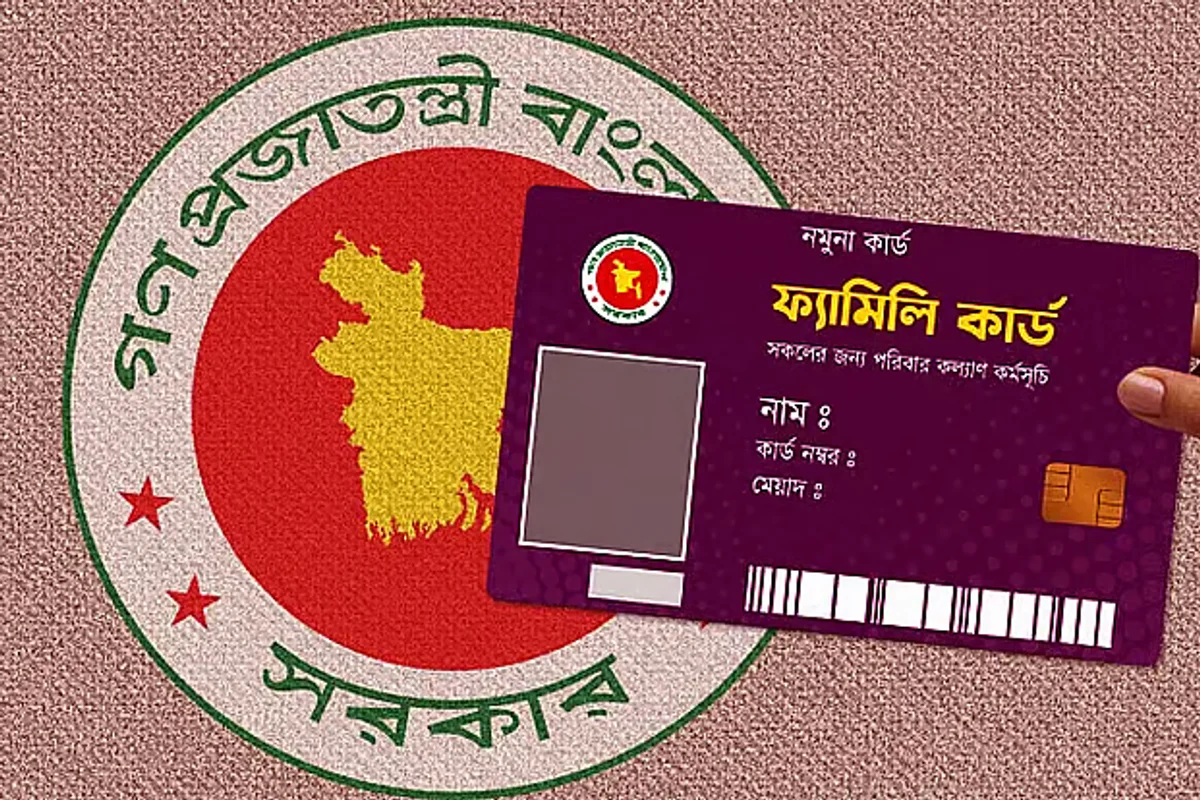
After a pilot phase, the government will formally launch the Family Card programme on 16 August, with a plan to bring 1.6 crore (16 million) families under it in phases within four years. Information will be updated regularly to ensure the benefits reach the genuinely poor.
Prime Minister Tareque Rahman will launch the programme in ward 8 of Latifabad union in Kishoreganj Sadar upazila on 16 August. It will then roll out in phases to all upazilas and unions of the country by the end of October.
Social Welfare Minister AZM Zahid Hossain gave the details to journalists on Thursday after a meeting of the cabinet committee on the Family Card at the Secretariat, chaired by Finance Minister Amir Khasru Mahmud Chowdhury.
The social welfare minister said there was a plan to bring about 1.6 crore families under the Family Card within four years, but that the number could rise further based on data collection and assessment.
He said the Family Card would be run through a dynamic social registry. Information would be updated regularly in line with changes in people’s socioeconomic conditions, so that if someone moved from poor to lower- or middle-income, or fell back into poverty, that too would be reflected in the registry.
The minister said data would be verified at union level so that genuine beneficiaries were not left out and no ineligible person could enter the list. The government’s aim was to ensure transparency by reducing the existing weaknesses in distributing allowances and Family Cards.
He said no one would be given benefits or deprived on the basis of religion, clan or political identity. The programme was being implemented in the light of the principle of building an inclusive and humane state.
The social welfare minister said that when support money reached women members of a family, it was more likely to be used for children’s education, nutrition and healthcare, poultry rearing, tree planting, cottage industry, sewing and small-entrepreneur activities. This would have a positive effect on women’s empowerment as well as on reducing rural poverty.
He said the pilot project run in 56 areas had produced positive results. Although some problems in data collection had appeared in two areas in Jashore and Netrokona, they had been corrected. No significant problems were found in the remaining 54 areas, and the error rate was below 3 percent.
It was said that from 16 August, data collection would begin fully online with a new questionnaire and new method. Information would then be updated every month, so that deaths, changes in socioeconomic condition or any other change could be quickly added to the registry.
The social welfare minister said a three-tier monitoring system had been put in place to ensure the programme’s transparency. A first-class government officer would supervise data collection at union level. Separate committees would work under the UNO at upazila level, the deputy commissioner at district level and the divisional commissioner at divisional level. There would also be a committee at national level, chaired by the finance minister. The prime minister himself would regularly monitor the programme’s progress.
He said the Cabinet Division and the finance ministry would verify data to ensure the same person could not take multiple allowances or benefits. An independent assessment would also be carried out through the Finance Division, the IMED and local and foreign universities, to measure the programme’s real impact on reducing poverty.
বাংলায় মূল প্রতিবেদন পড়ুন · Read the original Bengali report