Bangladesh’s exports to the New Zealand market are still mainly garments-dependent. To reduce that dependence, Bangladesh has taken new steps to expand markets for non-garment goods, including medicines, information technology, jute, leather and sustainable textiles, while also trying to attract New Zealand investment in agri-technology, dairy processing, green energy and the cold chain.
To this end, Bangladesh has proposed three immediate steps to boost direct links between the two countries’ businesses, virtual B2B meetings and government-level coordination. The two sides have also agreed to form a bilateral business council and to hold trade fairs.
The trade ministry’s public relations officer, Md Kamal Hossain, gave the information on Monday.
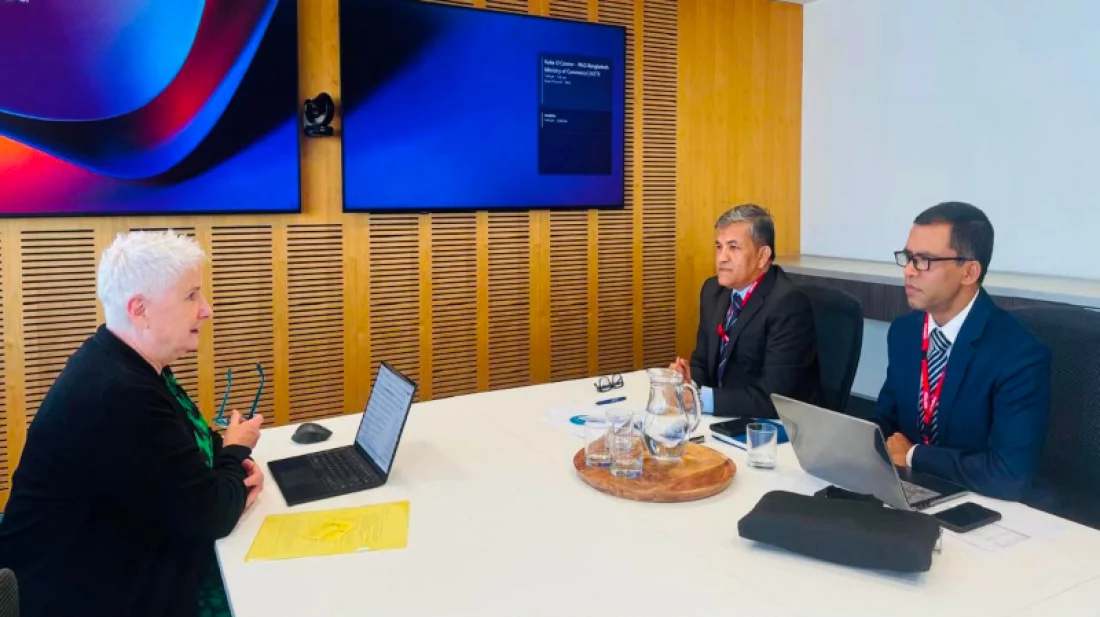
The proposals were put forward by Bangladesh at a meeting with New Zealand Trade and Enterprise (NZTE). The meeting, with NZTE market manager (Southeast and East Asia) Rachel McGuckian, discussed possible areas for boosting bilateral trade and investment.
The Bangladesh delegation was led by commerce ministry secretary Md Ataur Rahman, with joint secretary (FTA) Md Firoz Uddin Ahmed and deputy secretary (FTA) Farhana Islam.
The meeting was told that bilateral trade between Bangladesh and New Zealand currently stands at about $450 million a year, against which Bangladesh’s exports to New Zealand are about $147 million — most of it garments. Bangladesh mainly imports dairy and metal products from New Zealand.
To make bilateral trade more balanced and diversified, Bangladesh wants to raise non-garment exports, seeking NZTE’s help to create new opportunities in the New Zealand market particularly for pharmaceuticals, environment-friendly jute goods, leather goods, sustainable textiles and the IT sector.
The meeting highlighted the production capacity of Bangladesh’s pharmaceutical industry. Bangladesh said various drug makers were producing to international standards and certification, offering scope to supply generic medicines and vaccines to the New Zealand market at competitive prices, and expressed interest in expanding its entry into New Zealand’s health and pharmaceuticals market.
Bangladesh’s IT sector was also presented as a promising export area. The meeting was told the country had more than 650,000 technology professionals, and Bangladesh proposed using this workforce to build business partnerships with New Zealand tech firms in software, fintech and digital services.
Beyond exports, boosting New Zealand investment in Bangladesh also featured in the talks, with New Zealand firms invited to invest particularly in dairy processing, specialised nutrition products, cold-chain logistics, agri-technology, advanced manufacturing, renewable energy and green technology. The facilities available to foreign investors in Bangladesh’s special economic zones were also highlighted.
Bangladesh said New Zealand firms could, through production and investment in Bangladesh, tap not only the local market but the larger markets of South and Southeast Asia.
To turn the talks into real business ventures, Bangladesh proposed three quick steps: first, establishing direct contact between NZTE’s Southeast and East Asia team and the Bangladesh Investment Development Authority (BIDA); second, arranging virtual B2B meetings between Bangladesh’s pharmaceutical, IT and leather exporters and prospective New Zealand buyers and traders; and third, strengthening institutional contact with New Zealand’s Ministry of Foreign Affairs and Trade (MFAT) for bilateral trade and investment cooperation.
The two sides also discussed forming a bilateral business council as a platform for regular contact between the two countries’ private sectors, and agreed to hold trade fairs and increase participation in fairs held in each other’s countries. The meeting stressed building a mutually beneficial economic relationship by combining Bangladesh’s production capacity and large market with New Zealand’s expertise in technology, agriculture and high-value production.
বাংলায় মূল প্রতিবেদন পড়ুন · Read the original Bengali report