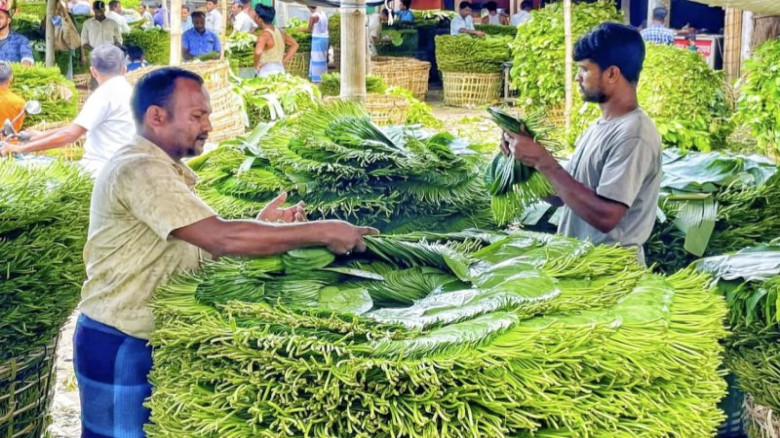
Betel leaf farming is an ancient traditional occupation on Cox’s Bazar’s island upazila. Thousands of families in Moheshkhali have long depended on this trade for their livelihood. However, rising commodity prices, increased production costs, falling market prices for betel leaf, and a lack of government support have now plunged local farmers into severe crisis. Many took loans to build betel leaf gardens (borojs) but, without fair prices, are living in misery with their families.
Local betel leaf farmer Amir Hossain said more than 3,000 betel leaf gardens are planted in Moheshkhali every year, with about 60% of the upazila’s families directly or indirectly involved in betel leaf farming. He said the practice dates back some 300 years in Moheshkhali. As in various regions of South Asia, betel leaf has been cultivated in Moheshkhali for centuries. Landlord families once placed special importance on betel leaf farming for weddings and social occasions.
Betel leaf is grown on 1,600 hectares of land in Moheshkhali upazila, of which 1,400 hectares are hillside land. There are around 20,000 betel leaf gardens.
Historians believe the sweet betel leaf grown on the sloped land around the historic Mainak mountain is produced nowhere else in the world — which is why Moheshkhali’s sweet betel leaf carries such significance and renown worldwide.
Betel leaf farming requires suitable, elevated land, growing best at the base of hills. In some areas, cultivation in low-lying wetland gardens is also practiced.
Building a betel leaf garden involves leveling the land, setting up posts, marking rows with rope, digging holes, building shade with thatch and bamboo, and constructing soil beds, among other steps. Disease-free, good-quality vines are then selected from other gardens, cut into two- or three-node cuttings, and preserved with a soil coating for planting.
Fertilizer must be applied 12 to 13 days after planting. Maintenance work begins 40 to 50 days later. Pesticides must be applied if disease appears. Betel leaf can be harvested starting roughly three months after planting.
Farmers say building and maintaining a medium-sized betel leaf garden costs up to Tk 150,000. Most farmers take loans to build these gardens, but without fair market prices, they aren’t even recovering their production costs.
Betel leaf farmers Sukunda, Midul, Abdul Karim, Amir Hossain and Abu Bakkar said: “We have farmed betel leaf as our ancestral trade for generations, but we’ve received no government support — not even a handful of fertilizer. If we got a fair price for betel leaf, our lives would be much better.”
They added: “We built gardens with loan money, and without fair prices, we’re under constant mental strain with our families. Sometimes the money from selling betel leaf doesn’t even cover our grocery expenses.”
Moheshkhali upazila agriculture officer Abdul Gaffar said the upazila administration has repeatedly petitioned the ministry on the matter. Since Moheshkhali’s sweet betel leaf is tied to Chattogram region’s folk culture and is famous across Bangladesh, farmers would be further encouraged to produce if given government support, benefiting the area’s betel leaf farmers.
Moheshkhali upazila agriculture department senior sub-assistant officer Joynal said a special support program for betel leaf farmers is being launched for the first time in fiscal year 2026-27. Plans are in place to provide cash assistance and various government benefits in the first week of the coming July.
MP Alamgir Mohammad Mahfuz Ullah Farid has played a strong role in raising demands in parliament for ensuring fair prices for Moheshkhali’s betel leaf and seeking GI recognition.
Local farmers hope that ensuring fair prices and increasing government support will improve living standards for around 60% of Moheshkhali’s families and bring smiles back to farmers’ faces.
Farmers and officials are calling for: ensuring fair prices for Moheshkhali’s sweet betel leaf; government efforts to increase betel leaf exports and create new foreign markets; compensation for gardens damaged by natural disasters and easy-term agricultural loans; modernizing storage, transport and marketing systems; and increased technical support and training from the agriculture department to control disease, along with accessible subsidies and farming inputs for betel leaf farmers.
Moheshkhali’s sweet betel leaf is one of Bangladesh’s most traditional and renowned agricultural products. The hillside slopes and coastal climate of Moheshkhali are exceptionally suited to betel leaf cultivation, giving it a unique taste and quality. Its sweet flavor, large size and superior quality have spread its reputation nationwide, making betel leaf farming a key pillar of livelihood for thousands of farmers and the local economy.
বাংলায় মূল প্রতিবেদন পড়ুন · Read the original Bengali report