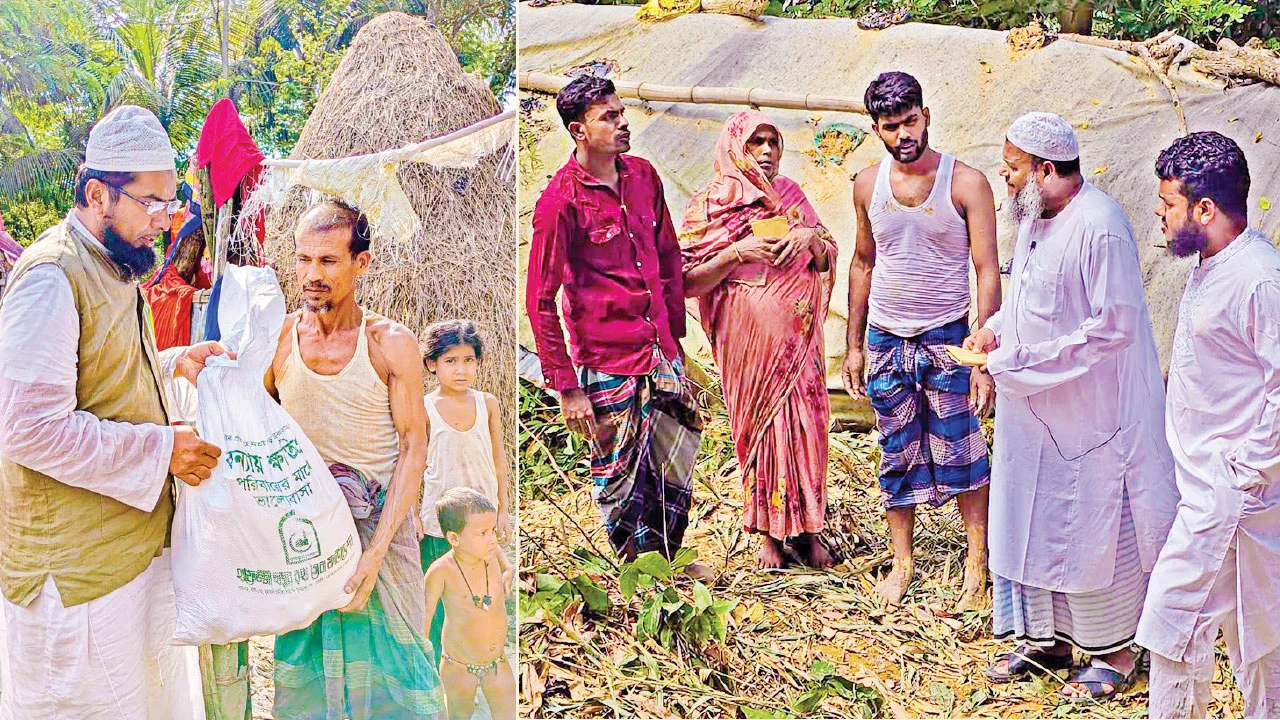
Islamic history holds countless examples of scholars serving humanity: the Companions (may Allah be pleased with them) fed the hungry, took responsibility for orphans, cared for the sick and became a refuge for the weak; Imam Abu Hanifa quietly gave financial help to many poor families; and Imam Nawawi and other luminaries played important roles in social welfare alongside scholarship. Their lives show that a true scholar is never cut off from society but is its well-wishing guardian.
In Bangladesh too, the ulama have long set a unique example of humanitarian service. In the country’s thousands of Qawmi madrasas, hundreds of thousands of orphaned and poor students receive education, housing and food free or at minimal cost — not merely an educational service but a vast humanitarian effort, run on zakat, sadaqah, fitra and public donations. In times of disaster the ulama’s role is also praiseworthy: in floods, cyclones, fires or cold spells they collect and distribute relief, provide medical aid and rehabilitation, and stand by those affected, with various Islamic charities and scholar-run foundations delivering food, clean water, medicine, winter clothing and cash to save many lives.
Among the scholar-run humanitarian bodies, the As-Sunnah Foundation, led by Shaykh Ahmadullah, is a notable name, running wide-ranging welfare work alongside its dawah activities; it has been particularly praised for delivering emergency relief, cooked food, clean water, medical supplies and cash to disaster-hit people, and also runs orphan care, education support, family rehabilitation, house-building, tube-well installation, mosque construction, distribution of qurbani meat, Ramadan iftar and food, and winter clothing, through thousands of volunteers. Alongside it, other scholar-led institutions work quietly for public welfare — the Taqwa Charity Foundation led by Maulana Gazi Yaqub, the Hafezzi Huzur Seva Foundation led by Maulana Rajibul Haque, the People’s Improvement Society of Bangladesh led by Maulana Imran Habibi, and the Hafezzi Charity Foundation, among more than fifty Islamic charities, along with madrasa-based trusts, orphanages, charitable clinics and relief bodies.
The ulama’s humanitarian service is not limited to relief: they play an important part in resisting moral decay, raising anti-drug awareness, settling family disputes, shaping young people into good citizens and building social harmony. To make this work more effective, the piece argues, the ulama should adopt modern planning, transparency, accountability and technology-based management, and take up long-term projects in education, health, employment and disaster management, so that the compassion, justice and empathy at the heart of Islam shine more brightly before people.
বাংলায় মূল প্রতিবেদন পড়ুন · Read the original Bengali report