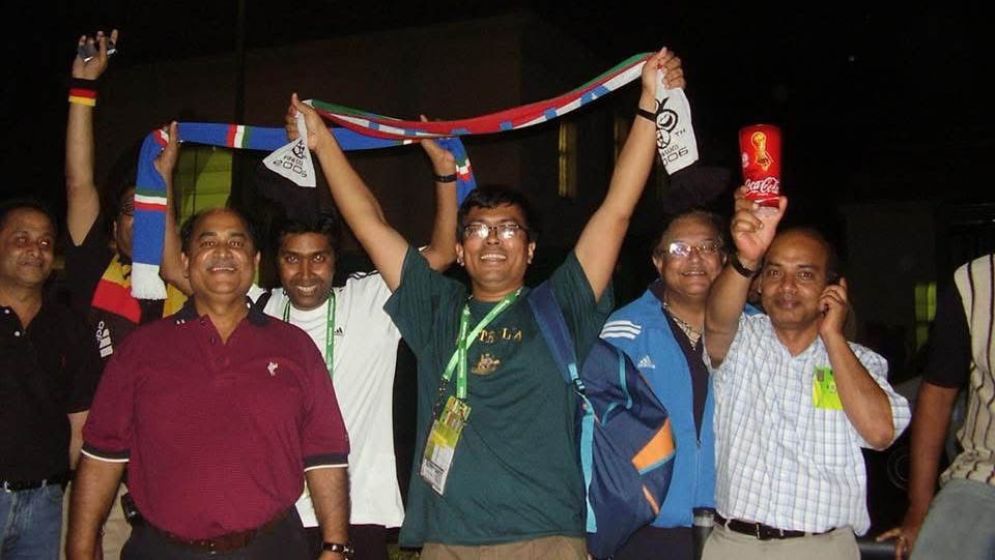
For some people, the World Cup means seeing the world up close — a way to make some moments of life eternal. Tapan Chowdhury’s story is just such a tale.
In his business identity, he holds the post of managing director of the country’s top industrial group, Square Group. He has a long career as a sports organiser too — he was general secretary of Brothers Union in Gopibagh and served as a sports adviser to a caretaker government. Beyond all this, there is another side that sets him apart: Tapan Chowdhury is a devoted traveller of the football World Cup.
His World Cup journey began in 1986, from Mexico. At the time there was much fear about Mexico; acquaintances had warned him to be careful, saying the situation was not good, with muggings and insecurity all around. Fear could not hold him back. With his friend Fakir Mahbub Anam (now Post, Telecommunications and Information Technology minister), he flew off to watch football’s biggest stage.
By the reckoning of that time, each of them spent about $1,800 — for accommodation, food and watching the matches, all told. They watched seven matches. But more than the results, it is the world outside the stadium that is etched in his memory.
Tapan Chowdhury can still recall the day Diego Maradona’s Argentina beat England.
He recounted how all of Mexico seemed to erupt in celebration that day — thousands of people on the streets, joy, exuberance, celebration. He and his friend too merged into that sea of people.
Then, returning to the hotel, they saw another story on television: Maradona’s famous “hand of God” goal. Sitting in the stadium, neither of them had understood what had happened.
Then began a long World Cup journey. In 1990 he saw that night in Rome, where the king of football, Maradona, wept and Germany lifted the trophy.
In 1994 he saw the language of football change in America’s heat, and finally the sight of Italy’s dream broken on penalties.
In 1998 he saw the rise of a young French side in Paris, when the whole stadium shook with Zidane’s name.
In 2002 he saw Brazil’s rebirth under the skies of Asia, as Ronaldo seemed to win back lost time.
In 2006 he saw the Berlin final, where a superstar’s farewell saddened football.
In 2010 the all-night vuvuzelas of South Africa and Spain’s patient football showed him a new kind of beauty.
In 2014 he saw, amid the festivity of Rio, one of the most unbelievable collapses in football history — that Brazil-Germany match. He recounted that, right after conceding the first goal, he felt something was not right; Brazil seemed unable to recognise even its own shadow. Annoyed, he told the people sitting beside him: “Brazil will concede seven goals today.” Minute after minute, time seemed to stop. The scoreboard changed, the people changed. At one point it was no longer the goals being counted but the silence. Tears in the eyes of Brazilian supporters, disbelief on their faces; some covered their faces with flags, some sat with bowed heads.
He said that in all his years of watching games, he had never seen a nation’s football heart break like that. When the seventh goal went in, an Italian gentleman beside him kept looking at him, perhaps wondering whether this man had really known beforehand.
Tapan Chowdhury said with a laugh: “I was no astrologer. I just felt Brazil was no longer on the pitch that day.”
In 2018 he saw the rise of a new generation. And in 2022, that night in Qatar, where football seemed to write the final chapter of an epic. After a long wait, Lionel Messi lifted the trophy, and the people standing in the gallery did not just watch a match — they watched time being fulfilled.
His relationship with the World Cup did not stop there. This time too he is going to the World Cup — it will be his 10th. Once, at almost every edition, a son or daughter or someone from the family was with him; the World Cup was a family festival too.
This time, before setting off, one absence touches him differently. His son Danny is no more, lost in a road accident. Tapan Chowdhury pauses as he speaks, saying he misses his son very much.
Perhaps this time too they were to have gone together — father and son sitting in the gallery watching the game, standing up at a goal, taking photos, arguing, returning to discuss it all night. Now that seat is empty.
The World Cup does not stop, and neither does life. Tapan Chowdhury is going again to watch another World Cup. This time his bag will hold not just a ticket and a passport, but the light of countless finals from 1986 to 2022, the sound of thousands of galleries, and a deep, silent wait for a companion who will not return.
বাংলায় মূল প্রতিবেদন পড়ুন · Read the original Bengali report