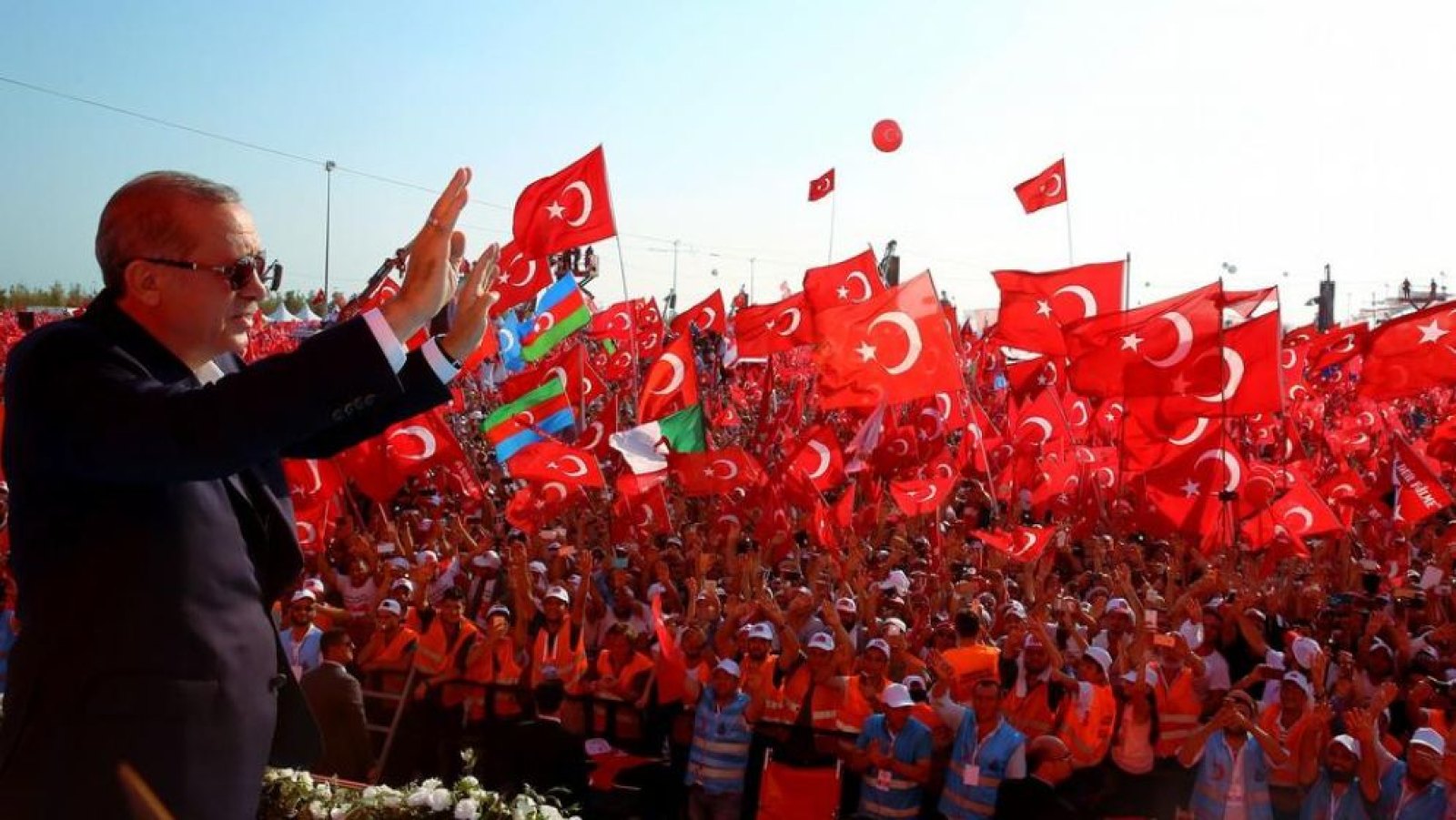
Gunfire in the streets, tanks on the move, warplanes flying low over government buildings, an attack on the parliament — all broadcast live on television. Even for a country with the experience of three military coups and two more military interventions, the night of 15 July 2016 was unprecedented.
Speaking live with a television presenter via a mobile phone application from an undisclosed location, Erdogan that night called on his supporters to take to the streets. Mosques across the country also broadcast his message through their loudspeakers.
By morning the coup attempt had failed. A total of 253 people were killed, of whom 184 were civilians. In addition, 34 alleged plotters were killed. The attempt lasted only a few hours, but its consequences have reshaped Turkish politics over the past decade, shifting the balance of power at home and redefining relations abroad.
The government said the measures were needed to dismantle the Gulen network. Gulen was once a close ally of President Erdogan, and members of his religious movement had for decades held important positions in the Turkish state and bureaucracy.
After the coup attempt, thousands of soldiers — including senior military officers and generals — as well as judges, prosecutors and lawyers, police officers, academics and civil servants were arrested, dismissed or suspended.
Hundreds of private schools and educational institutions alleged to be linked to the Gulen network were closed, along with several universities. Critics argue that the crackdown was not limited to alleged coup-makers and Gulen supporters but was also used more broadly to suppress dissent.
Opposition politicians allege that, over time after the purge, certain other religious communities became influential in state institutions. Government officials reject these allegations.
Supporters say the new system has ensured political stability, faster decision-making and more effective governance. Critics, on the other hand, say it has concentrated excessive power in the president’s hands, particularly around a single individual.
The US-based research organisation Freedom House says the capacity of lawmakers to shape policy has significantly weakened under the presidential system.
Dogan Cetinkaya, an associate professor at Istanbul University, agrees with this assessment. In his view, the presidential system is marked by “arbitrariness and an unclear institutional structure.”
Professor Cetinkaya said that after 15 July the institutions of Turkey’s political and administrative system were dismantled and lost their autonomy. The judiciary and the legislature no longer functioned as meaningful centres of power.
Since then, holding public gatherings has become increasingly difficult. Authorities frequently impose restrictions on assemblies and deploy heavy security. Press freedom has also weakened because of the government’s growing influence over media ownership and cases against prominent journalists. In the 2026 Reporters Without Borders World Press Freedom Index, Turkey ranks 163rd out of 180 countries.
Freedom House says that over the past decade Turkey has become more authoritarian, concentrating power through constitutional changes and the imprisonment of political rivals, independent journalists and members of civil society.
Istanbul mayor Ekrem Imamoglu, considered by many to be Erdogan’s strongest potential rival in a future presidential election, was arrested in March 2025 on corruption charges. Dozens of municipal officials were arrested along with him. They have denied the allegations, and his trial is still ongoing.
In May 2026, a court order effectively intervened in the leadership of his party, the main opposition CHP, handing charge to a former leader in place of the current one. The opposition described the move as a “judicial coup,” while the government rejected accusations of rolling back democracy.
The government’s position is that the changes adopted after the coup attempt and the subsequent purge have strengthened political stability, national security and democratic institutions, because they removed people linked to an organisation regarded as a threat to the state.
Nuri Salik, an associate professor at Yildirim Beyazit University, said: “I see the current system as a response built by the state to counter the existential threat exposed by the coup attempt. I do not see it merely as a step towards authoritarianism, but rather as an extension of the state’s instinct for self-defence.”
Turkey regards the YPG as linked to the Kurdistan Workers’ Party (PKK), which Turkey, the United States and the European Union list as a terrorist organisation. In recent years there have been efforts to revive a peace process with the PKK, though progress remains uncertain.
According to Professor Salik, the failed coup attempt further strengthened a security-centred outlook within the Turkish state. He said protecting the state had become the highest priority.
At the same time, despite being an important NATO member, Turkey has pursued a more diversified foreign policy by strengthening ties with Russia. Its purchase of the Russian S-400 air defence system created a major dispute with Washington, prompting the United States to impose sanctions and remove Turkey from the F-35 fighter jet programme.
Last week, however, US President Donald Trump said he would lift these sanctions and signalled that the F-35 sale could be reconsidered, though any such move could face significant opposition in Congress.
বাংলায় মূল প্রতিবেদন পড়ুন · Read the original Bengali report