By popular belief, Islam arrived in India with Muhammad bin Qasim’s conquest of Sindh in 712 CE, an arrival many see as resting on the power of the sword. But many modern historians and sociologists disagree, arguing that Islam’s arrival in India was not the result of a single event but the outcome of historical, social and economic processes spanning centuries.
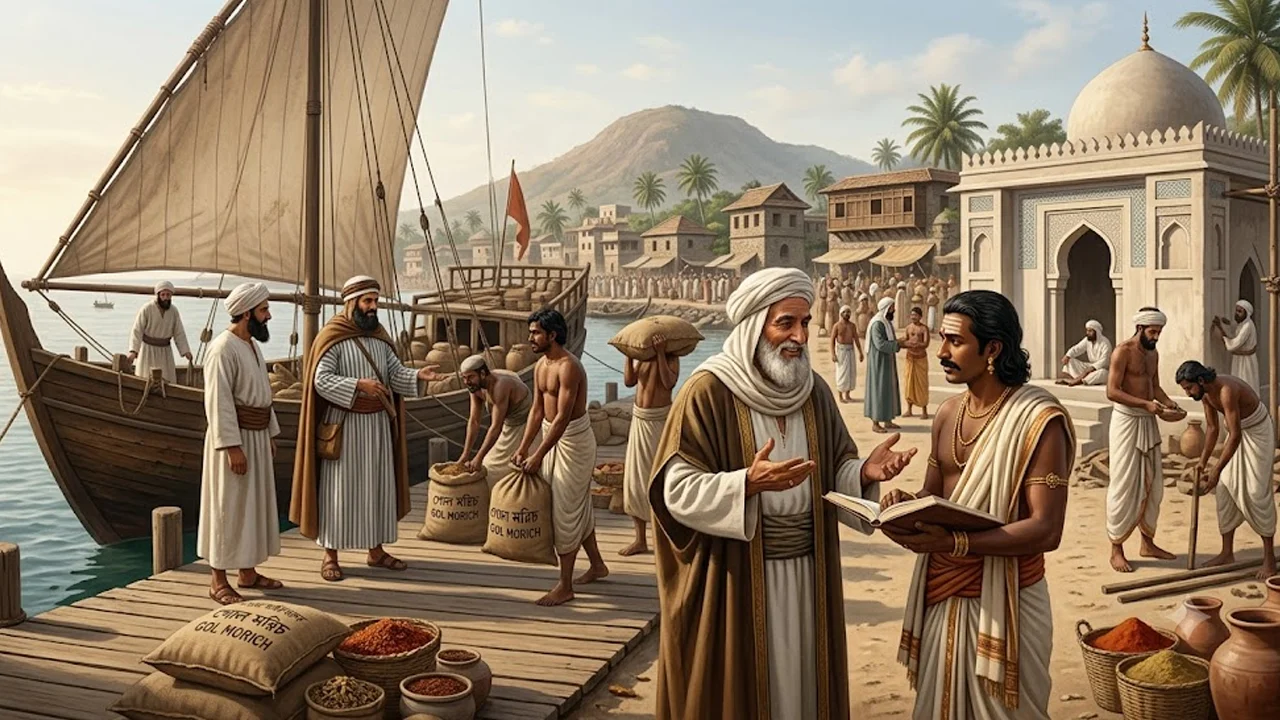
Trade played the most important role in Islam’s spread in India. From ancient times India was known worldwide for its black pepper, and with the Arabian Sea calm, Arab merchants long held influence on that sea route, coming to India during the monsoon and returning to Arabia once their trade was done. According to the noted historian Syed Sulaiman Nadvi, after the advent of Islam the world’s most important trade routes came under Arab control, and long contact gave rise to a Muslim community in south India known as the “Mappila Muslims.” The politician and writer Shashi Tharoor often notes that Islam reached the Malabar coast through familiar and trusted Arab merchants, not by the sword.
Several theories exist about Islam’s arrival in south India. One holds that it reached Kerala through the ancient port of Muziris during the Prophet Muhammad’s (peace be upon him) lifetime; the Cheraman Juma Mosque, said to have been built in 629 CE at the initiative of Malik bin Dinar, is cited as strong evidence, tied to the story of the Kerala Hindu king Cheraman Perumal’s conversion. According to Professor Ilyas, the Arabs came mainly to trade in pepper, and alongside commerce also taught methods of accounting, weighing techniques and better boat-building.
Some historians view Muhammad bin Qasim’s 712 CE capture of Sindh and Multan, and the later establishment of the Delhi Sultanate, as political expansion; but modern scholars say the main aim of these conquests was to establish power, not to convert people by force. The Sufi movement also played a large role: after the 11th century, Sufi saints of the Chishti and Suhrawardi orders settled across India, and their khanqahs and shrines became spiritual and social centres — the shrine of Khwaja Moinuddin Chishti in Ajmer, visited by people of all faiths, being a major example. Islam’s principles of equality, brotherhood and justice drew people in. Scholars such as the historian Richard Eaton offer another theory: that in regions like Bengal and Punjab, Islam’s spread was linked mainly to agricultural development and state policy, as Muslim rulers granted barren land to Sufi khanqahs and mosques, and as these institutions established new farming settlements local peasants gradually embraced Islam as part of economic advancement. In sum, Islam spread in the region through a long, mixed process of trade, spirituality, politics and social opportunity.
বাংলায় মূল প্রতিবেদন পড়ুন · Read the original Bengali report