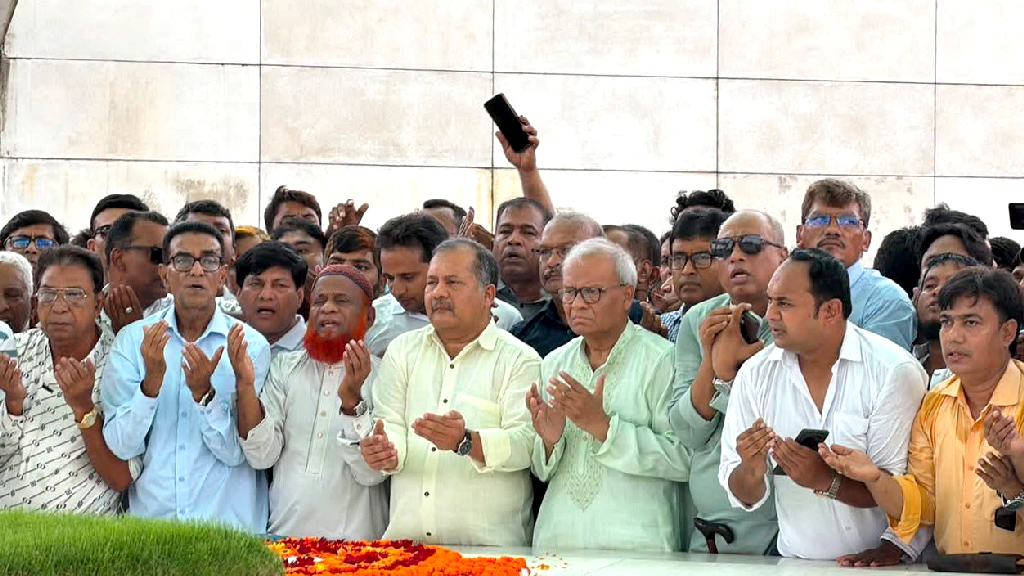
BNP Acting Secretary General and prime ministerial political adviser Ruhul Kabir Rizvi has said the current government is not responsible for the prevailing energy crisis. “The government or any individual is not responsible for the crisis [energy crisis] that has emerged recently,” he said. “It is a kind of natural crisis. The energy crisis has arisen because of the war.”
He made the remarks to reporters Sunday, August 23, after paying tribute and reciting fateha at the mausoleum of former President Ziaur Rahman and former Prime Minister Begum Khaleda Zia, both deceased, in the capital’s Sher-e-Bangla Nagar. Rizvi visited the mausoleum grounds that day with the prime minister’s newly appointed political adviser and former information minister, Zahir Uddin Swapan.
On the energy crisis, Rizvi said that faults at the Moheshkhali gas and LNG supply terminal had reduced gas pressure over the past several days, forcing factories in various areas to shut down and causing hardship for ordinary people cooking at home.
Rizvi further said on the energy crisis: “The faults at Moheshkhali’s floating terminal have already been fully repaired. LNG cargo has also arrived, and supply continues. As a result, gas pressure has risen again in various parts of the country, and load-shedding has also fallen significantly.”
The BNP acting secretary general said there was no shortfall in the government’s sincerity in quickly resolving this problem, and the country has seen that. Even so, he said, many plots and conspiracies were hatched during this period. The government identified and thwarted these conspiracies, he said, while continuing its work on public welfare, social protection and infrastructure development.
Asserting that the current government is working with sincerity, the BNP acting secretary general said a government succeeds only when it focuses sincerely on public welfare. The government under Prime Minister Tareque Rahman, he said, is also working sincerely for the welfare of the people.
Rizvi said that despite going through many crises, the government has shown honesty and dedication in its work. Before the election, he said, the party’s chairman and current prime minister, Tareque Rahman, made promises to the public, and the government is working tirelessly and continuously to fulfill them. That effort, he said, is now visible.
The senior BNP leader said the government will be accountable for every one of its actions. That accountability, he said, could come through parliament, through the party’s leaders and activists, and through the media. The government has already set several examples of this, he said.
Describing the current government as a people-focused one, Rizvi said it is strengthening social protection while carrying out infrastructure development free of any form of corruption. In the past, he said, particularly under what he called the “fascist era,” “mega corruption” occurred in the name of mega-projects. Having emerged from that state, he said, the government is now carrying out genuine development.
Asked what priorities he is focusing on as the party’s acting secretary general, Rizvi said: “My main responsibility is to strengthen the organization, deepen coordination and mutual relations among leaders and activists, and address any shortcomings that exist or may arise in the organization, from the grassroots to the national level.”
Rizvi said the party chairman Tareque Rahman’s directives will be implemented organizationally from the grassroots to the national level, and expressed hope that party colleagues will cooperate in this effort.
Asked about the expired committees of district BNP units and its affiliated organizations, Rizvi said new leadership will be announced for committees whose terms have expired, and that conferences for these committees will be held in due course.
The BNP acting secretary general said that even if someone steps down from a post, they will not be completely cut off from the organization. Rather, he said, they would see an “upward advancement,” and could be given a higher post and responsibility in BNP or another party organization.
বাংলায় মূল প্রতিবেদন পড়ুন · Read the original Bengali report