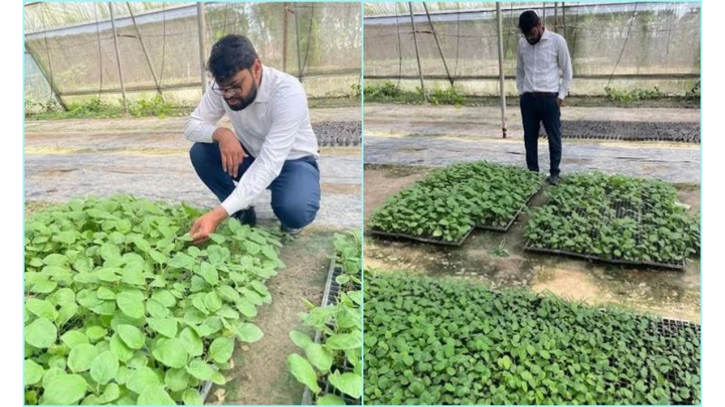
Large parts of the Jashore-Khulna region, including Khulna’s Bil Dakatia, stay waterlogged for most of the year. When the monsoon comes, fields go under water, and long spells of standing water make producing vegetable seedlings almost impossible. Without quality seedlings on time, farmers’ seasonal vegetable cultivation is disrupted. In this reality, poly net house technology has opened a door of new possibility.
Where waterlogging once forced farmers to fetch seedlings from far away, quality vegetable seedlings are now produced locally. These poly net houses are becoming a reliable source of seedlings not only for their own area but for farmers in surrounding upazilas — a successful example, in Dumuria upazila, of turning waterlogging into opportunity rather than limitation.
According to the agriculture department, a poly net house is a special protected structure made of thick, durable polythene, inside which seeds are sown scientifically in iron trays or nets. Grown in a controlled environment, the seedlings stay largely safe from disease, heavy rain and stormy weather, grow evenly and reach farmers with assured quality.
Dumuria upazila agriculture officer Nazmul Huda said a single poly net house can produce more than 100,000 seedlings at once, and with proper management up to 800,000 to 1,000,000 (8 to 10 lakh) a year. Three poly net houses have been set up as private ventures with the agriculture department’s help in the upazila’s Khornia and Atlia unions, mainly producing various vegetable seedlings. The technology’s biggest advantage in waterlogged areas, he said, is that quality seedlings can be produced even in adverse weather — during cyclones, heavy rain or waterlogging — so farmers get seedlings on time and seasonal cultivation is not delayed.
Tapas Sarkar, an agricultural entrepreneur from Baratia village in Khornia union, is one of the successful faces of this change. His Rudranil Agri Nursery is now a well-known name to farmers of waterlogged areas across the Bil Dakatia and Jashore-Khulna region. By producing quality vegetable seedlings, he has created not only his own livelihood but a reliable seedling source for local farmers.
Sarkar has produced vegetable seedlings since 2017, but his nursery gained new momentum after setting up a poly net house with government help in 2021. He now produces quality seedlings of cauliflower, cabbage, chilli, brinjal, tomato, capsicum and other varieties. Farmers from Dumuria as well as Jashore’s Keshabpur, Narail and surrounding areas now collect seedlings by season, and say the good quality means satisfactory yields after planting.
Sarkar said setting up the poly net house with government support had made year-round production of quality seedlings much easier, with his wife Bijaya Sarkar helping full-time as they try to build a successful agricultural enterprise as a family venture. He said that with more support from the agriculture department, more quality seedlings could be produced and supplied to meet the demand of farmers in waterlogged areas, cutting their production costs and increasing the certainty of getting seedlings on time. Local farmers said a shortage of quality seedlings had been a major barrier to vegetable cultivation in waterlogged areas, a problem now largely eased by local production.
বাংলায় মূল প্রতিবেদন পড়ুন · Read the original Bengali report