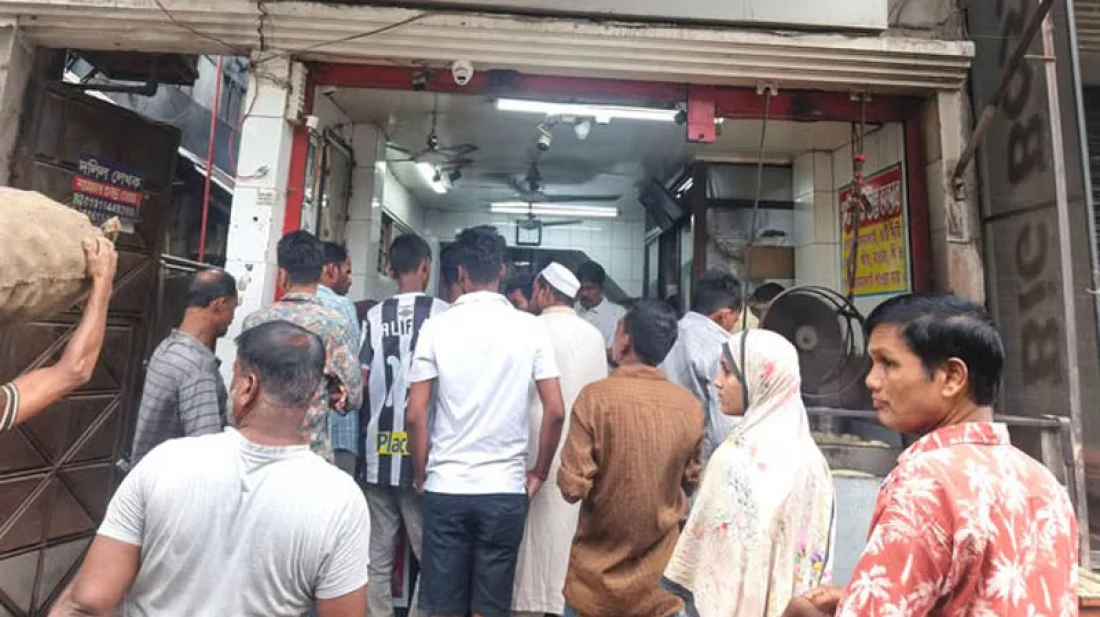
A severe gas shortage across the capital has left household stoves unable to light. Many people have been forced to cook on electric or firewood stoves instead. Others have become dependent on hotels for breakfast. This is driving up food costs while also creating health concerns. A visit to a hotel in Block F, Banasree, in the capital, at 7:30 a.m. Tuesday found it crowded with people getting breakfast — some eating, others waiting to take food away. Several of them shared their experiences.
Selim, who works at a private company and was waiting for breakfast at the hotel, said: “Because of the gas shortage, we’ve been eating breakfast at hotels for the past two weeks. After that, I cook lunch and dinner on an electric stove. We never used to eat at hotels like this, but now we’re forced to.”
He added: “Given the current state of the gas supply, there’s no option but to find alternatives. You can’t cook anything on the gas at all. That’s why we depend on hotels in the morning. It’s raising our costs, and it’s also causing various stomach problems.”
Abdullah, who had come to eat at the hotel, said: “We used to have breakfast at home. But not anymore, because there’s no gas at home. We’re cooking on an electric stove. But there’s reluctance to cook on an electric stove in the morning too. So now we’re forced to come to hotels.”
Akbar said he and his wife both work. They used to be able to cook and eat breakfast in the morning and take lunch with them. But that’s no longer possible. Because of the gas shortage, the stove doesn’t light at all. So he now picks up breakfast from a hotel in the morning and eats it on the way to work. Cooking at home on an electric stove happens only in the evening.
He said: “This has increased our costs too. Four parathas, eggs, and lentil fry cost Tk 120. If you add something else, it comes to around Tk 200. On top of that, there’s the question of whether it’s hygienic. At home, everything used to be hygienic, and it cost less too. People are now caught between two problems.”
Manjur Rahman, who had come to the hotel, said: “There are five of us at home — husband, wife, and children. For nearly two weeks now, we haven’t been able to eat home-cooked breakfast in the morning. Eating regularly at hotels is also causing stomach problems. And the children don’t want to eat it either. But there’s no alternative.”
He added: “The government doesn’t say anything about this gas crisis either. How much longer will we have to suffer like this?”
It isn’t just Banasree; the situation is the same across the capital. Because of the severe gas shortage, gas stoves aren’t lighting in homes. Housewives are cooking through alternative means. Many have become dependent on hotels for breakfast.
Inquiries found that Titas Gas users across areas including Badda, Rampura, Malibagh, Khilgaon, Dhanmondi, Mirpur, and Uttara are facing a severe crisis. Those who use cylinder gas are unaffected by this shortage. Many are using electric stoves as an alternative. Low-income people are using firewood stoves.
Asma Khanam, a homemaker in Banasree, said: “We now use an electric stove instead of gas. The gas is completely off. Even if you strike the burner repeatedly, no gas comes. This has been going on for more than a month now. Things have reached a point where there’s simply no gas at all.”
Selina Akter, a homemaker in Rampura, said: “The gas doesn’t light at all, so what can we cook? Before, a little gas would come at night. But now night and day are the same. We can’t cook without an electric stove.”
Arifa Akter, a homemaker in Badda, said: “We’re using a firewood stove. Since there’s no gas, we have to cook this way.”
She added: “People as poor as us can’t afford to buy an electric stove. So we’re cooking this way for now.”
Abu Bakar, manager of “Mehrin Hotel” in the Banasree area, said: “There’s been a bit more pressure than before in the mornings.”
Saiful Islam, manager of the nearby “Pithamela” restaurant, said: “There are more people in the mornings than before. Sales are good too.”
Asked why morning crowds had increased, he said: “There’s currently a gas shortage. Many people can’t make breakfast at home. So many are turning to hotels and restaurants.”
Suman, manager of Ghoroa Restaurant, said: “We have more customers in the morning than at any time before. Because of the current gas shortage, many people don’t want the hassle of making breakfast in the morning. They’re the ones who’ve turned to hotels.”
It may be noted that one of the main causes of the gas shortage is a technical problem at the floating LNG terminal, or FSRU (Floating Storage and Regasification Unit), in Moheshkhali, combined with adverse weather. The country’s LNG supply depends on two FSRUs. Supply fell after a recent technical fault at one terminal. Since yesterday afternoon, the other terminal has also been unable to supply LNG normally because of adverse weather. This has pushed the gas crisis to an even more extreme level.
বাংলায় মূল প্রতিবেদন পড়ুন · Read the original Bengali report