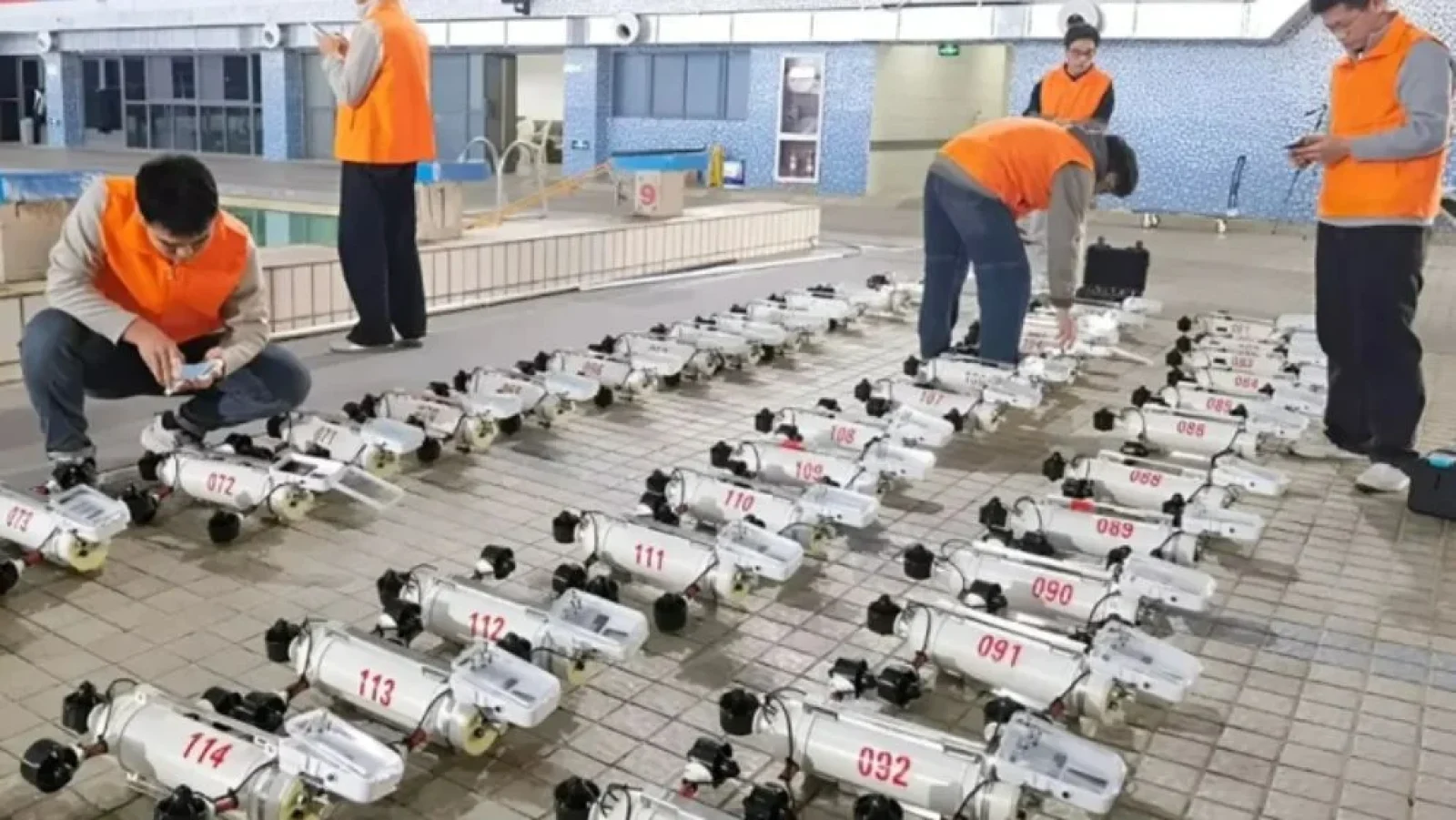
A team of Chinese researchers has set a new Guinness World Record by running 116 autonomous underwater drones together. In a test in a swimming pool, more than a hundred drones were coordinated along a set route without direct human control, opening new possibilities for operating uncrewed underwater vehicles at scale.
The test was carried out jointly by Northwestern Polytechnical University and Xi’an Tianhe Maritime Technologies. The university said in a statement at the end of September that 116 autonomous underwater vehicles called TH-618 were used.
The test took place on August 29 in a swimming pool 50 metres long and 20 metres wide, supervised by Guinness World Records officials, and was later approved and published as a record on the organisation’s website.
The drones were launched into the water in sequence and travelled a 500-metre route in coordination for 34 minutes without direct human control, using real-time data to keep their course.
The university said that coordinating dozens or even hundreds of underwater vehicles in the same environment, fully autonomously and stably over long periods, has long been a major challenge for intelligent underwater technology.
China is advancing rapidly in coordinating autonomous vehicles and drones on land, in the air and at sea, and such technologies are growing in importance as militaries worldwide increasingly use uncrewed systems instead of crewed platforms.
The TH-618 drones are 61.5 centimetres long and 20 centimetres wide, weigh 5.14 kilograms each, have a maximum range of 30 kilometres and can operate continuously for more than eight hours, the university said. They navigate using phone-based camera systems and can correct their course on their own if obstacles or changes appear on the route.
Underwater navigation faces difficulties with real-time communication and various environmental obstacles, the university said, and the record was made possible by more than two decades of research on underwater target detection, data collection, acoustic communication and visual technology. Drone supplier Xi’an Tianhe Maritime Technologies said autonomous underwater vehicles are now used in research and infrastructure work, including detailed seabed mapping and inspecting oil and gas pipelines.
বাংলায় মূল প্রতিবেদন পড়ুন · Read the original Bengali report