Twenty-year-old Omar Al-Sawahi didn’t know where he would be able to bury his father. Israeli forces shot and killed his father, Mohammad, 40, near Gaza’s so-called Yellow Line.
Mohammad, a resident of the Zeitoun area of Gaza City, was selling tea and coffee at a sidewalk stall near the Yellow Line — a military zone designated by Israel — on June 10 when a bullet struck him in the neck. He died instantly.
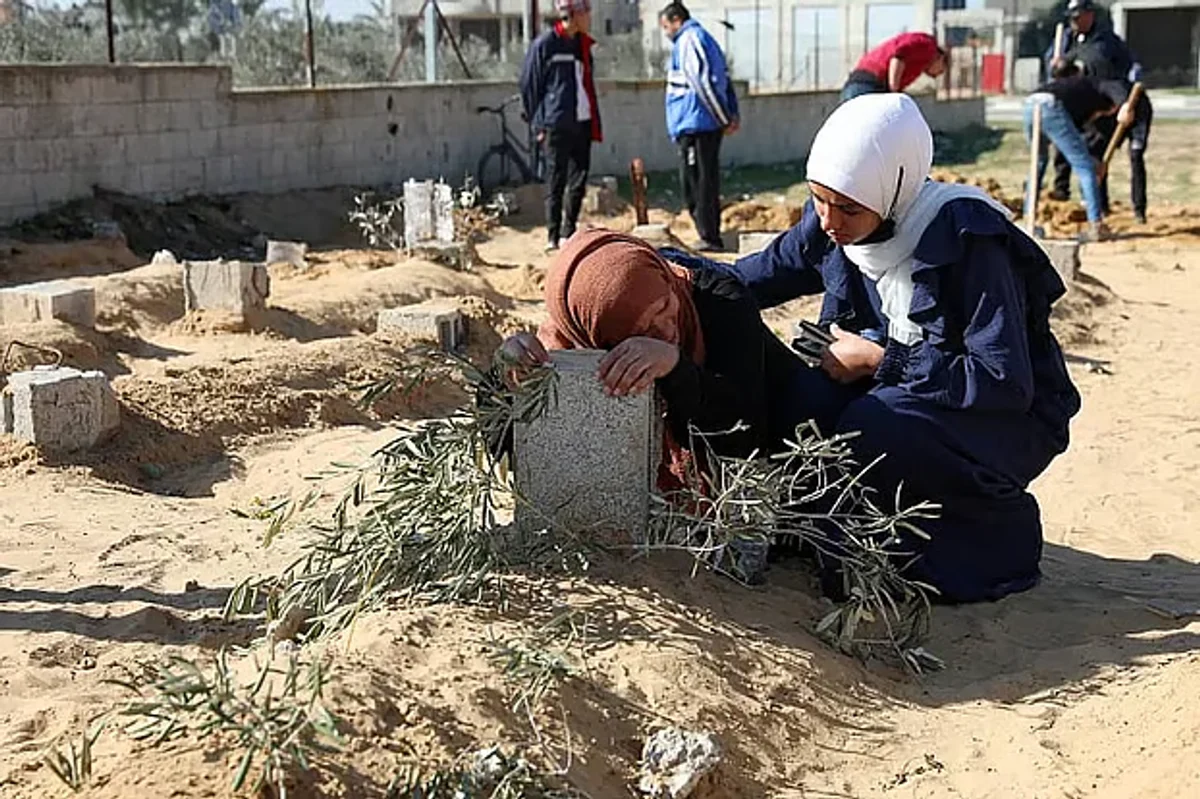
Omar went to the Zeitoun cemetery to bury his father’s body, but found the entire cemetery packed with grave after grave, with not a single space left. Most of those buried there were killed in what he described as Israel’s ethnic-cleansing campaign in Gaza.
Because of the lack of space and the devastating conditions of the war, most graves are marked only with a stone, with a piece of paper bearing the deceased’s name attached to it.
“I stood in the middle of the cemetery and all I could see was grave after grave,” Omar told Al Jazeera. “Mounds of sand everywhere, and beneath them, buried bodies.”
Omar said there is now nothing left of how a grave used to be prepared before the war. A grave today is marked with nothing more than a piece of stone, with a scrap of paper bearing the name and identity of the deceased placed on top.
Preparing a single grave in Gaza currently costs around 500 shekels (about $167). Omar’s family could not afford that sum, so they had to find another way.
“There was no space for a new grave,” Omar said. “So we were forced to bury my father in my grandfather’s grave.”
The complete collapse of civilian services in Gaza, combined with the constant risk of Israeli attacks, has made it impossible to identify or recover the bodies of thousands of Palestinians killed during the war. Many families have been forced to bury their loved ones in the courtyards of their homes, beside tents, in the grounds of displacement camps, or in the courtyards of schools and hospitals.
The level of Israeli violence in Gaza eased somewhat after a US-brokered ceasefire agreement in October 2025. Families were then able to recover the bodies of loved ones from the rubble of their homes and from temporary graves, and bring them to cemeteries for proper burial.
But at least 1,200 more Palestinians have been killed in Israeli attacks since the ceasefire was announced, each requiring a burial site of their own. Gaza authorities say 529 Palestinian bodies have so far been recovered from seven mass graves located in the grounds of various hospitals.
With the drop in Israeli violence, Mohammad’s family was able to recover his body and take it to the cemetery for a proper burial.
বাংলায় মূল প্রতিবেদন পড়ুন · Read the original Bengali report