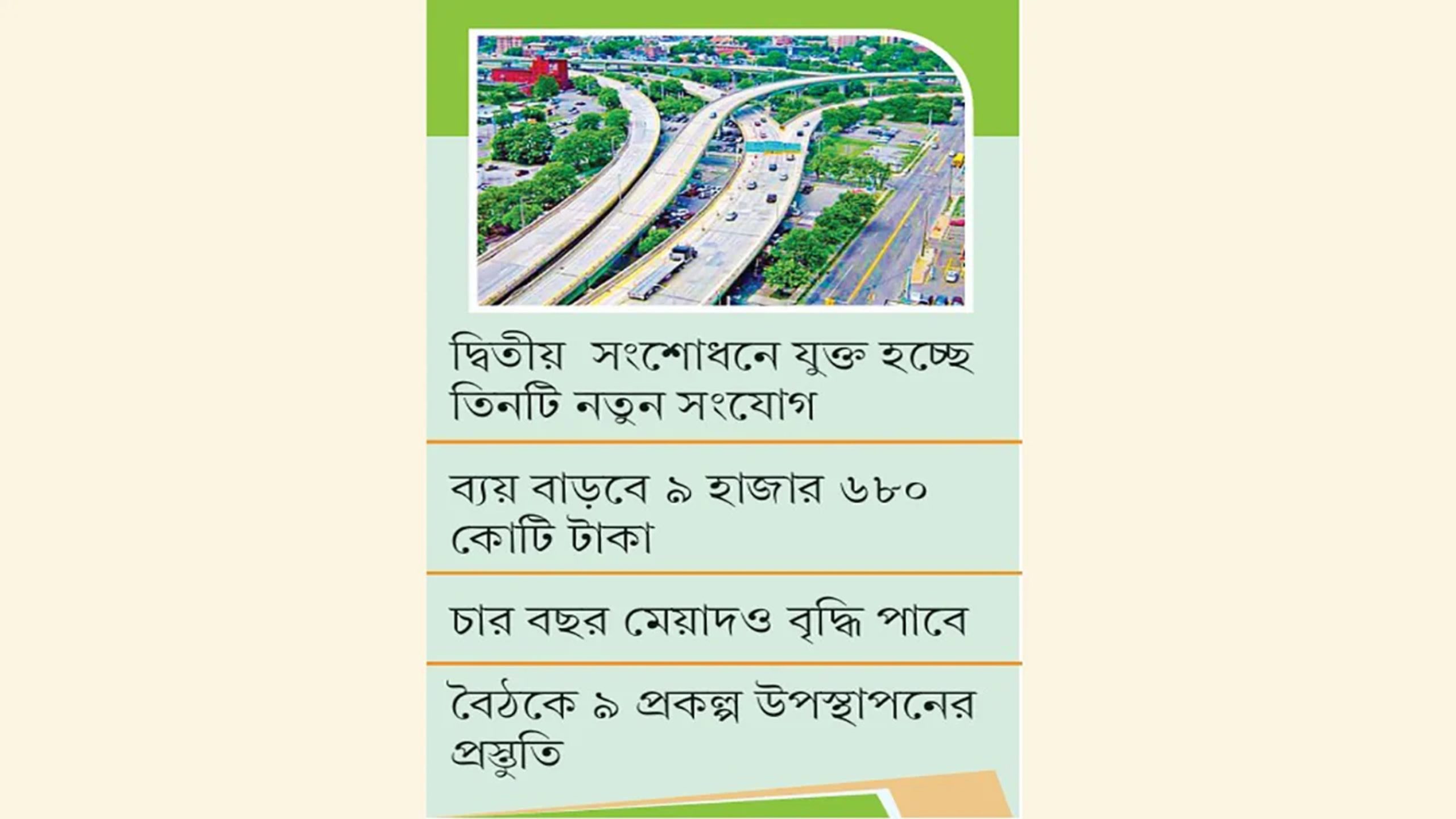
After six months of uncertainty, the second-revision proposal for the Dhaka-Ashulia Elevated Expressway — one of the country’s largest infrastructure schemes — is finally going before a meeting of the Executive Committee of the National Economic Council (ECNEC). Eight other projects will also be presented at the meeting. The Planning Division has completed preparations to present the proposal at the ECNEC meeting to be held on Wednesday in the cabinet room of the Bangladesh Secretariat, chaired by Prime Minister and ECNEC chairperson Tarique Rahman.
Planning Commission sources said that if the revision is approved, three important links will be added to the project’s design: the Baipail interchange, entry and exit access to the third terminal of Hazrat Shahjalal International Airport, and integrated connectivity with the under-construction MRT Line-1 (underground metro rail). These additions will significantly increase the expressway’s effectiveness within the capital’s road network, those concerned believe.
The project’s cost has also been proposed for a large increase. Initially approved at 16,901.32 crore taka, it rose to 17,553 crore taka in the first revision. This second revision proposes adding another 9,680 crore taka. If approved, the total cost will be 26,581 crore taka — about 55.15 percent higher than the original estimate. Project officials said the cost had to be revised because of the taka’s depreciation against the dollar, changes to VAT and income-tax structures, higher customs duties, utility relocation, additional land acquisition, consultancy costs and the addition of new infrastructure.
The Dhaka-Ashulia Elevated Expressway is being built under a government-to-government (G2G) arrangement with Chinese financing. Of the funding, 5,951.41 crore taka will come from government funds and 10,949.90 crore taka from a Chinese loan. Under the project, an elevated expressway about 24 kilometres long is being built from Kawla in the capital through Abdullahpur, Kamarpara, Dhaur, Ashulia, Zirabo, Baipail and the Savar EPZ to the Shreepur bus stand, along with several connecting roads at various points. Once open, it will significantly cut the time for northbound vehicles to enter and leave the capital, and ensure fast links between the airport area, the Dhaka Elevated Expressway, the Asian Highway and the country’s various national highways.
The project’s timeline is also being extended. Begun in September 2017 and due to finish in June 2022, its field work was delayed by a long wait to conclude the loan agreement; the term was later extended to June 2026. A new deadline of June 2030 has now been proposed, seeking four more years to finish the remaining construction. According to government documents, 11,735.17 crore taka had been spent by June 2025, bringing financial progress to 66.86 percent, while physical work has passed 52 percent — though the implementing agency’s latest figures put construction at about 58.5 percent complete.
Alongside the expressway, eight other development projects will be presented for approval at the same meeting, including river-erosion prevention in Bhola district, integrated development and rural-road maintenance in greater Dinajpur, universal social-infrastructure development, construction and renovation of disaster shelters, drilling of gas-exploration wells in the Begumganj and Sunetra areas, modernisation of the power-distribution system in Sylhet division, and the expansion of kidney-dialysis facilities at medical college hospitals and district sadar hospitals.
বাংলায় মূল প্রতিবেদন পড়ুন · Read the original Bengali report