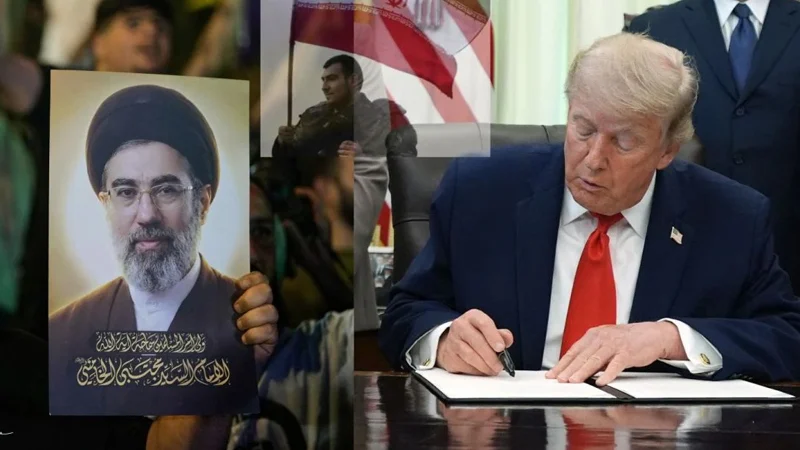
Four months of devastating war. So much bloodshed and destruction. So many failed efforts to halt the fighting. After hopes were raised many times only to be dashed in the end, it now appears that Iran and the United States have agreed on at least one thing. That is a “memorandum of understanding” (MoU) that the two longtime enemies have managed to finalize. They have reached a final peace agreement. Both countries say the deal will be formally signed in Geneva, Switzerland, next Friday. As countries around the world welcome the deal following this announcement of an end to hostilities, questions and uncertainties have nonetheless arisen over the agreement’s enforceability and durability.
Although the deal is extremely important, it is being seen only as a beginning. For Donald Trump, the deal is a remarkable moment. On Sunday he not only celebrated his 80th birthday but also secured a major diplomatic success. Yet the aspects of the deal that the two countries are emphasizing are largely confined to the parts that serve their own interests and are politically easy to accept.
Another important aspect of the deal is that the Lebanon issue features explicitly in both sides’ descriptions. A declaration has come of a permanent halt to military operations on all fronts, including Lebanon. But because Israel and Hizbullah are not signatories to the deal, serious doubt remains over whether they will abide by it. To be honest, although the deal is extremely important, it is only a beginning. It opens a 60-day window within which the United States and Iran must agree on how Iran will dismantle and remove its nuclear materials. The process itself could collapse at any time. Clear differences remain between the two sides over the precise status and treatment of the Strait of Hormuz. There is also no agreement between the two sides on the details of the timetable for lifting sanctions and freeing up Iran’s blocked assets.
Announcing the deal on social media, the U.S. president said the Strait of Hormuz would now remain open to commercial shipping. The United States would lift its naval blockade. On Sunday, Trump said exultantly: “I am hereby giving full approval for shipping to resume through the Strait of Hormuz without any toll or obstruction, and at the same time I am ordering the immediate withdrawal of the U.S. Navy’s blockade. All ships of the world, start your engines. Let the oil flow!”
He declared that, in complete contrast to the failures of past American presidents, he had secured a “remarkable deal” that would bring “peace and security across the entire region.” Such grandiose language is nothing new for Trump, however. His declarations on last year’s Gaza war ceasefire deal — such as “eternal peace” and “the dawn of an age of faith, hope and God” — were equally sweeping, even though the reality fell far short of his remarks.
The success or failure of high-stakes diplomatic deals usually depends on the details. And in the case of this deal, those details are notably scarce. In an interview with Fox News, U.S. Vice President JD Vance said that ensuring Iran can never build a nuclear weapon “has been included in this deal.” The United States would be able to verify Iran’s compliance with its terms. Even so, questions remain over some highly important issues, such as what kind of restrictions will apply to uranium enrichment and what will ultimately become of Iran’s current stockpile of highly enriched uranium.
Some of this will certainly be resolved through subsequent talks and “technical” discussions within the extended 60-day period of the current ceasefire. But after several decades of efforts to persuade and compel Iran to abandon its nuclear ambitions, if one thing is clear, it is this: no matter how firmly the United States believes it has secured exactly what it wanted in this “memorandum of understanding,” there is no hundred-percent certainty about anything here.
To reinforce the point, Iran’s Supreme National Security Council issued a statement on Sunday. It said: “Final talks will begin only after the other side (the United States) implements its commitments under the memorandum.” What exactly those commitments are, and how Iran interprets them, will largely determine whether the deal ultimately holds.
Energy market analysts have warned that an immediate return to pre-war conditions for oil transport through the Strait of Hormuz is unlikely. Clearing the huge backlog of tankers, removing mines, and reviving regular oil transport and production could take several weeks. With the formal signing of the deal still several days away, Iran and the United States have time to sort out the important issues to ensure its success. But there is also enough time for it to fall apart.
Beyond this, another major uncertainty is Israel. This was essentially a three-way war from the start. In an interview with The Wall Street Journal on Sunday, Trump said he was extremely angry that Israeli Prime Minister Benjamin Netanyahu had ordered an airstrike in Lebanon at the end of this week. Trump believes the strike could have wrecked the near-final Iran deal.
The deal has survived — at least long enough to be announced publicly. But if Israel launches a new military operation in Lebanon again, Iran could once more decide to close the Strait of Hormuz, which could put the global economy at fresh risk. In his own remarks, Vance acknowledged that high energy prices, and the resulting economic fallout, had caused considerable hardship for many Americans. He said his main message to the American people was “thank you,” while promising that energy prices would begin to fall. How quickly that happens, and how quickly overall consumer costs ease for Americans facing financial strain, will largely determine whether the mounting political pressure on Republicans eases before the midterm congressional elections this November.
According to recent opinion polls, Trump and his Republican party are facing an increasingly dissatisfied public. One survey found that 63 percent of Americans expressed dissatisfaction with the government’s handling of the economy. Some 57 percent believe economic conditions are getting worse. At the very least, however, the deal will ease, if not entirely remove, some of the economic pressure created by the ongoing conflict. If petrol prices really do begin to fall, it could be a visible sign of improving conditions for Americans.
This is a significant step toward returning to the situation before the war began. Yet Trump’s larger goals remain unfulfilled for now. At home, he still faces political risk.
বাংলায় মূল প্রতিবেদন পড়ুন · Read the original Bengali report