Bangladesh’s mangoes win over any buyer with their taste and aroma. Cultivation grows every year, and so does production — but not exports. Bangladesh ranks seventh in production, yet sits at the bottom in exports, nowhere near the mango-based industries flourishing in other countries. The agriculture department says Bangladesh’s mango market is worth more than 13,000 crore taka — and would exceed 25,000 crore if exporting were simply made easier. Despite being a top producer, Bangladesh’s share of the 4.19 billion dollar export market is negligible. Those involved say the opportunity cannot be seized without proper management from production through to the airport.
For several years, Rajshahi, Chapainawabganj and Naogaon have produced large volumes of exportable mangoes, but exports are not rising under existing government policy, and targets go unmet. What little is exported does not benefit the growers. Farmers in the Rajshahi region further allege that the entire profit goes to a Dhaka export syndicate, which buys mangoes from wholesale yards rather than from growers — and because quality fruit does not go abroad, no market for Bangladeshi mangoes is forming overseas. According to the agriculture department, 2,662,583 tonnes of mangoes were produced from 205,205 hectares in the 2024-25 season; production fell to 2,538,987 tonnes in 2025-26, and the target for the current 2026-27 season is 2,668,498 tonnes. The record was 2,867,678 tonnes in 2022-23.
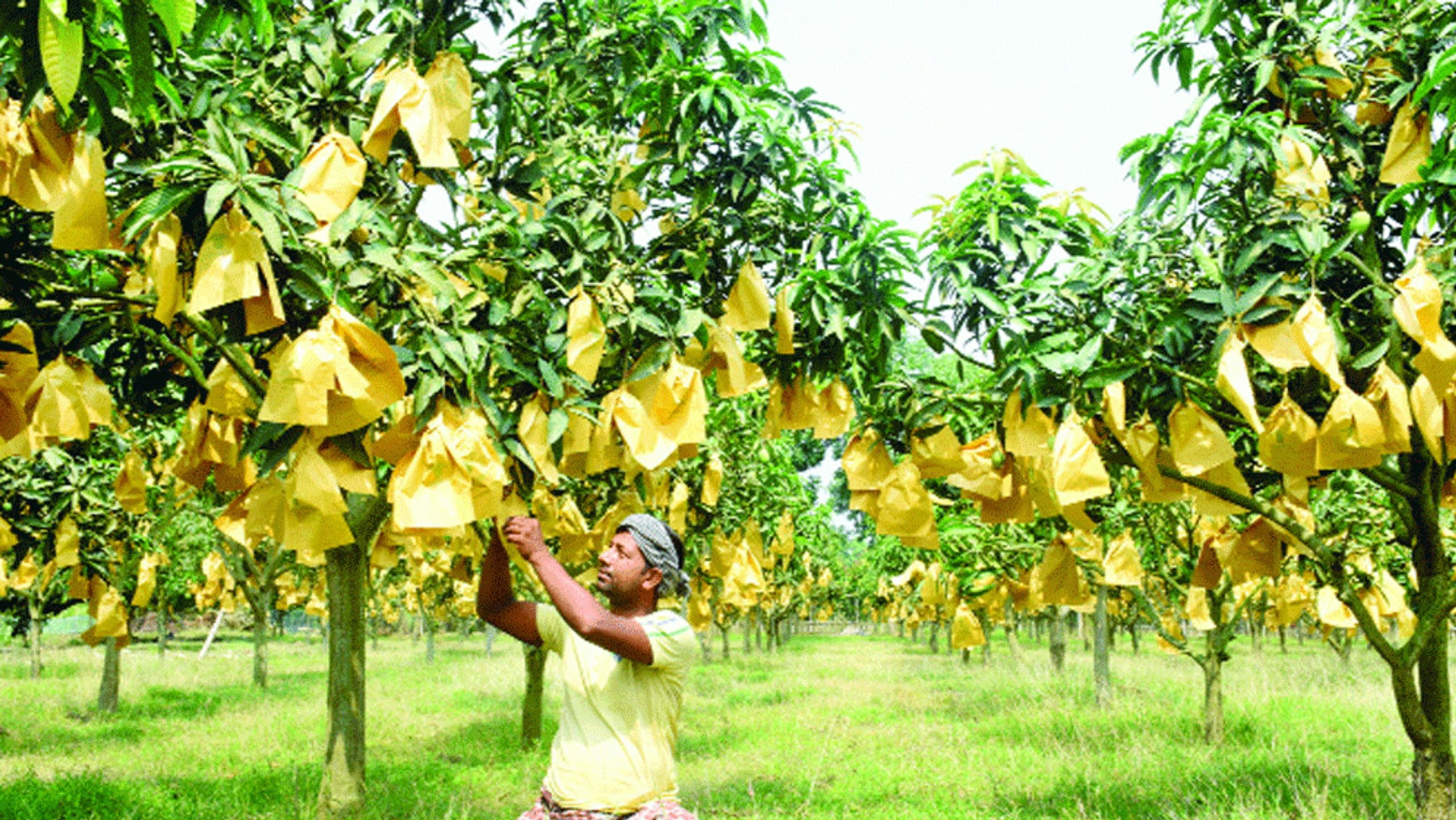
Experts say demand abroad for Rajshahi’s mangoes is enormous, but winning a place in the international market requires harvesting, standardised storage, packaging and transport facilities that have yet to be built. Md Ridwanul Karim, scientific officer at the Rajshahi Regional Fruit Research Centre, said export mangoes must meet set international standards: no blemishes, proper fruit-bagging technique, no insects, sterilisation in a thermal house, and a GAP (Good Agricultural Practice) certificate — burdens growers cannot carry alone. Export-ready infrastructure in the mango belt is essential, he said, and government support is badly needed. Rafiqul Islam, an exportable-mango grower in Chapainawabganj, said a key obstacle is the lack of refrigerated vans to move fruit to Dhaka at controlled temperatures and the enormous transport cost — about 850 taka to move one kilogram from orchard to Dhaka and on to a foreign market. Another Chapainawabganj entrepreneur, Munjer Alam Manik, said he had tried in the past to clear the complex export stages, but the work is not easy under the existing policy regime: the lack of international-standard cold chains, the scarcity of GAP certificates, gaps in packaging, standardisation and grading, high transport costs and the complexity of meeting phytosanitary conditions are the big barriers.
An “Exportable Mango Production Project” has run for several years, training growers in good agricultural practice, fruit-bagging technology and environment-friendly techniques, and linking them with exporters — yet targets are still missed. Mangoes currently go to 38 countries including Europe and the Middle East, but growers who spend extra to produce export-grade fruit are not getting the chance to export; this year, again, half the export target is unlikely to be met. Growers say about 30,000 tonnes of exportable mangoes were produced this year against a target of just 5,000 tonnes. Exports were 309 tonnes in 2016-17, rising to 1,767 tonnes five years later and a record 3,100 tonnes in 2022-23, before falling to 1,321 tonnes in 2023-24; in 2024-25, against a 5,000-tonne target, 2,121 tonnes were shipped. Bangladesh’s share of the world mango export market is under one percent. Chapainawabganj remains the top producing district — 469,000 tonnes from 37,498 hectares this year, with 250 tonnes to go abroad. Neighbouring Naogaon expects 387,000 tonnes from 30,321 hectares, with 100 tonnes for export (up to 250 tonnes in past years). Rajshahi’s target is 256,000 tonnes from 19,462 hectares; the agriculture department’s additional deputy director Papia Rahman said Rajshahi’s harvest would exceed the target and some would be exported. Mango cultivation is also growing in Natore, where output is expected to beat the 68,000-tonne target from 5,693 hectares.
বাংলায় মূল প্রতিবেদন পড়ুন · Read the original Bengali report