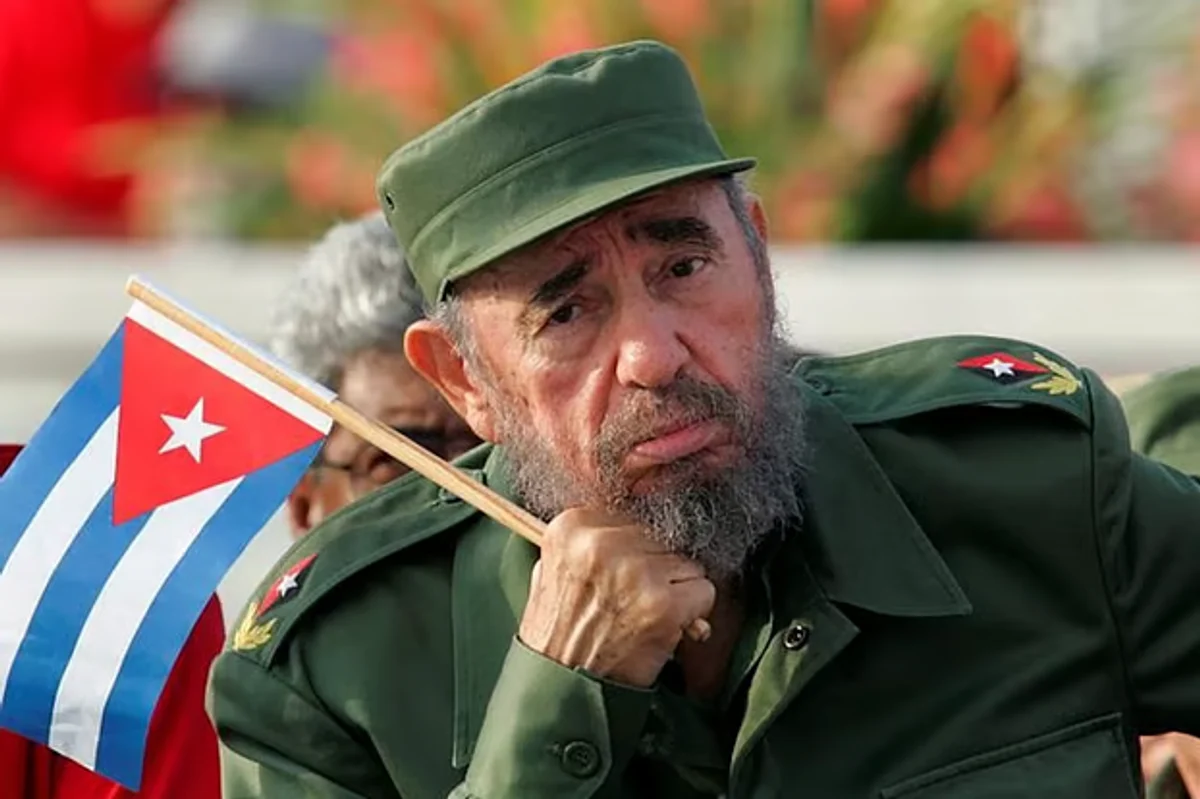
Havana to Washington is a distance of just 145 kilometres. Yet at the two ends of that short distance stood two very different political philosophies: on one side the United States, the world’s most powerful capitalist state, and on the other the socialist revolution of the small island nation of Cuba. Standing between them was one revolutionary — Fidel Castro.
Born on 13 August 1926, Fidel Castro’s birth centenary falls today, Thursday, 13 August. Although he died on 25 November 2016 at the age of 90, his shadow still falls long over Cuban politics, the left-wing movements of Latin America and the history of the anti-US struggle.
Castro ruled Cuba for nearly five decades. During that time, 10 presidents came to power in the United States, and he outlasted every one of them. In 2006 he handed power to his brother Raul Castro because of illness, and in 2008 he formally left the presidency. His story, however, did not begin at the presidential palace, but in the anger of a young lawyer.
Fidel grew up in a sugar-producing region of eastern Cuba. His father was a Spanish immigrant who first worked for a US sugar company but later became the owner of a large farm. After studying at a Jesuit school, Fidel read law and social sciences at Havana University.
When Fulgencio Batista seized power in a military coup in 1952, the path of democratic politics in Cuba was effectively closed. The young lawyer Fidel then chose the road of armed struggle. On 26 July 1953 he and his followers attacked the Moncada army barracks in Santiago de Cuba. The assault failed, many comrades were killed, and Fidel and his brother Raul were arrested.
But prison brought Castro onto the big stage of national politics. He turned his court defence into a political manifesto, and it was there that he made his famous declaration: “History will absolve me.”
Freed under a general amnesty, Fidel Castro went to Mexico, organised revolutionaries and returned to Cuba in 1956 on a yacht named Granma. After the landing, government forces killed or scattered much of the group; with the surviving fighters, Fidel took refuge in the Sierra Maestra mountains, where a new chapter of guerrilla war began.
In the mountains, Castro built not only a guerrilla force but also popular support, as anger against Batista’s rule steadily grew. In January 1959 Batista fled the country, and on 8 January Castro entered Havana with a revolutionary caravan. At just 32, he became one of the youngest rulers in Latin America.
At first Castro said his aim was to restore democracy, not to establish socialism, and on that assurance the United States and several other countries recognised his government. But within a few months the situation changed. Castro launched sweeping economic reforms — redistributing land and large property, nationalising foreign-owned assets and increasing state control of the economy. Members of the Batista government were put on trial, and hundreds of people were executed.
The press was hit too: independent newspapers were shut, political opposition was suppressed and the number of political prisoners later rose sharply, while many Cubans fled the country. To some, the same revolution was a symbol of liberation; to others, the beginning of a new repressive state.
The faster Castro leaned towards the Soviet Union, the faster relations with Washington worsened. The United States stopped buying Cuban sugar; in response, Castro seized the vast US assets in Cuba. Washington then imposed a sweeping trade embargo, and on 3 January 1961 the two countries severed diplomatic ties.
Then came one of the most dramatic chapters in Cuba’s history. On 16 April 1961 Castro formally declared his revolution socialist. The next day, about 1,400 CIA-backed Cuban exiles attacked at the Bay of Pigs — but the operation failed within days. It was a major political victory for Castro, and by repelling an invasion backed by the world’s most powerful state, he further strengthened the legitimacy of the Cuban revolution. Attempts on his life did not stop, however; according to Cuban government figures there were countless plots to kill him, and while some claims are disputed, US covert efforts to overthrow and kill Castro are well established in the history of the Cold War.
A year after the Bay of Pigs came an even more terrifying crisis. In October 1962 the placing of Soviet nuclear missiles in Cuba came to light, and US President John F Kennedy declared a naval blockade around the island. For 13 days the world waited to see whether the United States and the Soviet Union would be drawn into nuclear war. In the end Nikita Khrushchev agreed to remove the missiles and the crisis passed — but Cuba had by then become one of the most important geopolitical centres of the Cold War.
Castro’s influence was not confined to Cuba. For many young revolutionaries across Latin America, Cuba became a symbol of inspiration, and his government took part in Africa’s anti-colonial struggles, sending Cuban military help to the fights in Angola, Mozambique and South Africa, along with doctors and teachers to countries across the developing world. At home, Castro’s Cuba brought big changes in education and health — universal education, healthcare and guarantees of food and housing, with an emphasis on women’s rights and ethnic equality, and a mass literacy campaign after the revolution. Cuba’s medical system, especially its preventive healthcare, won international recognition, and the country also achieved remarkable sporting success for its size.
It is over his legacy that the sharpest debate lies. The revolution limited political pluralism: independent media were shut, the freedom of trade unions was curtailed and religious institutions came under state pressure, while neighbourhood “Committees for the Defence of the Revolution” kept watch over citizens. Political imprisonment and exile were also hard realities of his rule. Close ties with the Soviet Union were an important part of his policy, yet it is not enough to describe him as a mere follower of Soviet socialism: he criticised Stalin’s personality cult and repression, even as he did not always openly oppose Soviet military actions.
The collapse of the Soviet Union in 1991 dealt a devastating blow to Cuba’s economy, ending billions of dollars in preferential trade and subsidies. In the severe crisis of the “Special Period,” Castro had to open some space for limited private business and foreign capital; later, as tourism revived the economy, state control tightened again, but his slogan did not change — socialism was his path.
After falling ill in 2006, Castro’s hold on power began to wane, and in 2008 he formally handed the presidency to his brother Raul. Even in retirement he did not entirely withdraw from politics, backing Raul, and near the end of his life he saw the most symbolic change of all — the ice between the United States and Cuba beginning to thaw. On 17 December 2014, Washington and Havana announced the restoration of diplomatic ties, a historic moment after long enmity that Castro cautiously welcomed. Two years later, on the night of 25 November 2016, Fidel Castro died, aged 90.
Fidel Castro cannot be judged in a single word. Just as he overturned Batista’s dictatorship and changed the course of Cuban political history, he also built a long-lasting one-party rule of his own; just as he brought education and healthcare within reach of ordinary people, he also curtailed political opposition and freedom of expression. His long speeches were the stuff of legend: his 269-minute address to the United Nations in 1960 long held the record for the longest speech at the world body.
A century after his birth, Fidel Castro remains a living question in Cuban history: can a small country stand up to a superpower and forge its own path? Castro’s answer was yes. History’s counter-question is whether, when a revolution becomes state power, it expands freedom or creates a new kind of control. Between those two questions stands Castro’s legacy — which is why, a hundred years on, his story is not over.
বাংলায় মূল প্রতিবেদন পড়ুন · Read the original Bengali report