With hostility towards Muslims and attacks on mosques rising in Britain, more than a hundred mosques have opened their doors to the public to give people a chance to learn directly about Islam and British Muslims. Events were held under the Visit My Mosque programme at mosques in London, Birmingham, Sheffield, Manchester, Glasgow, Southend, Cardiff and other cities.
The Visit My Mosque programme, organised by the Muslim Council of Britain, is now in its eleventh year. The mosques lay on tea, food from various cultures, talks, interfaith activities, art exhibitions and discussion for visitors. In the organisers’ view, the importance of the effort has grown this year against a background of rising hostility towards Muslims.
The London Islamic Cultural Society in north London also took part. The mosque has faced several attacks and instances of harassment over the past three years. In one, a woman told worshippers she would kill their children. In another, the building’s gas pipe was opened and altered in a way that would let gas build up and create a dangerous situation. Even after these incidents the mosque decided to open itself to more people.
The secretary general of the Muslim Council of Britain, Dr Wajid Akhter, said that in the present climate many people are getting their information about British Muslims and their neighbours through social media algorithms and online campaigns. That, he believes, is creating scope for hatred to be spread against religious communities.
Sufia Alam, head of the Maryam Centre at the East London Mosque and London Muslim Centre, said their mosque took part in order to show that friendship and solidarity are stronger than hate. In her view, when people come to a mosque and get the chance to talk to Muslim families, volunteers and worshippers, many established assumptions and fears begin to fall away.
Concern among Muslims about the security of mosques is also growing. By the reckoning of the British Muslim Trust, a mosque is attacked in the United Kingdom every five days. Those incidents include intimidation, violence, damage to property, harassment, anti-Muslim speech, online abuse and vandalism.
Farooq Rafiq of Cheadle Mosque in Greater Manchester described Visit My Mosque as a place where people get a chance to learn directly about a faith that is misunderstood and about those who follow it. The chairman of Finsbury Park Mosque, Mohammed Kozbar, also stressed openness, dialogue and solidarity in countering anti-Muslim hostility.
The London Islamic Cultural Society’s mosque is run by Bibi Khan, the first woman to be president of a mosque in the United Kingdom. In her view the media often fail to convey the real picture of the local Muslim community. It is therefore important, she said, to create the chance to speak directly about their beliefs, their work and their relationships with people.
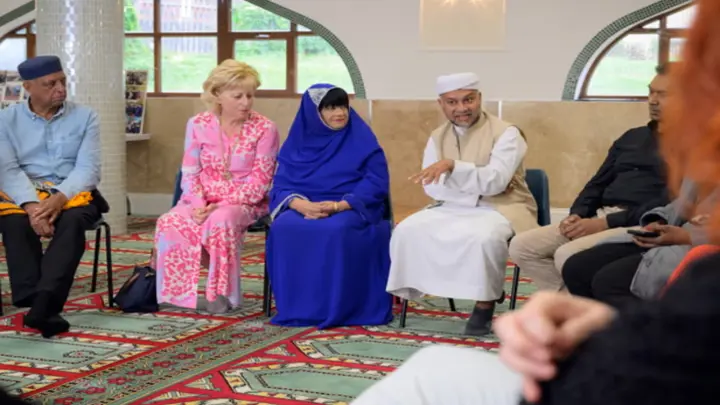
People of various faiths took part in the event at that mosque. About two dozen sat down for a round-table discussion. Some of those who do not practise Islam came out of an interest in learning more about mosques and about Islam. Police were also present at the mosque during the event.
Representatives of the Jewish community also took part. Haringey has a large presence of both the Muslim and Jewish communities. Bibi Khan said that despite differences of opinion, mutual understanding and living together are important for the two communities. A Jewish representative, Judith Prinsley, also spoke of antisemitic graffiti near her place of worship and of worshippers being afraid.
Bibi Khan also expressed concern about false information spread on social media. In her view rumours and conspiracy theories of that kind can create further fear and suspicion among people. For that reason she regards direct contact and mutual understanding between Muslims and people of other faiths as important.