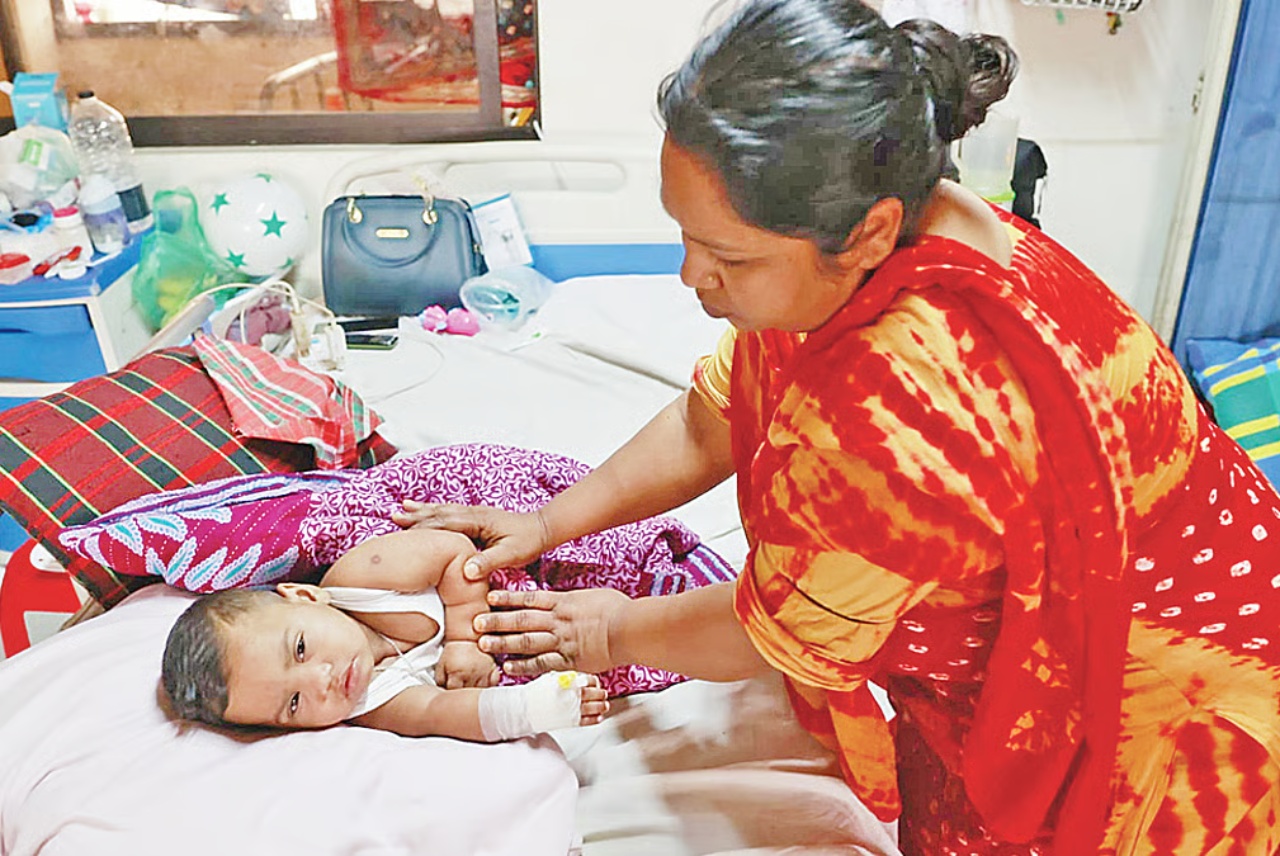
A survey has drawn a picture of the financial burden families are bearing — alongside the grief of losing children — during the measles outbreak in the country.
The assessment survey, conducted on some 2,750 families, found that about 89 percent of families had to take on debt to meet the cost of measles treatment.
In addition, six of every 10 families (about 61 percent) had to break into their own savings to cover treatment costs.
The Bangladesh Red Crescent Society (BDRCS) and the International Federation of Red Cross and Red Crescent Societies (IFRC) conducted the survey jointly.
Releasing the results in a press release on Monday, they said the survey covered 2,746 families that received treatment at 12 government medical colleges and district hospitals across the country, with the aim of assessing the social and economic impact of the outbreak and providing financial support to affected families.
Among the families surveyed, 75 percent of patients were under 4 years old; 19 percent were aged 5 to 17, and 6 percent were over 18.
Each family spent an average of 16,000 taka (about $130) on treatment and other related costs, the release said. To meet this, 4 percent of families sold their assets and about 3 percent relied on donations.
Every family that took part said they needed financial help to recover from the shock.
Of these, 35 percent named medicine as the most urgent support, followed by water, sanitation and hygiene (WASH) support (33 percent) and food support (22 percent).
Of the families that gave occupational information, 78 percent work in the informal sector, with monthly incomes between 6,000 and 20,000 taka.
Because of long hospital stays to care for a sick child or family member, many lost income, and some even lost their jobs.
Hazera Khatun of Rangpur took her 11-month-old daughter to Shaheed Suhrawardy Medical College Hospital in Dhaka for treatment last June. They have already spent more than 70,000 taka on her daughter’s measles treatment.
Hazera Khatun said that although treatment at government hospitals was free, there were many costs outside it. “Just coming to Dhaka by ambulance cost us about 20,000 taka,” she said.
Food has to be bought every day, various medical tests have to be paid for, and there are many other daily costs.
“I have already borrowed money from relatives. My husband works in Saudi Arabia, but he did not get his salary this month. That has made our situation even harder,” Hazera said.
The press release said 2,400 of the worst-affected families, selected according to risk criteria set from the survey, would be given emergency cash support of 10,000 taka each.
BDRCS secretary general Kabir M Ashraf Alam said: “This assessment shows that many families face not just a health crisis but a major financial crisis at the same time. As part of our emergency response, we are giving cash support to the most vulnerable families and continuing awareness activities in the community.”
IFRC head of delegation in Bangladesh Alberto Bocanegra said: “The impact of this measles health emergency is not confined to hospitals. Many families face severe financial constraints caring for a sick child or other family member. The findings show that in a public-health emergency, both humanitarian assistance and strong social protection are essential. Our work must be guided by evidence.”
With the support of the IFRC and partners, the BDRCS is assisting the Bangladesh government’s nationwide measles vaccination programme. More than 1,000 Red Crescent volunteers are working in the field to raise community awareness, support vaccination centres and encourage people to get vaccinated, the release said.
বাংলায় মূল প্রতিবেদন পড়ুন · Read the original Bengali report