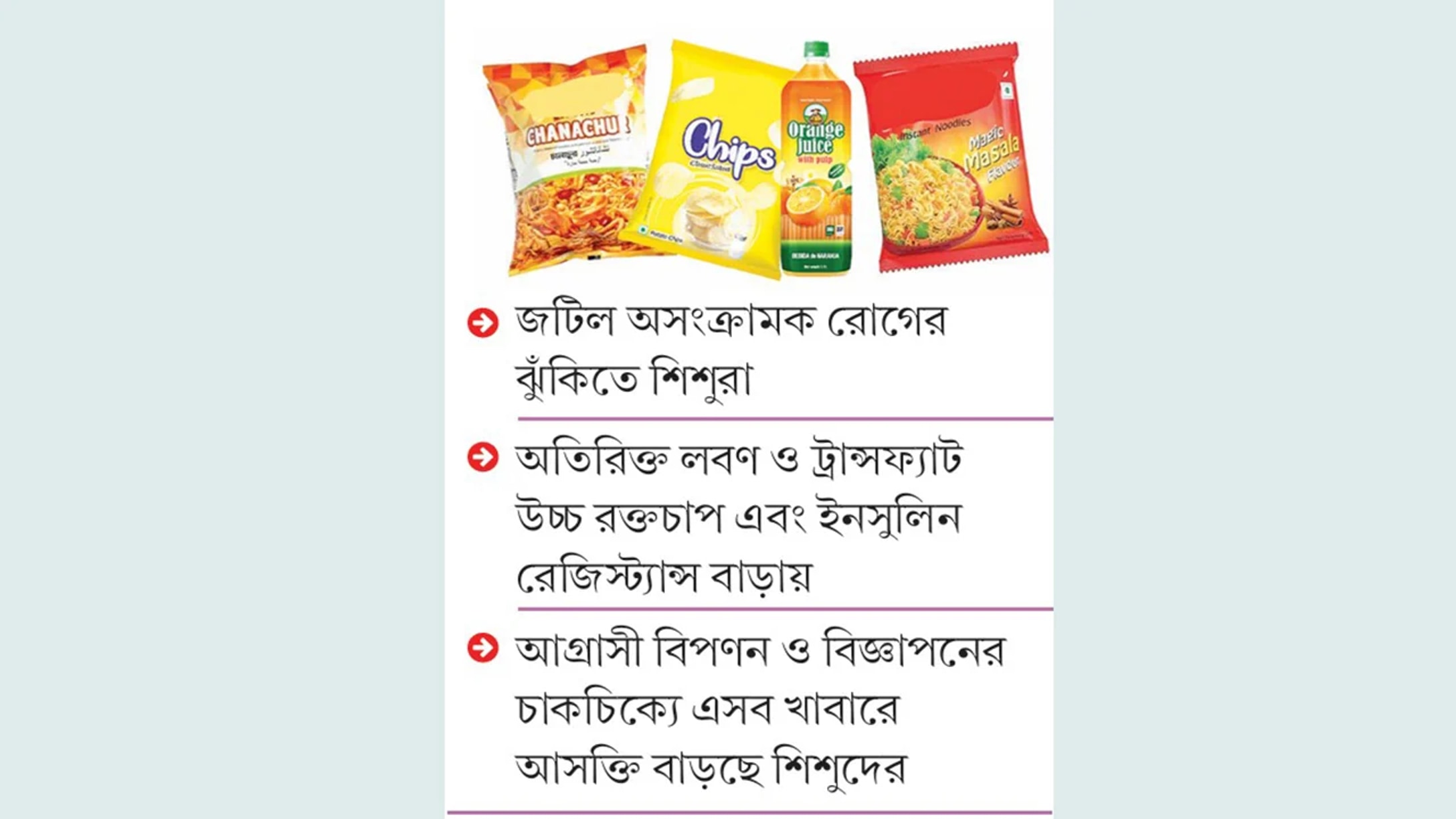
DHAKA — Nearly all packaged foods sold in Bangladesh carry high health risks, with 61 percent exceeding safe salt limits and child-targeted snacks containing 50 percent more sodium than recommended, a National Heart Foundation of Bangladesh study found.
Shop shelves are lined with biscuits, chips, chanachur, instant noodles and soft drinks — easy, affordable choices for busy households. But reliance on these foods is weakening immunity in children and teenagers and building long-term health risks, experts said.
Ultra-processed foods contain high levels of refined sugar and trans fats, which reduce the effectiveness of insulin — a condition known as insulin resistance. The result is not just a higher risk of diabetes but also weakened heart muscle.
Aggressive marketing and child addiction
The spread of ultra-processed foods in Bangladesh is driven largely by aggressive marketing by companies, particularly slick advertising and gift promotions targeted at children. Public-health experts said these foods are engineered with combinations of salt, sugar and flavor enhancers that deliver short-term pleasure to the brain. Once children develop a taste for them, they lose interest in nutritious home-cooked meals.
About two-thirds — 61 percent — of processed packaged foods on the market contain more salt than is considered safe, the study found. While a maximum of 750 milligrams of salt per 100 grams is regarded as safe, these products consistently exceed that limit. Items tested included biscuits, chips, chanachur, noodles, instant soups, jhalmuri, pickles and chutneys.
The artificial preservatives and chemicals in these foods multiply the risk of heart disease and cancer, the study said. Chips and artificial juices packed in tiffin boxes are pushing children toward obesity and Type 2 diabetes.
The findings come from a 2025 National Heart Foundation of Bangladesh study, “Assessment of Salt Content and Label Compliance of Commonly Consumed Processed Packaged Foods of Bangladesh.”
A recent National Heart Foundation of Bangladesh survey found that about 97 percent of packaged foods on the market pose high health risks. In many cases, the nutrition and salt information on the labels does not match what lab testing reveals. Even products marketed as “sugar free” or “low fat” have been found to contain chemicals harmful to the heart.
About 97 percent of Bangladeshis eat packaged food at least once a week, and many of these products contain high levels of salt that is not always clearly labeled, the survey found.
Packaged foods use heavy doses of sodium to enhance taste. A single packet of chips or noodles can contain more salt than a person needs in a day. Excess sodium directly raises blood pressure, forcing the heart to pump twice as hard and leading to heart failure over time, the study said.
Researchers analyzed 1,000 packaged products favored by children, including macaroni, packaged cheese, mini hot dogs, cakes, crackers and yogurt, without naming any brand. They found 10 types of children’s snacks contained more salt than needed: each packet should contain 210 milligrams of salt and sodium, but the tested packets contained 361 milligrams — 1.5 times the recommended level.
Bangladesh has no official cap on salt content in processed foods, allowing companies to add as much as they want, the study said. Under the Packaged Food Labeling Regulations 2017, however, the salt content must be declared on the label.
Ultra-processed foods sharply raise blood levels of high-sensitivity C-reactive protein, or hs-CRP, a leading marker for heart disease. Elevated hs-CRP means the heart and blood vessels are under serious stress, raising the risk of heart attack or stroke at any moment, the study said.
The emulsifiers, preservatives and artificial flavorings used to make these foods colorful, tasty and shelf-stable are foreign to the body’s cells. Once absorbed into the bloodstream, the immune system treats them as outside invaders, creating chronic inflammation in blood vessels that damages artery walls.
Dr. Sohel Reza Choudhury, professor and head of the epidemiology and research department at the National Heart Foundation, said Bangladesh is in the middle of a food crisis. The rising rate of premature heart attacks among young people stems mainly from ultra-processed foods and lack of exercise, he said. People are choosing packaged and street foods over home cooking, slowly hardening their arteries.
Abdul Kayum Sarker, former chairman of the Bangladesh Food Safety Authority, said many packaged products do not display accurate nutritional information and conceal salt content, raising blood pressure in unsuspecting consumers.
Choudhury said a simple but effective solution would be a clear front-of-pack warning label, known as FOPL, indicating whether a product contains excess sugar, salt or saturated fat. Current nutrition information is printed in small type with complex numbers on the back of packages, making it nearly impossible to read quickly. Consumers often buy unhealthy products thinking they are safe, he said. Bangladesh urgently needs FOPL.
Dr. Lelin Choudhury, a public-health specialist, said excess sodium, sugar, saturated fat and trans fats in ultra-processed foods are increasing the risk of diabetes, hypertension, heart disease and other non-communicable diseases. Parents must be careful when buying food for their children, he said, because correct sodium and sugar levels from an early age can protect them later in life.
Worldwide, about 11 million people die each year from unhealthy diets. In Bangladesh, the situation is alarming: about 13.9 million people have diabetes and 23.5 percent suffer from hypertension. About 71 percent of all deaths are caused by non-communicable diseases.
Mohammad Ruhul Quddus, Bangladesh country lead of the Global Health Advocacy Incubator, called the food-safety authority’s draft Safe Food (Packaged Food Labeling) Regulations 2026 a timely step. The draft proposes clear front-of-pack warnings for products containing excess sugar, salt or saturated fat. A simple front-of-pack alert could be the start of conscious decisions, he said.
At an April 15 workshop on hypertension control and the role of front-of-pack labeling, presenters said 97 percent of Bangladeshis regularly consume packaged foods without clearly understanding their nutritional content or health risks. Forty-four countries have already introduced FOPL as a cost-effective public-health measure recommended by the World Health Organization, and the system is mandatory in 10 of them. Consumption of unhealthy food has fallen in those countries, speakers said.
ABM Zubair, executive director of Progga (Knowledge for Progress), said non-communicable diseases including hypertension are rising sharply in Bangladesh, but funding remains inadequate. Sustainable financing for community clinics and upazila health complexes could ensure regular medicine supply and significant progress in controlling hypertension and other non-communicable diseases.
Saiful Islam, director (certification marks) of the Bangladesh Standards and Testing Institution, said: “People need about 5 grams of salt a day, but on average we are consuming more than 10 grams. Packaged chips and snacks are often found to contain more salt than the label declares, multiplying the risk of hypertension and heart disease.”
BSTI mainly acts as a certifying authority and verifies products against standards set by expert committees, he said. Given current conditions, the agency is urging big companies to switch from regular salt to low-sodium or potassium-enriched alternatives. “We are ready to provide technical support to companies. The Heart Foundation is also interested in working with us to promote such healthier products,” Islam said. He stressed that legislation alone is not enough; changing food habits is essential, and the media must play a stronger role in raising public awareness.
বাংলায় মূল প্রতিবেদন পড়ুন · Read the original Bengali report