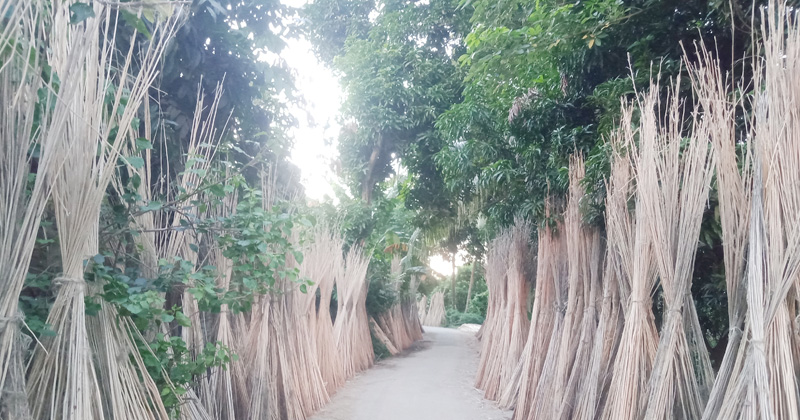
In Magura’s Shalikha, jute sticks are drawing more demand than jute itself, and farmers are seeing a ray of hope in the silvery sticks of the golden fibre. From time immemorial, jute sticks have been indispensable for cooking fuel, house fencing, betel-leaf frames, household items and various decorative jute products. Nowadays, besides making various kinds of particle board, jute sticks are being used in various mills and factories. As a result, their price is steadily rising. Once used only as fuel, jute sticks have now become several times more valuable because of their many uses.
On the ground in Gangarampur, Bunagati, Baraichara, Dhaneshwargati and other riverine areas, bamboo racks have been set up on both sides of the roads with countless jute sticks laid out to dry. Jute farmers are also busy tying the sticks into bundles to dry.
To collect cooking fuel, women from various areas come early in the morning to ask jute farmers for jute and help strip the fibre. In exchange, instead of taking money, they take jute sticks. In Baraichara village of Arpara union at the upazila headquarters, hundreds of women can be seen stripping fibre from jute along canals, marshes and riverbanks. At the end of the day they take jute sticks as wages, which they carry home by van.
Siuli Khatun, one such woman, said she had come to sort jute because of a fuel shortage at home, and was collecting jute sticks in exchange. Another woman, Panna Khatun, said jute sticks played an important role in many aspects of their daily lives, which was why she had come to collect them in exchange for stripping the fibre.
বাংলায় মূল প্রতিবেদন পড়ুন · Read the original Bengali report