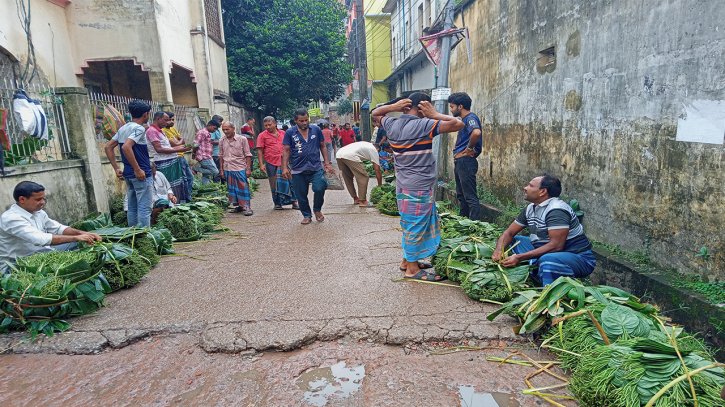
Betel leaf and areca nut worth crores of taka are bought and sold two days a week at the wholesale betel-leaf market in Barobazar in Jashore town. For the past thirty to forty years it has been a source of livelihood for thousands of people. It also plays an important role in the farm economy. This market is the centre for the sale of betel leaf and areca nut by growers of Jashore and various surrounding districts. Yet over all these years no government office responsible for it has built the necessary market infrastructure. As a result, this crore-taka wholesale market runs without a shed, safe water or toilets.
Betel growers say the biggest problem is that there is nothing here that could be called market infrastructure. With no shed, they have to sit on the road under the open sky, in sun and rain, to sell betel leaf and areca nut. There is no water supply either. Because of traffic congestion, vehicles carrying betel leaf and areca nut cannot enter the market properly. At this gathering place of thousands of buyers and sellers there is no toilet. Yet the toll money has to be counted out on every market day. One group collects more than half a lakh taka in “tolls” at every market.
A visit to the market and conversations with buyers and sellers showed that this wholesale market, one of the biggest in the south-west, sits two days a week — on Saturdays and Wednesdays. On those two days betel leaf and areca nut worth crores of taka are bought and sold. LC betel, sachi betel, sweet betel, pungent betel, Sylheti betel, Maheshkhali betel and Patuakhali betel are all sold here. Besides Jashore, hundreds of wholesale traders come here with betel leaf and areca nut from Jhenaidah, Narail, Magura, Khulna, Bagerhat, Patuakhali, Pirojpur, Faridpur and Gopalganj districts.
A large share of the sellers and producers come from Mahespur, Kotchandpur and Kaliganj upazilas of Jhenaidah. At every market, 450 to 500 betel growers bring betel produced directly from their fields. Alongside them, a large number of middlemen collect betel from growers and sell it. About 25 permanent areca-nut traders also run their businesses around this market.
Traders at the market say betel leaf and areca nut worth several crore taka are bought and sold at the two markets each week. In the peak season these sales almost double. That amounts to trade worth a hundred crore taka a year, which is a source of livelihood for thousands of farmers, labourers, transport workers and traders.
Pradip Kumar Ghosh of Dularmundia village in Kaliganj upazila, Jhenaidah, said: “I have been growing betel for 40 years. I come this far because you get a good price when you bring betel to the Jashore market. But the toll rate here is higher than at other markets. Both buyers and middlemen have to pay a toll of 15 taka per ‘dhop’, which creates extra pressure on marginal growers like us.”
A betel grower of Bodhkhana village in Jhikargacha, Delwar Hossain, said: “I have three bighas of betel garden. I sell betel at this market regularly. You get a good price here. But the big problem is this market’s weak infrastructure. There is no permanent place to sit. There is no shed or roof overhead. With no toilet, growers coming from far away face all kinds of hardship.” A wholesale trader from Patuakhali, Habibur Rahman, said he has been in the betel business for about 30 years. Good-quality betel is available at comparatively low prices at this Jashore market, he said.
Bipul Roy has been trading areca nut at the market for 40 years. He said: “I sell one and a half to two lakh taka worth of areca nut at every market. This market is the main source of my family’s income. All the costs, including my children’s education, depend on this business. With no roof overhead, hardship begins as soon as it rains. On hot days we have to burn in the sun. Without a permanent shed it becomes hard to run a business.”
Growers and traders demand that modern market infrastructure and market management be built quickly. That would both relieve the farmers’ hardship and allow the government to earn revenue.
The central organising secretary of the National Farmers and Farm Labourers’ Association, Taslim Ur Rahman, said it is not only growers who are involved in betel cultivation but also farm labourers, transport workers, jute growers and people in various supporting occupations. Greater government initiative is therefore needed to keep the betel sector alive.
On this, a member of the Jatiya Nagorik Party’s district coordination committee and district organiser of Jatiya Krishak Shakti, Salman Hasan Rajib, said farmers and traders have built up the market for a cash crop like betel and areca nut on their own initiative. Yet it was the agriculture department’s responsibility to build such a market. He said responsibility for developing the market structure falls on the Department of Agricultural Marketing. Since the market is under the control of Jashore municipality, they could have done it in coordination with that local government body. But as far as he knows, no agriculture-related office has any connection with this market at all.
The administrative officer of Jashore municipality, Uttam Kundu, said it has not yet been possible to lease out the market since 5 August 2024. If anyone has been collecting money illegally in the municipality’s name and evidence of it is found, legal action will be taken, he said. He also said the matter of building a permanent market shelter and infrastructure to make the market modern and well organised would be reported to higher authorities.
A senior agriculture officer of the Department of Agricultural Marketing, Kishore Kumar Saha, said more than a crore taka is bought and sold at this Jashore market every week. Although responsibility for market management lies with the local government body, the Department of Agricultural Marketing does the work of ensuring fair prices for farmers, market analysis, training and marketing support.
The Jashore Sadar upazila agriculture officer, Razia Sultana, said a role will be played in ensuring that farmers benefit from this market. The matter has been reported to higher authorities.
According to the agriculture department’s latest 2026 statistics, betel is being grown commercially on about 1,043 to 1,152 hectares of land in Jashore district. The Department of Agricultural Extension’s report for the 2025-26 financial year shows that Jashore retains the country’s top position in betel production. About 9,669.51 metric tonnes of betel are currently produced in the district each year. Alongside meeting domestic demand, this production makes an important contribution to the national economy.
বাংলায় মূল প্রতিবেদন পড়ুন · Read the original Bengali report