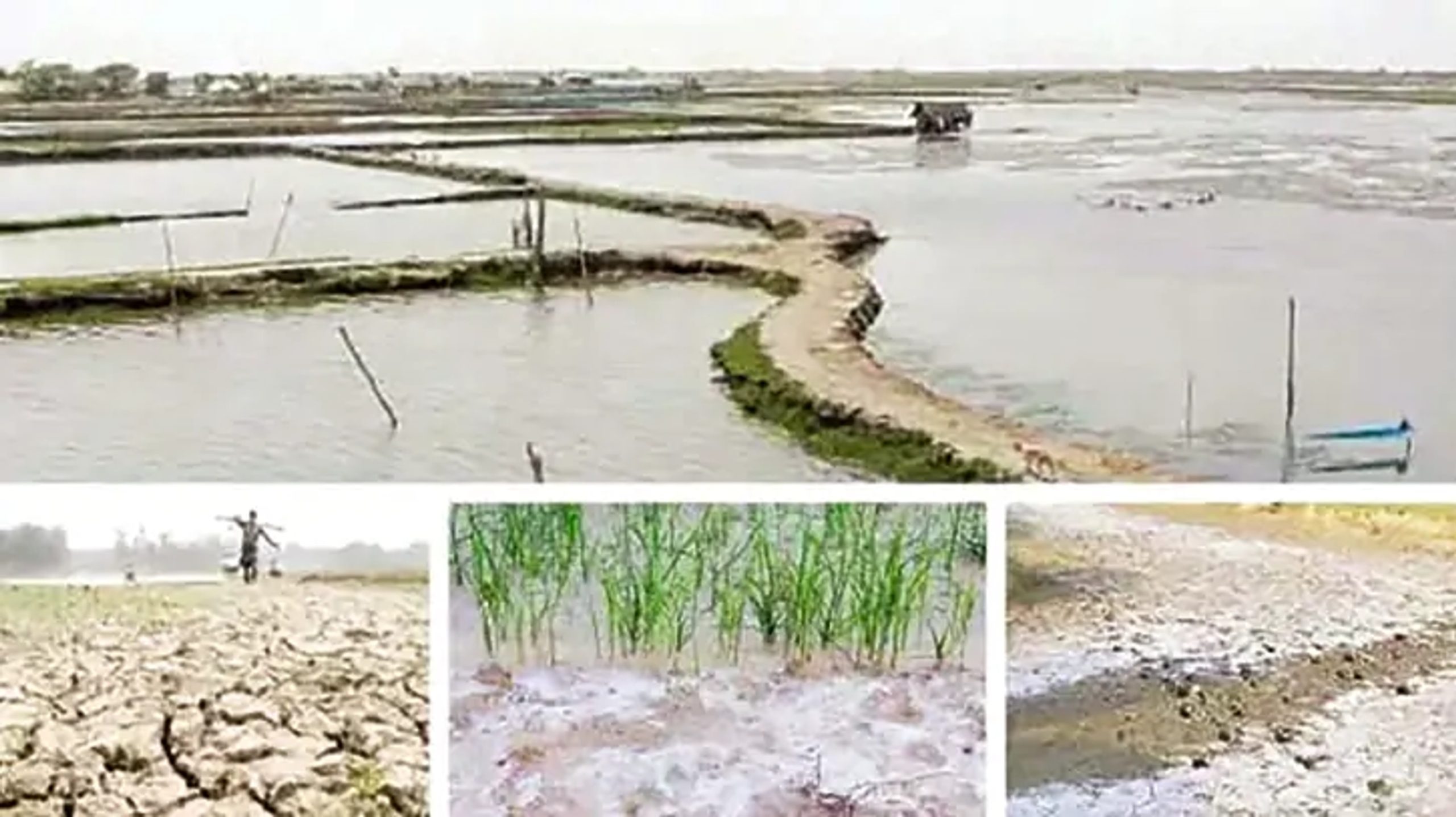
Over the past four decades, the unplanned entry of saltwater and the spread of shrimp farming have changed the familiar face of the coast in Koyra and Paikgacha. The farmers’ golden dream now lies largely under the water of the enclosures, and the coastal farm economy has fallen into crisis as green nature disappears.
Speaking to locals, it emerged that in the mid-1980s a class of influential fish farmers began cultivating brackish-water black tiger shrimp in the area. Through arrangements with large landowners and various inducements, small and marginal farmers’ land began to be leased. Later, saltwater was let in from the rivers onto cropland inside the polders, and shrimp enclosures spread. As a result, much farmland gradually became unfit for paddy cultivation, local farmers allege.
Affected farmers allege that in many areas influential enclosure owners have taken control of the government sluice gates used to regulate water inside the polders. To ease the entry of water, pipes have been installed in places by damaging the embankments of the Water Development Board (WDB). This damages government infrastructure on one hand, and on the other weakens the embankments, creating a major risk during cyclones and tidal surges, locals fear. They allege that although these problems have persisted for a long time, no effective action is being taken against the influential enclosure owners.
Farmers allege that, although landowners are supposed to be paid lease money at a fixed annual rate, in many cases this is not honoured, and landowners are often paid only nominal sums. It is alleged that if anyone disputes land or objects to saltwater entering an enclosure, they are even denied the lease money. Disputes, attacks, clashes and litigation over enclosure control and letting in water are also occurring in various areas, disrupting the social stability of the coastal region.
Four decades of shrimp farming have brought major changes to the coastal agricultural system. According to locals, for want of a specific, environmentally sound policy, many farmers can no longer grow paddy on their ancestral land as before. Years under saltwater have reduced the natural fertility of much of the soil, salinity is damaging vegetation and biodiversity, and many native freshwater fish species are disappearing. According to residents and those linked to agriculture, although shrimp exports contribute to the national economy, the benefits are concentrated in a few hands, while many people lose farmland, jobs and food security. They say strict control of saltwater management is needed to protect the farmland of Koyra and Paikgacha, along with a planned zoning system to determine where shrimp farming and where farming will take place. Local residents want the government to act quickly to restore the coast’s balance through modern, environmentally friendly shrimp farming, the conservation of freshwater reservoirs, and agricultural rehabilitation.
বাংলায় মূল প্রতিবেদন পড়ুন · Read the original Bengali report