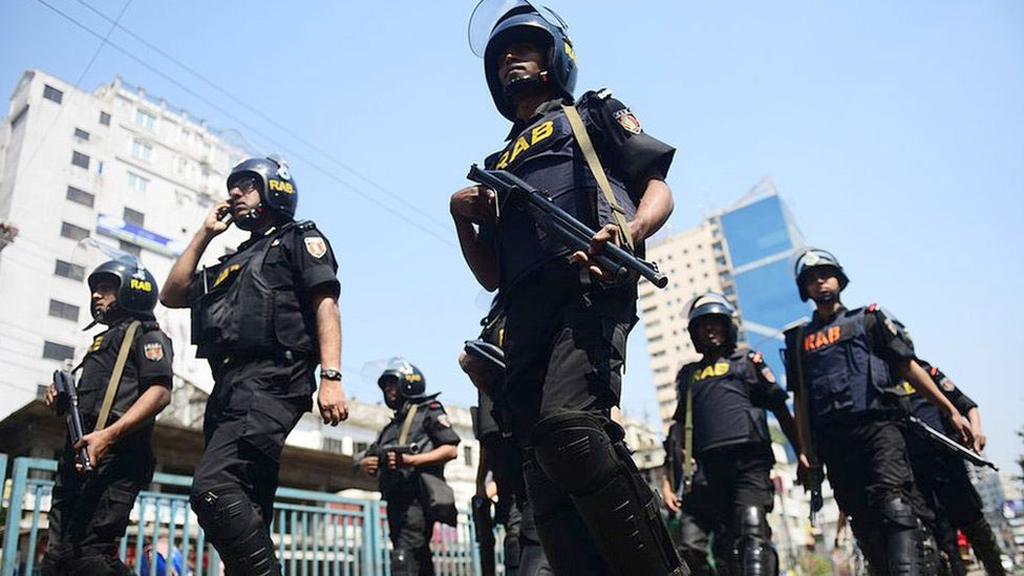
The government has moved to abolish the much-discussed and much-criticised elite force Rapid Action Battalion (RAB), in existence for more than two decades, and form a new Special Response Battalion (SRB) in its place. While making no major change to the force’s core duties, the new law adds several provisions to ensure accountability. The most important is that ordinary citizens will be able to complain against any SRB member over misconduct, abuse of power or harassment, and a complaint-redress committee will be formed to investigate and settle such complaints.
To this end, the draft “Special Response Battalion (SRB) Act, 2026” has been published on the home ministry’s website for public opinion. The draft proposes forming the SRB as a specialised unit under Bangladesh Police, and includes provisions on the force’s duties, operational powers, case investigation, members’ discipline and the settlement of citizens’ complaints.
Asked about it, home ministry senior secretary Manzur Morshed Chowdhury said the opinions received on the published draft would be reviewed. After necessary additions and deletions, the draft would be finalised and further administrative steps begun.
RAB has long faced allegations of extrajudicial killings, “crossfire” deaths, enforced disappearances, custodial torture and abuse of power. In December 2021, the United States imposed sanctions on RAB and several of its officers over allegations of serious human-rights violations. Later, the commission investigating enforced disappearances and various rights groups also recommended abolishing the force.
According to home ministry sources, once the draft law is finalised, it will be placed before the cabinet after taking the opinions of various ministries and divisions. After cabinet approval, it will be introduced as a bill in parliament. When the law takes effect, RAB’s existing legal basis will be abolished, though RAB’s existing provisions will remain in force where needed until new rules are framed.
Under the draft, the SRB will be a specialised unit under Bangladesh Police, headed by a director-general of additional inspector-general of police (additional IGP) rank. Battalions, companies, platoons and sections can be formed as needed. Its headquarters will be in Dhaka, but units can be set up anywhere in the country. The force can be formed by bringing in members on deputation from police and other law-enforcement agencies, with a proposed minimum deputation term of two years.
A review of the draft shows that, despite the name change, there is no major change in the scope of duties. The SRB’s duties include protecting internal security, gathering intelligence, recovering illegal arms and explosives, curbing drugs, terrorism, human trafficking, organised and cyber crime, and assisting other law-enforcement agencies. The force will also have the power to file and investigate cases on the direction of a court, the government or the inspector-general of police.
One of the draft law’s key additions is the complaint-redress committee, to be chaired by an SRB additional director-general. Its members will include a home ministry representative, an officer of police headquarters and the director (legal and media), and a government-nominated person with at least 10 years’ experience in human rights, law or justice administration.
This committee will be able to investigate citizens’ complaints, forming a separate inquiry team if needed. If a complaint is found to have initial merit, the committee will recommend that the relevant authority take necessary action. It can also review complaints against force members over abuse of power, harassment, irregularities, unlawful influence, and promotion or posting.
The draft law also sets out detailed disciplinary rules for members. It provides for departmental and legal action if a member is intoxicated on duty, disobeys a superior’s orders, neglects duty, unlawfully collects money, misuses government arms or equipment, helps a criminal escape, or is involved in gambling and other illegal activity. If a member absconds, the officer-in-charge (OC) of the police station will, on the application of the relevant battalion commander, arrest him and hand him over to the SRB.
বাংলায় মূল প্রতিবেদন পড়ুন · Read the original Bengali report