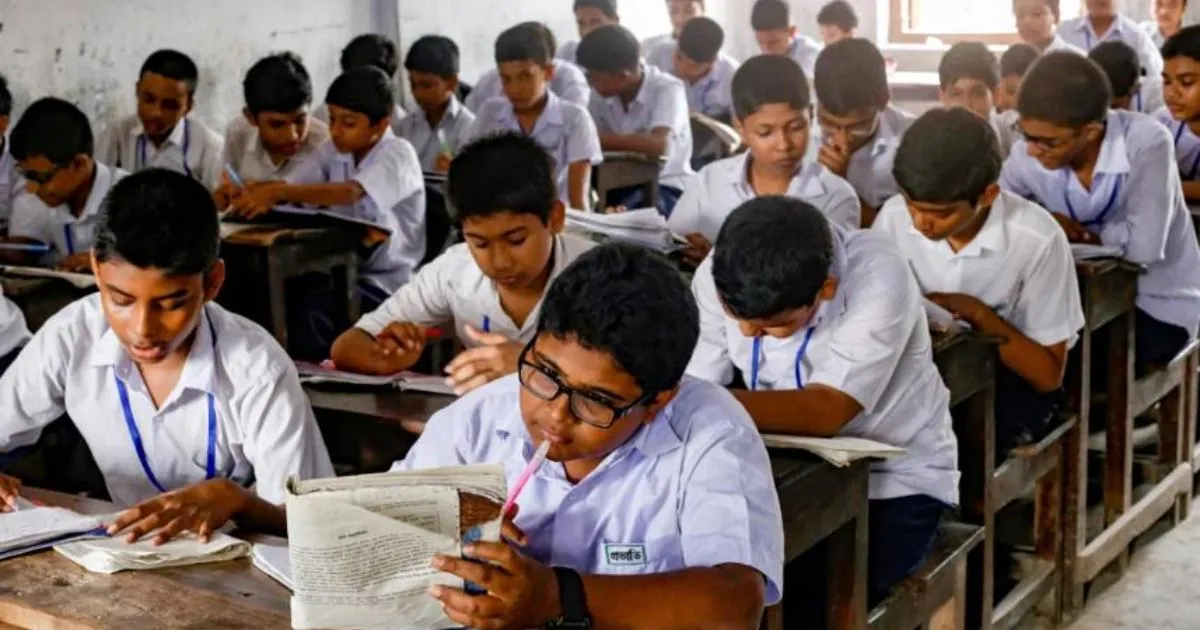
Following its primary-level initiative, the government has undertaken a major program to curb dropout rates among secondary school students. A “mid-day meal” program along with free distribution of school uniforms, shoes and socks is set to launch for secondary students. The Directorate of Secondary and Higher Education (DSHE) has taken up this large-scale scheme, titled “Combined Students Facilities Program in Secondary Education,” at a cost of Tk 3,502 crore.
The program will launch in its first phase this fiscal year at 1,000 underserved secondary schools nationwide, initially benefiting around 200,000 students.
Education experts have viewed the initiative very positively, though they note that the primary-level mid-day meal program has drawn some controversy over complaints of low-quality food, and that monitoring food quality has placed additional mental and workload pressure on many teachers. They stress the need for well-planned management, strict quality control and an effective oversight system from the outset to ensure the secondary-level program launches successfully.
According to DSHE sources, a 180-day special action plan has been adopted to prioritize implementation of pre-election pledges, and this new scheme falls under the Secondary Education Development Program (SEDP). The scheme has already been approved at an inter-ministerial review meeting, and drafting of its documentation is in the final stages, with final approval expected soon.
Officials say the scheme’s main objective is to create a favorable environment that increases enrollment and retention in secondary education, alongside the integrated development of students’ knowledge, skills, ethical values, technological capability and leadership qualities — building them into skilled, responsible citizens, and creating a healthy learning environment in schools.
Officials added that, alongside uniforms and mid-day meals, common rooms are being built because many students in the country’s schools travel long distances to attend — sometimes arriving soaked from rain or exhausted after walking far. The common rooms will allow them to rest upon arrival. The government also wants to reduce reliance on devices by expanding healthy cultural activities, placing greater emphasis on sports and culture — separate textbooks on sports and culture will be introduced for certain classes at the primary and secondary levels from the coming academic year.
According to sources, the project, funded entirely by the government, is set to run for five years, from this July through June 30, 2031. Under the project, lunch will be provided at 1,000 educational institutions in underserved, marginalized and remote areas. The daily cost per student for meals will be Tk 120, bringing the total cost to Tk 2,872.63 crore. Each student at these schools will also receive two sets of school uniforms annually worth Tk 4,000, along with a pair of shoes and socks worth Tk 1,500. Over five years, this will cost Tk 416.32 crore for uniforms and Tk 156.12 crore for shoes and socks. The remaining funds will go toward common rooms, health supplies, sports and culture, and related areas. Officials noted that these allocations are estimates and may increase or decrease.
DSHE Planning and Development Wing Director Professor Dr. Mir Jahida Naznin said a draft of the scheme has already been prepared, and another workshop will be held soon to finalize it, after which formal implementation will begin at the field level once the necessary approvals are secured.
DSHE Director General Professor Dr. Khan Moinuddin Al Mahmud Sohel said the main goal is to ensure “learning with happiness” — providing students with school uniforms, nutritious and quality midday meals, separate rooms for rest, and necessary health supplies so they come to school willingly and with a smile. He added that this is part of the 180-day special action plan adopted to implement the prime minister’s election manifesto, and expressed hope that the scheme would receive approval soon if all goes as planned.
বাংলায় মূল প্রতিবেদন পড়ুন · Read the original Bengali report