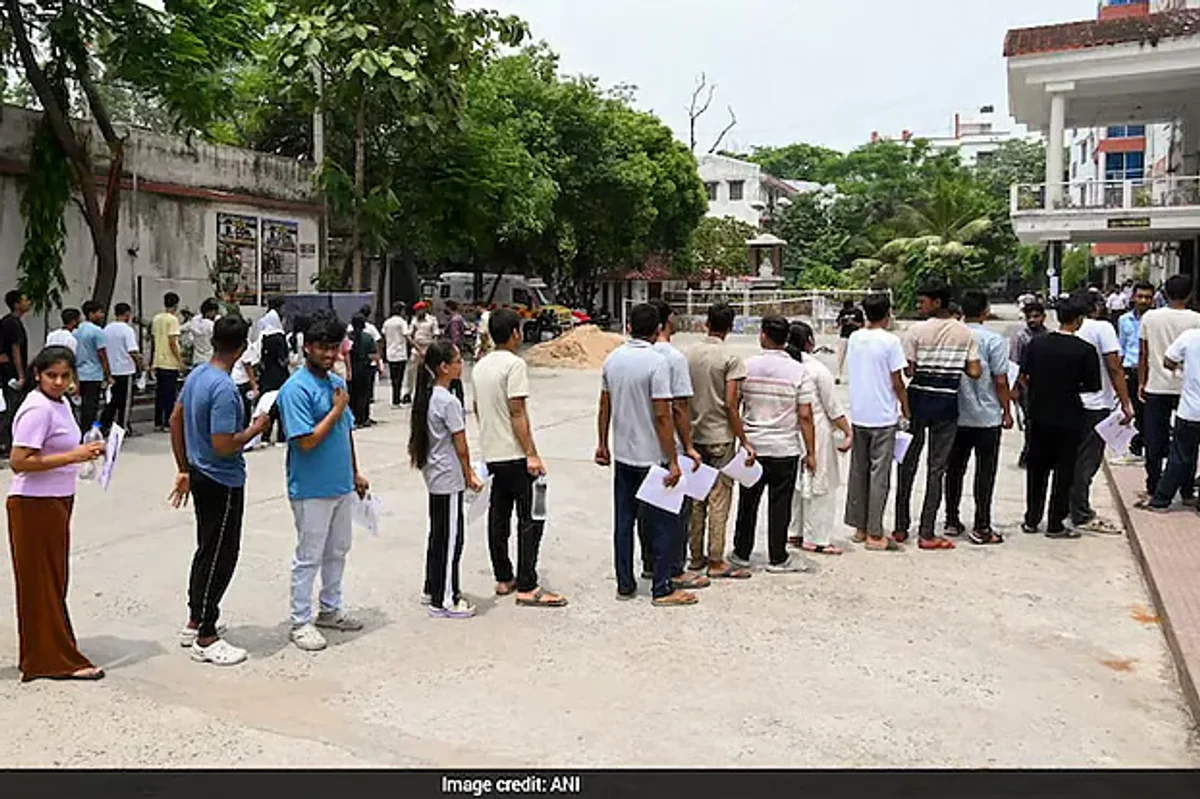
In India, a “knowledge park” refers to a planned zone where educational institutions, research centers, information-technology companies and startups are built together. Several knowledge parks have emerged to advance the knowledge-based economy and technological innovation. These zones are generally known for housing numerous universities, engineering and management colleges, and other educational institutions.
North India’s “Knowledge Park III,” in the Greater Noida area, is part of one such large education hub. It was built on a promise: that a college degree would carry young Indians into middle-class life. But for many of the roughly 100,000 students who come to study at the private colleges and universities built in this area, two hours from the center of the capital, New Delhi, the experience has been different. Instead of a degree, many of them end up with debt and a heap of disappointment.
Over the past decade, countless educational institutions have sprung up across five knowledge parks in this area. Families are exhausting their savings to educate their children at these institutions. But each year, the number of graduates far outpaces the number of well-paying jobs being created.
Harshit Rai, 18, from the north Indian city of Varanasi, is studying subjects including artificial intelligence and machine learning that could help him land a job. Completing his degree at Noida Institute of Engineering and Technology will cost roughly $15,000, of which $7,000 is a bank loan. His goal is to earn 80,000 rupees a month, or roughly $10,000 a year. But he says he would accept a job paying even half that. In that case, it would take him five to six years just to earn back what he spent on his education. One year after graduating, interest of 10 percent a year will start accruing on his loan. Harshit said: “I feel some pressure. How will I repay the loan on time?”
This anxiety is growing steadily among young people in India. Last month, facing massive student protests — called by the Cockroach Janata Party (CJP) — Prime Minister Narendra Modi’s government was rarely forced to back down. Open protests have since eased, but the frustration that sparked the movement remains.
The movement began around allegations of leaked exam papers and cheating in examinations. It later grew into anger over the various obstacles young people face on the path to a better life. The protests began at the call of the “Cockroach Janata Party.” India’s Chief Justice had made a remark in May comparing the country’s unemployed youth to “cockroaches.” The party took its name from that very remark. Private universities are also a major source of young people’s discontent.
India has roughly 1 billion working-age people, the highest number in the world. That number is growing by roughly 2 million a year.
For families with some financial means, education is one of the few paths out of a life of low-wage farm work and manual labor. The best opportunity is admission to one of the country’s highly competitive public universities. For those who don’t get in, the alternative is a private institution. This private education business has grown enormously in India. In the decade since Narendra Modi became prime minister in 2014, the number of private colleges has tripled.
According to government data, the number of students in higher education in India stood at 45 million in 2024, 41 percent higher than a decade earlier. More than two-thirds of students in higher education attend private institutions. Good jobs have not been created at anywhere near the pace at which higher education has expanded.
According to a study published by Azim Premji University, roughly 40 percent of college graduates under 25 are unemployed.
Only about 250,000 new jobs paying more than $500 a month are created in India each year. Among the country’s higher earners, that salary is considered a benchmark for a comfortable life. Graduates from prestigious public universities have a significant edge in competing for these jobs.
Akshay Saxena, an entrepreneur and founder of an education fellowship program, said: “Young people have been sold a lie — that getting a degree means getting a job.”
India has roughly 550 public universities. But only about a tenth of them are considered elite or top-tier institutions.
Fewer than 5 percent of applicants to top institutions get admitted. Average annual tuition there is under $250. A degree from one of these institutions can propel a student toward some of the country’s most attractive jobs. For everyone else, the odds are far riskier.
By Akshay Saxena’s estimate, roughly 400,000 students spend more than $20,000 a year to attend private engineering colleges. They hope that, after finishing their degree, they will earn a substantial salary. But the median annual salary for graduates of these institutions is roughly $3,000. He said: “The average graduate’s employability is only around 20 percent.”
This mismatch has created what Akshay Saxena calls a “severe national mental health crisis.”
Engineering degrees were once considered a reliable path into India’s technology sector, fueling intense competition to obtain them. Companies like Infosys and Tata Consultancy Services built massive businesses providing IT services to multinational corporations. But because of artificial intelligence, the future of these jobs now looks more uncertain than before.
Sridhar Vembu, co-founder of Indian cloud-software company Zoho, wrote on social media: “Taking on large amounts of debt to get a degree in India is not wise. I firmly believe young people should not be trapped in debt in the name of education.”
Amity University’s main campus is in Noida, on the outskirts of New Delhi. For many students unable to secure a spot at a lower-cost institution, Amity University becomes the alternative. Atul Anand had earned admission to a top public institution in his home state of Bihar. But a car accident two years ago prevented him from enrolling there. He later took out a loan and enrolled at Amity University instead. Between his degree and living costs, he will need roughly $15,000 (1 dollar equals 95.70 Indian rupees). The state government gave him a $4,000 loan to cover these costs. To raise the rest, his family has nearly exhausted its savings.
Atul’s father teaches math and Hindi at a village school. To cover his own daily expenses, Atul does freelance graphic design work at night. If he’s lucky, he hopes to land a tech-sector job paying $10,000 a year. He said: “My dream isn’t very big. I just want to reduce the burden of debt and expenses on my family.”
Amid all this, Atul took part in the final day of last month’s CJP protests at Delhi’s Jantar Mantar. He says he attended not as a protester, but to show solidarity with the students who had gathered there to voice their various grievances. He said: “I didn’t go there for any political reason.” His friend, M J Biswas, was skeptical of the protesters’ stated demands. Their core demand centered on major changes to India’s examination system. In Biswas’s view, there was a deeper cause behind the movement. Addressing the protesters, he said: “The anger is really a mask hiding your fear. You’re all deeply afraid about the future.”
Akshay Saxena knows the privileged side of India’s education system well. He studied at the Indian Institute of Technology Bombay, one of the country’s elite institutions. He later joined Boston Consulting Group and helped build new tech companies in Silicon Valley in the United States. Now, through Avanti Fellows, he helps talented, low-income students prepare for admission exams at elite institutions. Through this program, students receive free exam preparation and intensive training.
But the number of students trying to get into top institutions far exceeds the number of available seats. Likewise, the number of graduates far exceeds the number of good jobs. As a result, a vast private-education sector is selling families the promise of social and economic mobility — a promise that is growing dimmer by the day. Akshay Saxena said: “In reality, almost no one will get a job. People’s desperation is being turned into a way to make money.”
বাংলায় মূল প্রতিবেদন পড়ুন · Read the original Bengali report