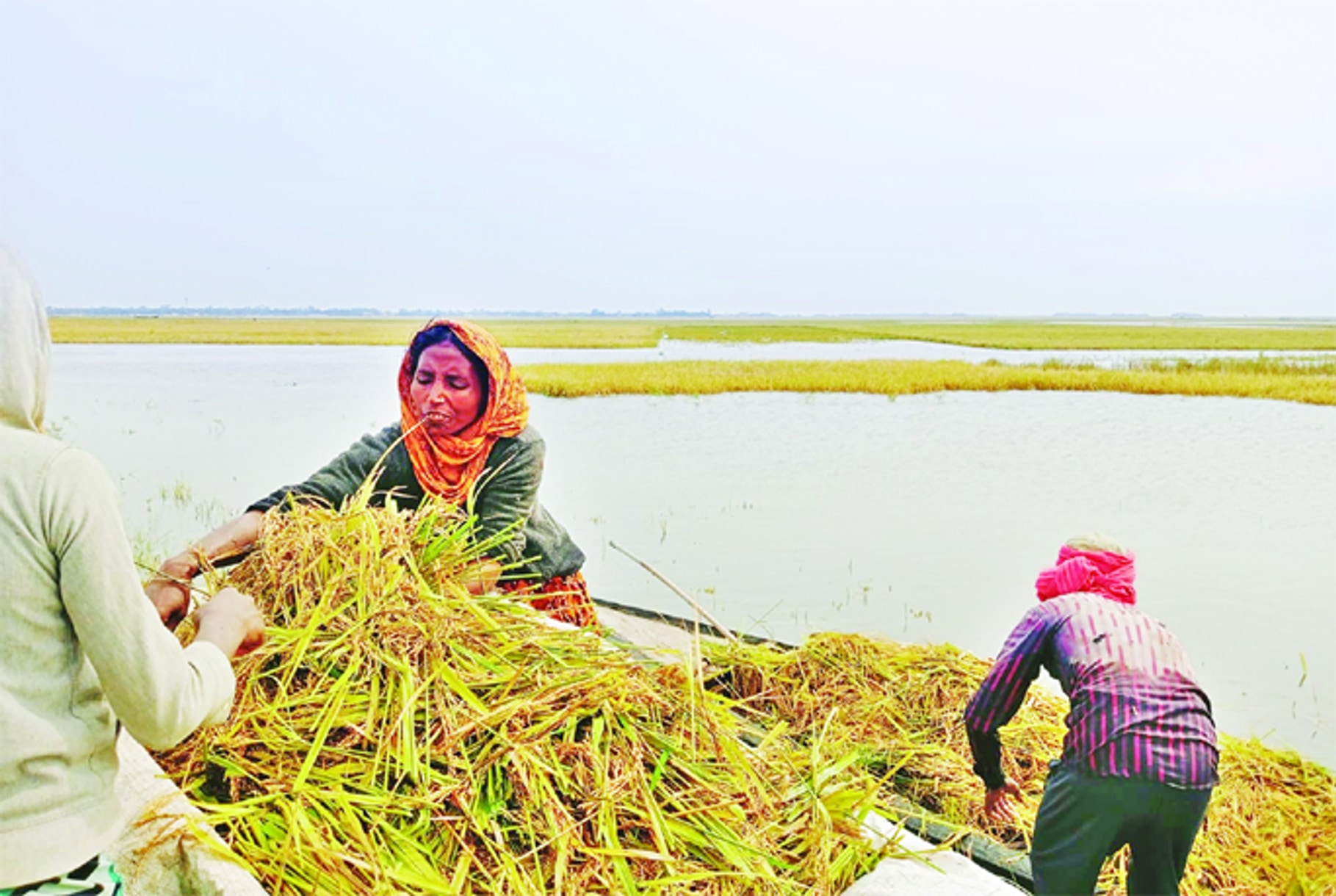
DHAKA — It is the summer rice harvest season. Heavy rains and floodwaters from India have put vast areas at risk of flooding.
Despite incessant rain, strong winds and thunderstorms, farmers are rushing to the fields to save their crops. They are harvesting partially submerged crops while wading through knee-deep water.
Mohammad Al Amin, a farmer in Sunamganj, described the struggle to save the crop: “We are trying to save whatever is still standing.”
Rice is the main crop in the South Asian country of Bangladesh. Boro rice has begun to ripen in the haor basin. The flooding may affect rural life and the national food supply in the haor and other areas.
Days of continuous rainfall combined with water flowing from India’s Meghalaya and Assam regions have increased the risk of sudden flooding in vulnerable districts of Bangladesh, authorities said.
Local officials said crop fields in many parts of Sunamganj, Sylhet, Kishoreganj, Habiganj and Moulvibazar are submerged. In several places, embankments have weakened in the current or overtopped, allowing floodwaters into cropland. The heavy rains have damaged various crops, including vegetables, raising fears of a shortfall in food supply.
The Meteorological Department forecast more rain in the coming days. Officials warned that excess upstream water could heighten the risk of more widespread flooding across the haor basin. Agricultural officials said even brief submergence at this stage can significantly reduce rice yields.
Heavy rainfall has caused widespread waterlogging and disruption in major cities, including the capital Dhaka and the port city of Chattogram. Submerged roads have slowed traffic and disrupted daily life.
Bangladesh, one of the world’s most climate-vulnerable countries, faces flooding almost every year. According to a 2015 World Bank Institute analysis, about 3.5 million people in the country are at risk of river flooding each year.
The country is the world’s third-largest rice producer, with most of its output meeting domestic demand. Bangladesh also imports rice when shortfalls arise due to flood or drought.
বাংলায় মূল প্রতিবেদন পড়ুন · Read the original Bengali report