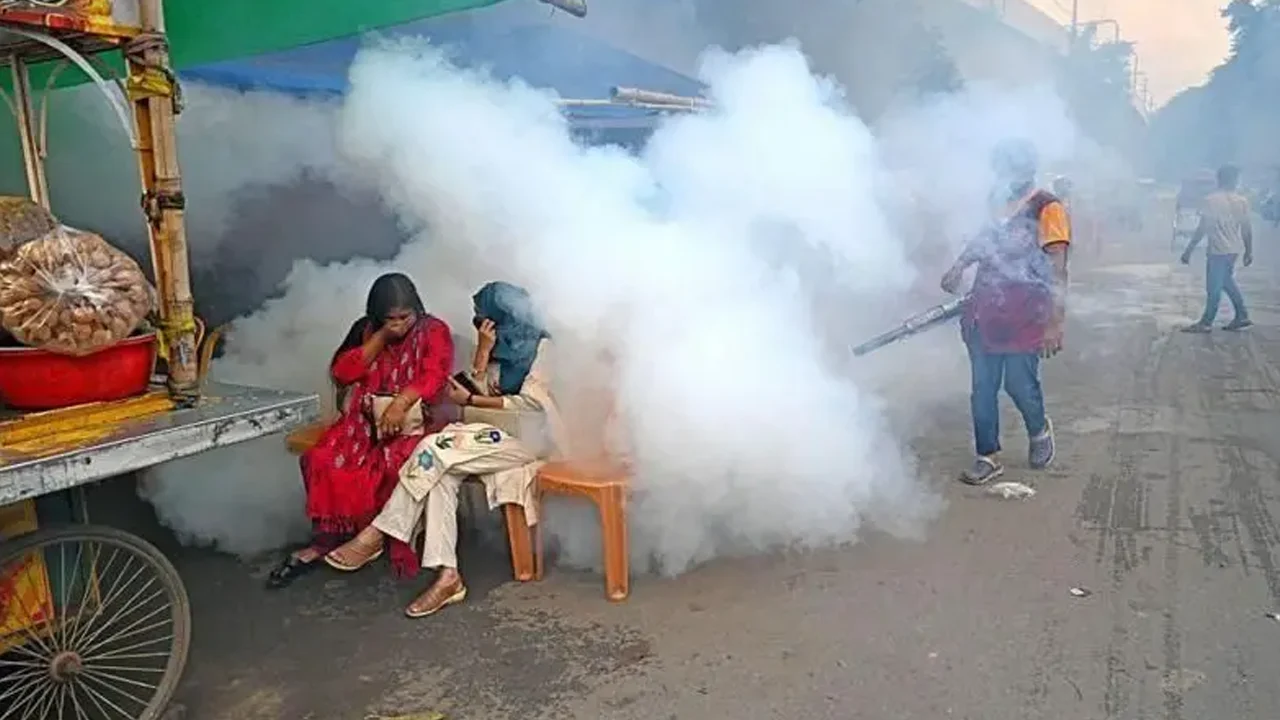
Dengue infections in Bangladesh have been rising since July. But in just the first 19 days of August, more patients have been hospitalized than in all of July combined. According to the Directorate General of Health Services (DGHS), roughly 11,000 dengue patients had been hospitalized as of August 19 this month. In July, that figure was just over 9,200.
A total of 76 people have died of dengue since January this year. More than 26,500 people have been hospitalized after contracting the disease.
As in previous years, dengue this year is not confined to the capital, Dhaka. A significant number of people are also being infected in various districts outside Dhaka. This has raised concern over which areas are seeing dengue spread fastest, and where the situation could worsen next.
The monsoon season creates favorable conditions for Aedes mosquito breeding. After rainfall, Aedes mosquitoes breed in water that collects in various places. This has also raised the question of whether the number of dengue patients will continue to rise in the coming days.
The five districts outside Dhaka with the highest infection rates
An analysis of DGHS data shows that more than 7,000 people have been hospitalized with dengue in the capital, Dhaka, from January through now this year. Thirty-four people have died in Dhaka during this period. By both infection and death counts, Dhaka has the highest rate of transmission.
Outside Dhaka, the highest number of dengue patients has been found in Khulna district, where more than 1,600 people have been infected. Khulna also leads outside Dhaka in deaths, with 14 people having died of dengue there.
Chattogram district ranks next, with 1,391 people hospitalized with dengue there. Three people have died.
Pirojpur, in Barishal division, ranks third by infection count. More than 1,200 people have been infected with dengue in this district so far this year. One person has died.
Mymensingh district ranks fourth, with 924 people hospitalized after contracting dengue. Six people have died.
Among districts in Dhaka division, Gazipur has 720 infections. However, no one has died of dengue there. Within this division, only Manikganj has recorded a single dengue death.
Why these five districts are at higher risk
Dengue patient numbers were once concentrated mainly in Dhaka and its surrounding areas. This year, several districts outside Dhaka have seen higher infection numbers than in the past.
Public health and epidemiology expert Dr. Mushtaq Hossain, citing data from the DGHS and the World Health Organization, said a greater presence of Aedes mosquito larvae has been found in coastal areas this year, particularly in Barguna, Jhalokathi and Pirojpur.
He attributed this partly to coastal salinity and the need to store rainwater in earthen containers year-round.
Dr. Mushtaq said Aedes mosquitoes can lay eggs, and larvae can form, in any container or location where water has stood for more than 48 hours. Using chlorine tablets in stored water can destroy mosquito larvae. While awareness campaigns on this have been run in some areas, they have not been conducted uniformly across all saline-affected areas.
Dr. Mushtaq sees dense population and an unclean environment as key factors behind Gazipur’s dengue prevalence.
In his view, the large low-income population living there makes it difficult for individuals to keep the local environment clean on their own. Authorities need to take the initiative to improve environmental conditions.
In Mymensingh’s case too, he said, an unclean environment and standing water could be playing a role, though the matter warrants further investigation.
Among Bangladesh’s eight divisions, Chattogram has the most hilly terrain. This year, Chattogram district ranks second by dengue infection count.
According to experts, rainwater collects in Chattogram’s hilly, tree-covered areas. However, this factor alone does not explain the spread of dengue.
Dr. Mushtaq said Chattogram and Dhaka face similar levels of risk. Sparsely populated hilly areas pose less of a problem. But densely populated hilly areas see a higher dengue risk.
Entomologist Monjur Ahmed Chowdhury, a former chairman of the National River Commission, believes that alongside coastal areas, dengue transmission could also be higher in areas with elevated arsenic levels in water.
He said that in arsenic-affected areas, people often collect water from safe tube wells and store it in various containers. When water is stored this way for extended periods, these containers can become breeding grounds for Aedes mosquitoes.
Other factors behind the rise in dengue
There are roughly 3,500 mosquito species worldwide. Among the harmful mosquito species commonly found in Bangladesh are Anopheles, Aedes and Culex.
Malaria is transmitted through the bite of female Anopheles mosquitoes. Aedes mosquitoes spread dengue and chikungunya. Culex mosquito bites can cause filariasis, or elephantiasis.
The dengue virus is carried by the Aedes aegypti and Aedes albopictus mosquito species.
Entomologist Monjur Ahmed Chowdhury said Aedes aegypti is mainly found in urban areas, while Aedes albopictus is more commonly found in tree-covered rural areas.
Aedes aegypti breeds in water that collects in artificial containers such as pots, plastic bottles, cans and yogurt containers. For this reason, this mosquito is known as a “container-breeding mosquito.”
Aedes albopictus, on the other hand, breeds in naturally occurring pools of standing water, such as tree hollows or the base of taro leaves.
According to Monjur Ahmed Chowdhury, Aedes aegypti is a comparatively more effective vector for spreading dengue. However, in some areas, Aedes albopictus can serve as the primary vector.
There are also areas where dengue patients are found even though Aedes aegypti is absent. For this reason, dengue can no longer be viewed solely as an urban disease.
According to entomologists, while Aedes mosquito outbreaks were once seen mainly in urban areas, the effects of urbanization have now spread this mosquito to rural areas as well. Conditions favorable for Aedes mosquito breeding have increased in rural areas too.
Monjur Ahmed Chowdhury said that two or three decades ago, in Dhaka neighborhoods that regularly faced water shortages, people would store water in drums and various containers. Citing examples from parts of Old Dhaka and Elephant Road, he said water shortages led people in these areas to store water in drums, which created opportunities for mosquito breeding.
The situation has changed further since then. As people’s per capita income and consumption have risen, the use of various containers has also increased. There are now far more pots and containers than before. Rooftop gardens have also increased. In rural areas too, many people now drink water from plastic bottles. Single-use plastic in particular has narrowed the gap between urban and rural areas.
As a result, new breeding grounds for Aedes mosquitoes are emerging in both urban and rural areas.
Experts also point to weather patterns and shortfalls in mosquito-control programs as factors behind the spread of Aedes mosquitoes nationwide.
Dr. Kabirul Bashar, a teacher in the Department of Zoology at Jahangirnagar University and an entomologist, said high temperatures and frequent rainfall are causing water to collect in various locations, creating conditions favorable for Aedes mosquito breeding.
In his view, local government structures across the country collapsed after the July mass uprising. For nearly two years now, city corporations and upazilas have had no elected representatives. As a result, mosquito-control work has not been carried out properly, allowing mosquito populations to grow.
When did dengue first take hold in Bangladesh
It is difficult to say precisely when Aedes mosquitoes first appeared in Bangladesh.
The dengue virus was detected in some patients in 1998. The following year, from October through December, dengue pathogens were found in many patients in the capital.
Around 2000, dengue outbreaks grew further. From that point on, research and awareness campaigns on Aedes mosquito control methods and the dengue situation gradually began.
Professor Mushtaq Hossain said that while Aedes mosquitoes existed in the past, opportunities to diagnose dengue were limited. As a result, there was little scope at the time for research or concern over the mosquito’s presence. That capacity has since expanded significantly.
According to IEDCR data, dengue’s severity in Bangladesh became acute in 2019. That year, more than 100,000 people were infected with dengue, and 179 people died.
বাংলায় মূল প্রতিবেদন পড়ুন · Read the original Bengali report