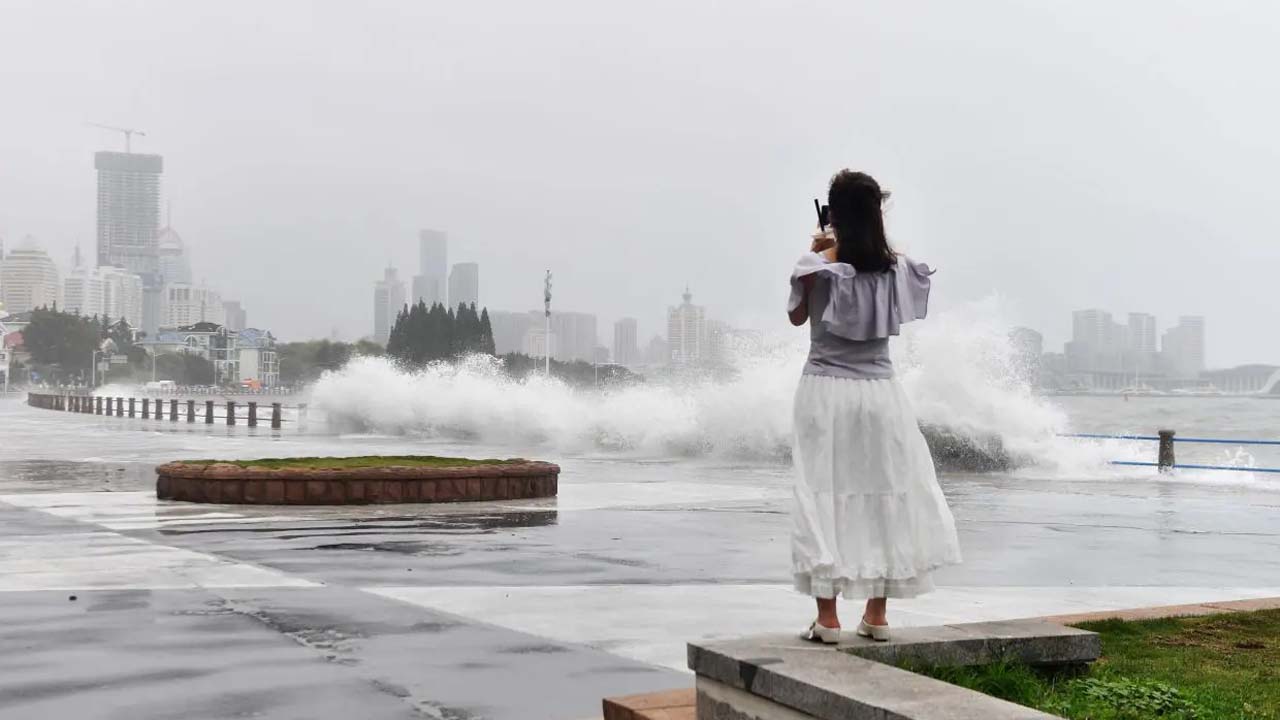
As Typhoon Bavi advanced toward North Korea, Pyongyang issued warnings of heavy rain and strong winds on Tuesday (July 14). To avert possible damage, the country’s leader, Kim Jong Un, ordered that “maximum alert” be maintained. Natural disasters tend to hit North Korea relatively hard because of its weak infrastructure and fragile economy. The news agency AFP reported this from Seoul.
The state daily Rodong Sinmun said the typhoon could weaken into a low-pressure system before crossing the country’s central region via the Yellow Sea between Tuesday and Wednesday. The paper said the country’s weather agency had issued heavy-rain and strong-wind warnings. Quoting Kim Jong Un, it said all officials and staff had been ordered to “remain on maximum alert and take the necessary measures to reduce damage.”
Rodong Sinmun said 80 to 120 millimetres of rain could fall on Tuesday in various areas of the country’s north and centre, with forecasts of heavy downpours of up to 30 to 60 millimetres an hour. In some areas, including the south, 150 to 200 millimetres of rain could fall, and winds of 10 to 15 metres per second could blow along the west coast and some inland areas. Last week, the Korean Central News Agency (KCNA) said North Korea had stepped up disaster-prevention activities.
Meanwhile, South Korea has also seen heavy rain recently, with up to 200 millimetres recorded in some places. Several hundred residents in the central Chungcheong province had to leave their areas, and many were trapped in floodwaters. Broadcaster KBS said a man in his 70s went missing after being swept away by a swollen river current in the southern Gyeongsang region. Seoul’s weather agency has forecast rain nationwide from Tuesday to Wednesday, with heavy rain possible in the central region and the southern Jeolla province. Scientists say human-induced climate change is making extreme weather more frequent, longer-lasting and intense. Last summer was the warmest in South Korea’s history, and this June was record-warm in both Koreas. The return of El Nino this year has also raised the risk.
বাংলায় মূল প্রতিবেদন পড়ুন · Read the original Bengali report