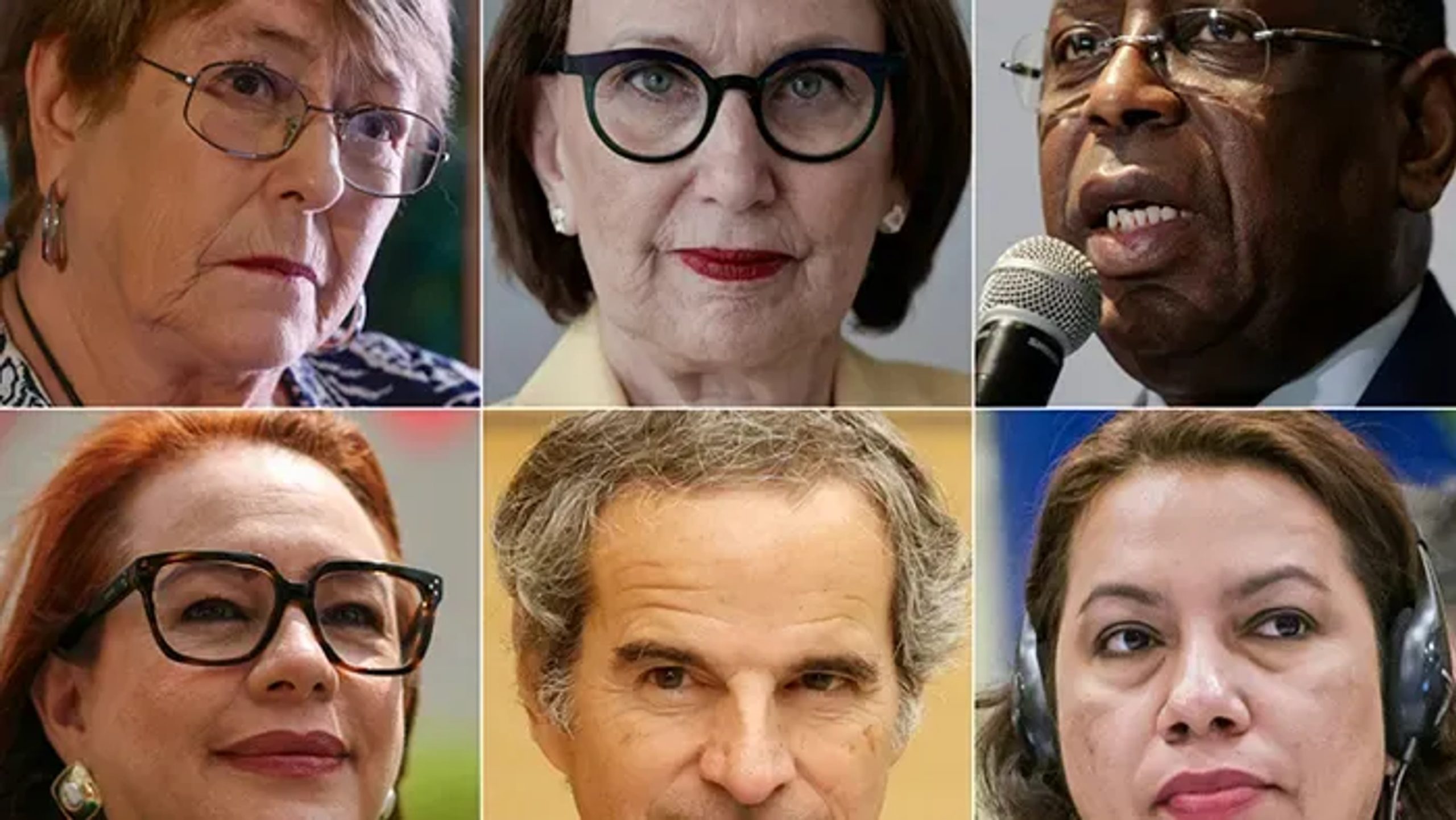
António Guterres will leave the post of United Nations secretary-general on December 31 this year after serving two consecutive terms over a decade. Six candidates are currently in the race to succeed him. Whoever is chosen will take office at a time when the UN’s effectiveness, influence and financial capacity are all under international scrutiny.
According to the UN, the secretary-general’s job is to act simultaneously as diplomat, advocate, chief administrative officer and chief executive. The office-holder oversees the work of the UN’s various key organs, including the Security Council, whose primary responsibility is maintaining international peace and security.
The General Assembly votes on the secretary-general on the recommendation of the Security Council. But because the council’s five permanent members — China, France, Russia, the United Kingdom and the United States — hold veto power, the path to the post is extremely difficult.
Michelle Bachelet (Chile)
Chile’s first woman president (2006-2010 and 2014-2018), Michelle Bachelet is running with the aim of becoming the UN’s first woman secretary-general, remaining hopeful even after several women candidates lost to Guterres in 2016.
Earlier this year the 74-year-old said that, put politely, the world may not have been ready then. “Is it ready now? I hope so,” she said, adding that electing a woman secretary-general would send a positive message to the world and be a symbol of hope for many.
She was UN High Commissioner for Human Rights from 2018 to 2022, working on many important geopolitical issues. While admitting she has no “magic solution” to the Security Council’s deadlock, she presents her long experience as her greatest strength.
Rafael Mariano Grossi (Argentina)
The Argentine diplomat Rafael Mariano Grossi has spent much of his career in the nuclear and atomic energy field, becoming director general of the International Atomic Energy Agency (IAEA), an autonomous UN-related body, in 2019.
With the risk of nuclear war rising in the current global situation, Grossi believes his experience in the field is a major advantage. “You have to understand the world you are living in,” he told the Switzerland-based outlet Geneva Solutions.
Grossi supports the UN’s ongoing UN80 reform initiative. In his view there is no need to rebuild everything; rather, costs should be cut by merging agencies and reducing duplicated structures.
María Fernanda Espinosa (Ecuador)
Born in Spain, María Fernanda Espinosa is a former foreign minister of Ecuador. The 61-year-old diplomat is a poet, essayist and specialist in sustainable development and climate change who began her career working with indigenous communities in the Amazon. She has also served as president of the UN General Assembly.
In an interview with Britain’s The Observer she said the UN’s biggest challenge now is its financial crisis: the UN must be reformed and transformed, or survival will be difficult. Espinosa wants closer cooperation with regional organizations and greater emphasis on European financial and diplomatic support.
Rebeca Grynspan (Costa Rica)
Costa Rica’s former vice-president Rebeca Grynspan is currently secretary-general of the UN Conference on Trade and Development (UNCTAD). Her role in negotiating and implementing the deal that kept Ukrainian grain exports flowing between the warring sides after Russia’s 2022 invasion drew international praise.
Grynspan believes the UN must be bolder. At an event hosted by Chatham House in London she said bureaucratic institutions are inherently reluctant to take risks, but that implementing new ideas requires taking them. She also favours greater representation on the Security Council, particularly for Africa and Latin America.
Macky Sall (Senegal)
Macky Sall, 64, was president of Senegal from 2012 to 2024, having earlier served as its prime minister.
Although his rule brought significant infrastructure development, his popularity fell in his second term after protests erupted over the jailing of opposition leader Ousmane Sonko. A failed attempt to postpone the 2024 presidential election triggered further deadly protests, making him a controversial figure at home. Senegal’s current government initially did not back his candidacy but reversed its position last month to support him.
Carolyn Rodrigues-Birkett (Guyana)
Carolyn Rodrigues-Birkett was the last to announce her candidacy, joining the contest in mid-June. She is currently Guyana’s permanent representative to the UN, having previously held various UN roles and served as Guyana’s foreign minister. She is a member of the Amerindian indigenous community and has held government responsibilities relating to it.
Explaining the aim of her candidacy, Guyana’s President Irfaan Ali said Rodrigues-Birkett seeks to strengthen multilateral cooperation, make the UN more effective and quicker to respond, build inclusive global governance and make the UN more capable of tackling contemporary global challenges.
বাংলায় মূল প্রতিবেদন পড়ুন · Read the original Bengali report