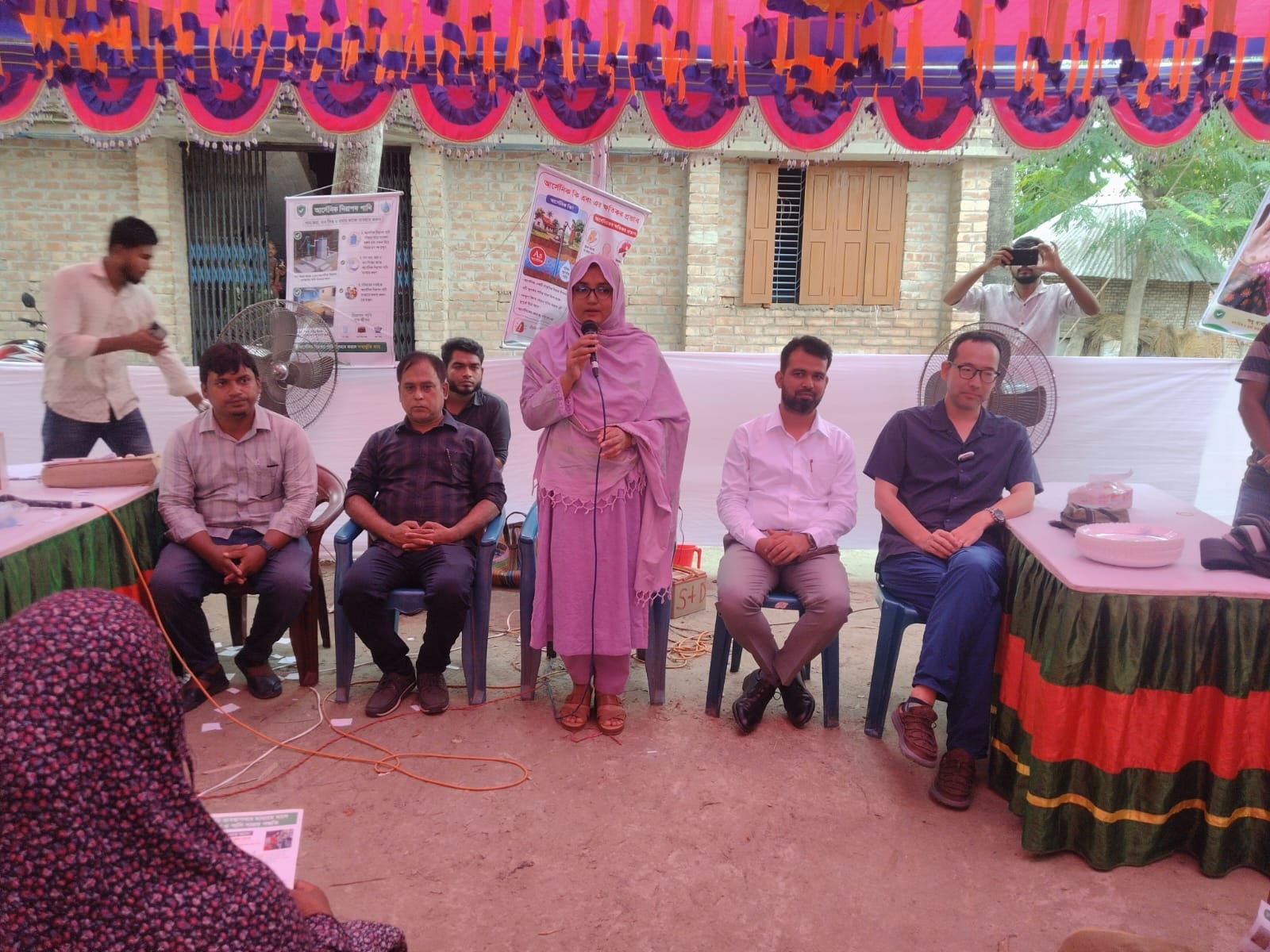
A field day organized by the Asia Arsenic Network Bangladesh was held in Chougachha, Jashore. With support from the Department of Agricultural Extension, the event took place on the afternoon of Monday, June 15, in Marua village of the upazila.
The event raised awareness about growing safe and nutritious rice using the 3F4D+MD method and about the serious harm caused by arsenic. More than a hundred local farmers took part.
Project manager Rezaul Karim presided over the event. Upazila Nirbahi Officer Farzana Islam attended as chief guest. Upazila Agriculture Officer Musabbir Hussain spoke as special guest. The project’s researcher, Professor Dr. Takehiro Kamiya of the University of Tokyo, was the keynote speaker.
Professor Dr. Takehiro Kamiya of the University of Tokyo said 13 percent of arsenic enters the body through drinking water, but 56 percent comes from cooked rice.
He said an arsenicosis-affected family was found to have serious arsenic-related health problems even after drinking arsenic-free safe water for more than 15 years. The reason, he said, is that the rice they eat daily was grown with arsenic-contaminated irrigation water. Because rice is the staple food of people in Bangladesh, the risk of arsenic entering the body through rice is the highest. Upazila Agriculture Officer Musabbir Hussain said that if rice is grown with arsenic-contaminated water, the rice too will contain arsenic. By using the 3F4D+MD irrigation method, he said, it is possible to reduce arsenic levels in food crops grown with such water.
3F4D+MD is a modern, environment-friendly irrigation method that saves water in paddy fields. Its full form is “3 Days Flooded and 4 Days Dry.”
Under this method, instead of keeping water standing in the field continuously, the paddy is flooded for three days and kept dry for four in turn. Because the soil is not constantly waterlogged, the level of inorganic arsenic in the rice falls by up to about 40 percent. He said the method uses 65 percent to 80 percent less irrigation water than the conventional method, cutting farmers’ production costs and easing pressure on groundwater. Even with less water, rice yields rise by 13 percent. Abu Hasan, field coordinator of the Asia Arsenic Network, said 30 people in this agriculturally rich village of Chougachha upazila have died from arsenic poisoning over the past two decades, and many others have lost limbs. Many people in the village still suffer from the disease. He said various steps had been taken to prevent arsenic exposure through drinking water, but it was also spreading to rice and other crops through irrigation. The 3F4D+MD method has been introduced to reduce the number of arsenic cases among the people of Marua village.
At the field day, water from local tube wells was tested free of charge for arsenic levels, along with diabetes screening.
বাংলায় মূল প্রতিবেদন পড়ুন · Read the original Bengali report