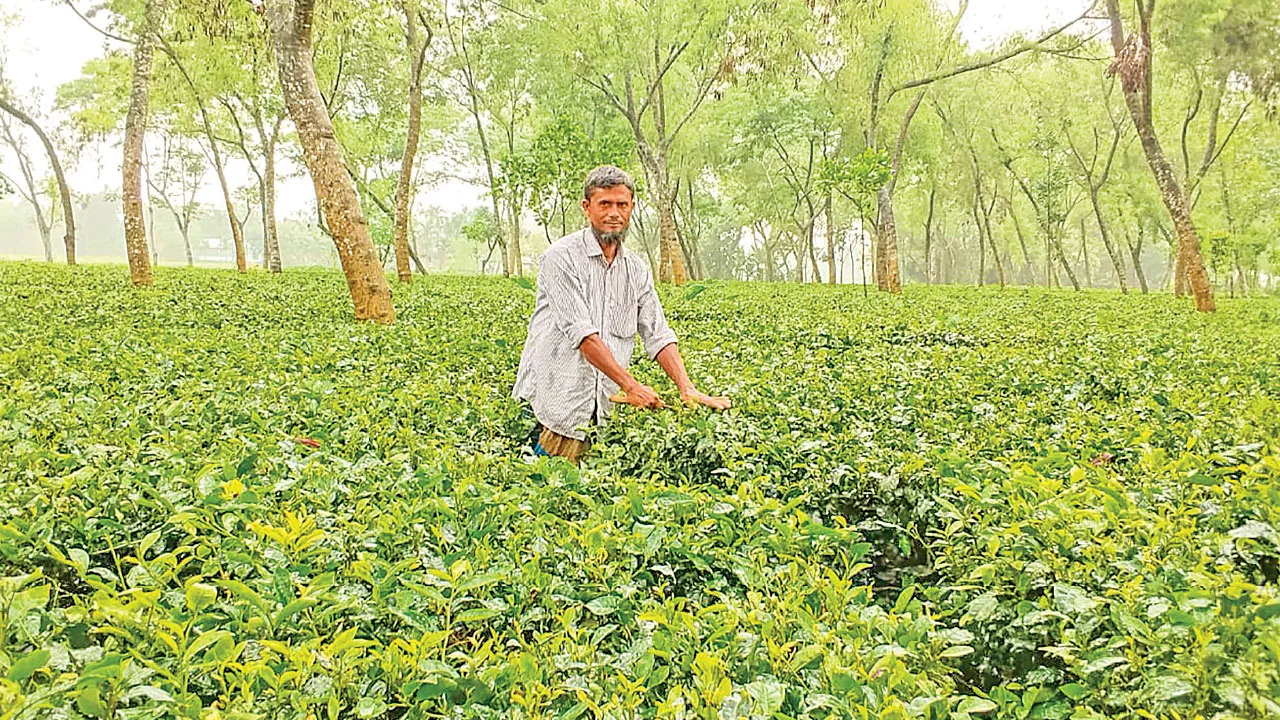
Tea cultivation has emerged as a major opportunity in the northern border district of Lalmonirhat. As an alternative to harmful tobacco, tea could turn the wheels of the district’s economy. Interest among many farmers has grown as tea farming proves profitable, and growers say they can turn things around if they get an adequate fertiliser supply and support from the Tea Board.
Entrepreneur Jamal Uddin Sarkar began experimental tea farming in 2016 at Taluk Dulali mouza in Velabari union of Aditmari. A lawyer by profession, he was the one who launched tea cultivation here, and many farmers followed his lead. Earlier, in 2007, the government took up a project to cultivate tea on 100 hectares of land under the “Eradication of Rural Poverty by Extension of Small Holding Tea Cultivation in Lalmonirhat” scheme, with a target of producing 2.5 lakh (250,000) kg of tea a year. Cultivation later spread to Patgram, Hatibandha and Kaliganj. To develop tea farming, the Tea Board opened an office in the district under the Northern Tea Belt.
During the coronavirus period, tea cultivation in the district stalled somewhat and ran into losses because of a labour shortage and poor market prices. As no local purchase house had been set up to sell the district’s tea, it had to be taken to Panchagarh for sale. The long journey left the tea leaves somewhat discoloured, and the buying centres used this as a pretext to deduct discounts of 20 to 30 percent from farmers. This left growers facing continuous losses, and many wound up their farming.
Having overcome the crisis, tea farmers in the district are now profiting as the current price stands at 38 taka per kg. At a time when Lalmonirhat’s farmers were turning away from agriculture after continuous losses from potatoes, paddy, maize and tobacco, they are now weaving dreams of self-reliance by cultivating tea, a cash crop.
After tea saplings are planted, the leaves can be plucked seven times a year. Per bigha, the first round early in the year yields 800 kg, the second 1,200 kg and the third 1,700 kg — rising with each round to as much as 3,000 kg per bigha.
After each round of plucking, each bigha requires 25 kg of urea, 25 kg of TSP, 25 kg of DAP and 15 kg of potash fertiliser, worth about 2,800 taka. Spraying for pests and soil fertility is needed four times, costing about 1,000 taka; loading the plucked leaves onto vehicles costs 5 taka per kg and transport to the factory 1 taka per kg. With incidental costs, production comes to 11 to 13 taka per kg, and the tea sells at 38 taka. After each round, output rises by about 500 kg per bigha on average, so by year’s end tea farmers make a profit of about 3 lakh (300,000) taka per bigha without any risk.
Rafiqul Islam, a tea farmer from Taluk Dulali in Velabari union, said he had become self-reliant by cultivating tea on 12 bigha of land, and many others had grown interested after seeing him. But the big problem, he said, was a lack of adequate fertiliser and a shortage of saplings, and he also complained that the Tea Board was not helping.
He said adequate fertiliser was needed to maintain output after each plucking. Because of the fertiliser shortage, maize, paddy and potato farmers get fertiliser under a rationing system, but tea growers do not get the fertiliser they need, he said. The Tea Board is not providing any help in this regard, and the Department of Agricultural Extension has made no arrangement for tea farmers, forcing growers to buy fertiliser from the black market at double the price when they need it.
Entrepreneur Jamal Uddin, who cultivates tea on 36 bigha, said the government had set up a Tea Board office in Lalmonirhat to expand cultivation. “At first the Tea Board supplied us with tea saplings, spray machines, shallow machines for water supply, leaf-pulling machines and cutting machines, but for the past three years the Tea Board’s project has been suspended, so we have received no support,” he said. Although the government has arranged incentives for tea workers, the Aditmari upazila social services office has so far given them no minimum benefits, he said.
He added that the district had huge potential for tea farming. If all the obstacles were removed and cultivation spread, the district’s people would benefit financially, he said, adding that at the current market price tea farming was highly profitable and risk-free. As a result, those who had wound up their cultivation during the coronavirus period were becoming interested in it again.
Amir Hossain, the acting officer of the Lalmonirhat Tea Board, said farmers were given facilities through projects. “Because no new project has been taken up for three years, we cannot give tea farmers any facilities,” he said. With the scientific officer on leave for higher studies, advice could not be given to farmers at the field level. “As I am in charge of five districts — Panchagarh, Thakurgaon, Lalmonirhat, Nilphamari and others — I struggle to manage everything alone,” he said. If the manpower shortage were resolved and a new project taken up, the obstacles to expanding tea cultivation in the district could be removed.
He also said the district had produced 4,28,641 (428,641) kg of green tea leaf last year.
বাংলায় মূল প্রতিবেদন পড়ুন · Read the original Bengali report