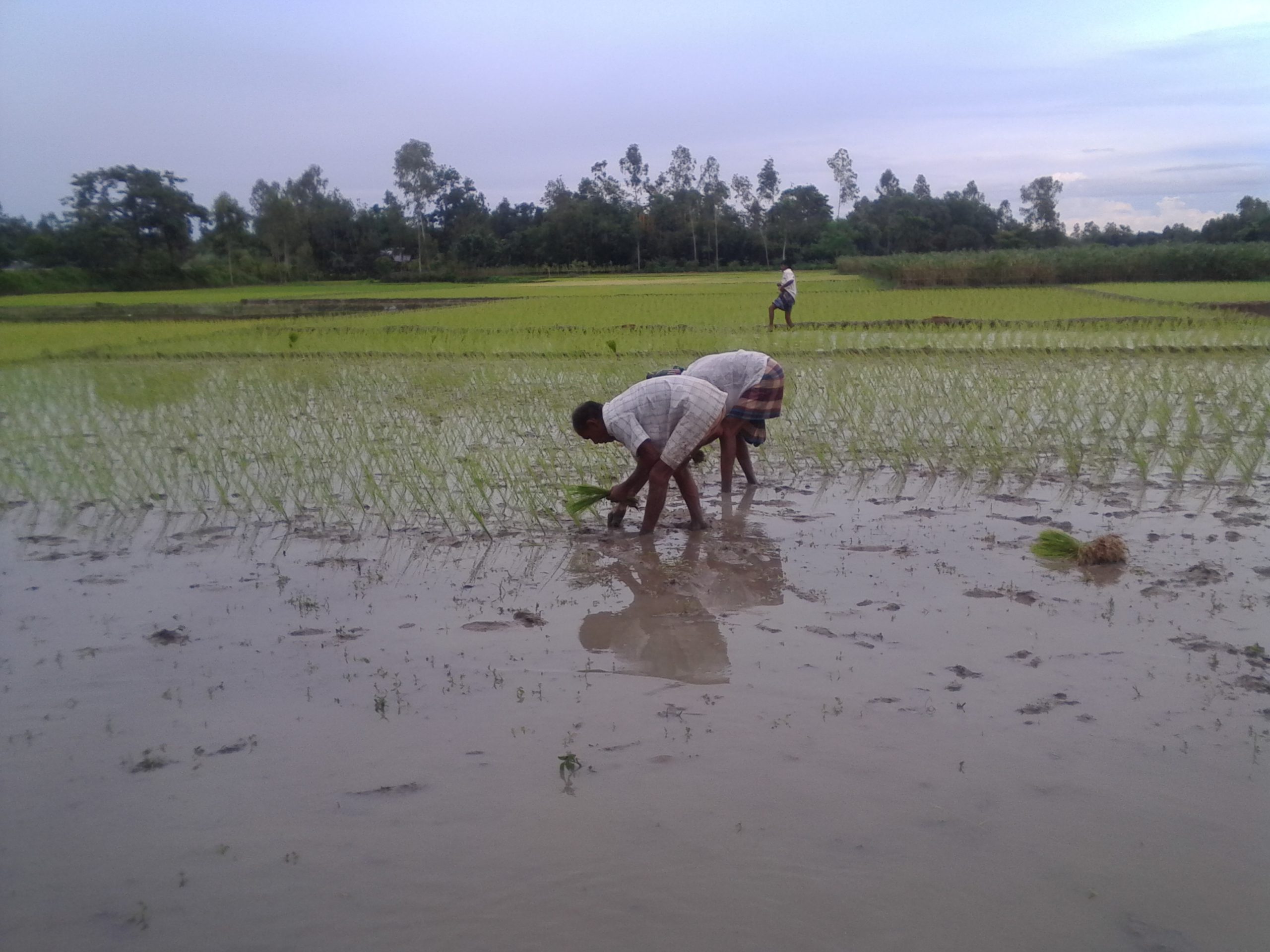
DHAKA — A growing exodus from villages to Dhaka and other cities has left Bangladesh’s fields short of hands at the height of the boro rice harvest, with farmers paying up to Tk 1,500 a day and still failing to find workers, agricultural economists and farmers across seven districts said.
The mornings that once rang with the sounds of plows, sickles and farm laborers now find the fields silent, while the streets of Dhaka and other big cities are choked with people and traffic. Sidewalks have turned into hawker markets. The collapse of rural labor supply, agronomists said, reflects a wider failure of planned urbanization.
Jahangir Alam, a professor of agricultural economics and dean of the animal science and veterinary medicine faculty at Sher-e-Bangla Agricultural University, said higher earnings in non-farm sectors are driving the shift. A large share of the rural workforce has moved into construction and other informal urban jobs, sharpening the labor shortage in agriculture, he said.
Alam said the absence of a minimum-wage structure for agricultural workers and gender-based wage disparities are key drivers of the crisis. Marginal farmers, unable to profit from cultivation and battered by natural disasters and climate change, are being forced to move to cities in search of work. Most industrial factories — especially garments and leather — are concentrated around Dhaka and Gazipur, drawing workers to those areas, he added. Better access to education and health care in cities also pulls people from villages.
The problem cannot be solved overnight, Alam said. The rural economy must be diversified, and farmers must be guaranteed fair prices for their produce. Strengthening the rural economy is essential to drawing workers back to villages, he said.
A second agricultural economist, Mohammad Jahangir Alam, a professor of agricultural economics and rural sociology at Bangladesh Agricultural University, said seasonal farm work alone cannot sustain laborers year-round, which is why so many migrate to cities. The solution requires diversifying the rural economy and ensuring year-round employment, he said.
Correspondents from Kishoreganj, Netrokona, Sylhet, Moulvibazar, Sunamganj, Habiganj and Brahmanbaria reported that paddy-cutting laborers are scarce across the haor wetlands. While ripe boro paddy should be bringing relief and abundance to farmers, much of the golden crop now lies submerged.
Bhairab, Kishoreganj: About 215 hectares of boro paddy have gone underwater after sustained rain. Even at Tk 1,500 a day, farmers cannot find workers to cut the submerged crop.
A tour of the haor areas in Srinagar, Aganagar, Shimulkandi, Sadekpur and nearby unions found ripe and half-ripe paddy submerged, making combine harvesters unusable. Many farmers, who had taken loans to plant the crop, now face uncertainty over repaying their debts and feeding their families. Some are wading into the water with their families to cut the rice themselves.
Islam Mia, a farmer from Jafarnagar village in Srinagar union, said he had planted five plots of paddy in Joyan Shahi haor this year. “I can’t find anyone to cut the paddy now. Even when laborers come for Tk 1,500 a day, they start at 8 a.m. and leave by 2 p.m.,” he said. Producing one maund of paddy costs Tk 2,000, but the market price is just Tk 700 to Tk 800, he said.
Afil Uddin, a farmer from Jagmohanpur village, said he had managed to cut only two of his plots and the rest are underwater. “This paddy is what we eat all year. The rest pays for the household,” he said. “This year, it’s all gone.”
Another farmer, Jalal Mia, said heavy rain had submerged his land and the paddy was rotting. Even at Tk 1,500, no workers were coming. He was cutting the paddy himself and hauling it out by boat.
Jahanara Begum, a farmer from Jafarnagar village who has no son and cultivates 10 plots in Joyan Shahi haor with her husband, said she had managed to cut just one plot. “There are no people, no boats — how do I cut it?” she said. “If we can’t get the paddy in, what will we eat all year? Looking at the haor, all I want to do is cry.”
Aklima Begum, Bhairab upazila agriculture officer, said the upazila had set a target of 6,910 hectares of boro cultivation this year but actual planting reached 6,930 hectares. About 215 hectares of paddy were submerged by excessive rain, and a list of affected farmers is being prepared so that government support can be arranged, she said.
Madhabpur, Habiganj: The upazila has produced ample boro paddy, but farmers cannot find enough workers to bring it in. They are scrambling with their own family members to finish the harvest.
Local farmers said laborers were once easy to find during harvest. Over the past eight to 10 years, major industrial plants have been built in Madhabpur, drawing in much of the area’s young workforce. Many young people consider farm labor too strenuous and are not interested, farmers said. Workers who do remain are charging Tk 1,200 to Tk 1,500 a day, pushing production costs to unsustainable levels.
Abdul Hai, a farmer from Bagasura village, said his paddy was ripe but he could not find anyone to cut it. A storm or more rain would mean heavy losses, he said, and harvesters cannot reach low-lying plots. Cutting one bigha of paddy now costs Tk 3,000 to Tk 4,000.
Sadek Mia, a farmer in Jagdishpur, said the limited workers available demanded high wages. “Given the price of paddy in the market, it’s very hard to absorb this cost,” he said.
Samuj Ali, a farmer from Chowmuhuni, said producing one bigha of paddy costs at least Tk 12,000, but a maund sells for just Tk 700 to Tk 850. “If this continues, farmers will gradually walk away from rice cultivation,” he said.
Sunamganj: No paddy is left above water in the haors. Anything still standing has rotted while submerged. A little remains on the higher ground, but a shortage of laborers has kept farmers from harvesting it.
Abdul Motin, 60, has 1.5 bighas of paddy underwater at Dekhar haor and depends entirely on the crop. He spent Monday afternoon trying to cut it with his college-age son, Junayed Ahmed. He had hired a small boat for Tk 1,000 for the day. Father and son were stacking the cut paddy on the haor bank under the harsh sun.
Motin said workers refuse to cut submerged paddy on a share-of-harvest basis. They demand Tk 1,000 a day, which he does not have. “There’s no money in hand and no one to be found,” he said. “So I’m doing what I can with my son.”
বাংলায় মূল প্রতিবেদন পড়ুন · Read the original Bengali report