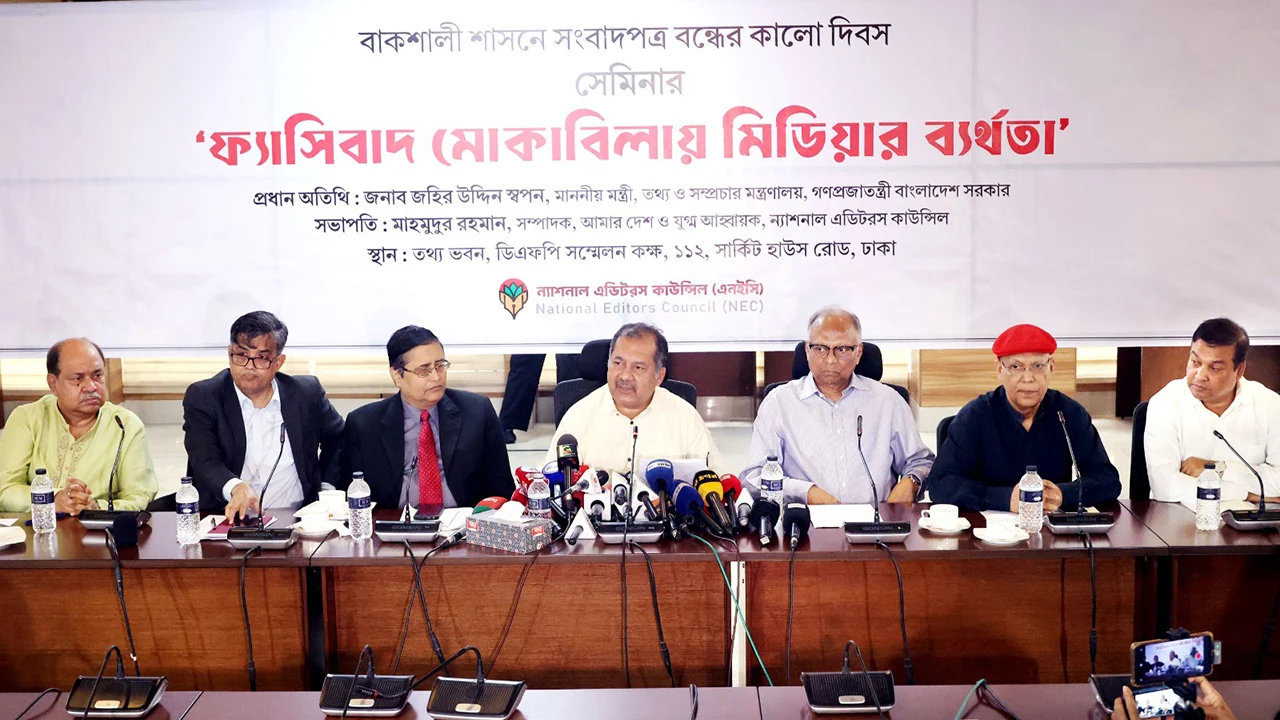
Information and Broadcasting Minister Zahir Uddin Swapan has said the media is the mirror of society and the state, and so it must be flawless. But the responsibility of building a flawless media also falls on the media itself, he said, and all sides need to unite for this.
He said that without standing on an objective viewpoint, an independent and responsible media commission cannot be formed in the future either. He made the remarks as chief guest at a seminar titled “The media’s failure in confronting fascism,” organized by the National Editors Council (NEC) at the DFP conference hall of the Information Building in the capital on Monday. The seminar was held to mark June 16 as the day newspapers were shut down under Baksal rule.
The seminar was chaired by NEC joint convener and Amar Desh editor Mahmudur Rahman, conducted by Jugantor editor and poet Abdul Hai Sikder, and the keynote paper was presented by Protidiner Bangladesh editor Maruf Kamal Khan.
Information Minister Zahir Uddin Swapan said: “Unfortunately, it seems to me that all the initiatives taken to build the media flawlessly were always somewhat partial. Because it never reached completeness, we could not build Bangladesh’s media into a strong institution. Certainly all the governments of the past should bear this responsibility.”
Stressing the need to unite all sides around a specific goal, the minister said: “Because if we cannot build consensus on our goal at the outset and cannot bring all the relevant stakeholders onto the same platform, then this difficult task, for the very reasons it failed in the past, may once again end in failure this time.”
Saying that democracy cannot be practiced until it is given structure, the minister said the main problem here had been that the culture of collectively practicing dissent, and the work of giving it structure, was never institutionalized. “I am very hopeful this time. I found no real difference between the views expressed in this seminar and the goals and conclusions of others I have already spoken with,” he said.
He said: “If we can once establish a collective stance amid this diversity, and if we can all unitedly set up a commission there, then it can serve as a refuge for the solution of all problems.”
In his address as chair, Mahmudur Rahman said the history of the Awami League is the history of one-man rule and Baksal. The history of the Awami League is the history of fascism and of the suppression of newspapers, he said. “We have seen this since independence, and the day this seminar marks, the black day of the press, was June 16, 1975. So the history of the Awami League stripping people of their rights has been running since the period after independence. Our position has been broadly set out in today’s keynote paper.”
Recalling that 35 cases were filed against him in 2017 over a comment about Tulip, the daughter of Sheikh Rehana and a former minister in England, Mahmudur Rahman said: “In one context I had said that intolerance toward newspapers or the media is in the genes of the Sheikh family. Because Sheikh Sahib destroyed newspapers, what his daughter Sheikh Hasina did with the press, everyone knows, and Tulip too misbehaved with a journalist of a London newspaper. In that context I had said the Sheikh family has a problem in its genes, that they cannot tolerate a free media. For saying this, 35 new cases were filed against me, on top of the earlier 100. It was while attending a hearing in one such case that I was attacked in Kushtia.”
On the purpose of organizing the seminar, the Amar Desh editor said: “We want a change in this kind of state system. And to seek this change, we must unite.”
He said: “We want to free the media from cliques and give it a national character. That is why we named our organization the National Editors Council, and for the first time it includes editors from outside Dhaka as well.”
Mahmudur Rahman said: “We want the media’s true freedom. That is, that I can express my opinion. If you do not like my opinion, you will write and protest against it. But you will not silence me. That is what we want. That is the media’s true freedom. To achieve this freedom, we must at least unite on this issue.”
He said: “Editorial policies will not all be the same. But on some fundamental issues, including freedom of expression, we can unite. Under the fascist regime this was completely destroyed. For example, at that time Justice Nizamul Haque Nasim was made chairman of the Press Council. Yet he should have been impeached for breaking his oath. From this appointment we can understand how the Sheikh Hasina government, or she and her government, viewed the media.”
Drawing the information minister’s attention to the matter, Mahmudur Rahman said government appointments are important. “Because appointments send a message about what the government actually wants to say and wants to do. For this reason they should be cautious about appointments,” he said.
He said: “If the collaborators of fascism want to purify themselves and join our unity, there is no objection. But those who were involved in killings, or who justified mass killing, cannot be taken into this unity. They must be tried under criminal law. We hope that the media freedom Sheikh Hasina destroyed, which the Dr. Yunus government largely restored, the current government will also maintain.”
Others who spoke at the seminar included Nayadiganta editor Salahuddin Mohammad Babar; Kaler Kantho editor and National Press Club president, poet Hasan Hafiz; Wada editor Shafiqul Alam; Bangladesh Federal Union of Journalists (BFUJ) president Obaidur Rahman Shaheen; BFUJ general secretary Kader Gani Chowdhury; New Nation editor Mokarram Hossain; Manobkantho editor Shahidul Islam; Bangladesher Khabor editor Syed Mesbahuddin Ahmed; Dhaka Reporters Unity (DRU) president Abu Saleh Akon; PIB chairman Faruk Wasif; Chattogram Metropolitan Journalists Union general secretary Saleh Noman; Khulna Metropolitan Journalists Union president Rashedul Islam; and New Times editor Saiful Islam.
Editors, executive editors and senior journalists of various newspapers were also present at the seminar.
বাংলায় মূল প্রতিবেদন পড়ুন · Read the original Bengali report