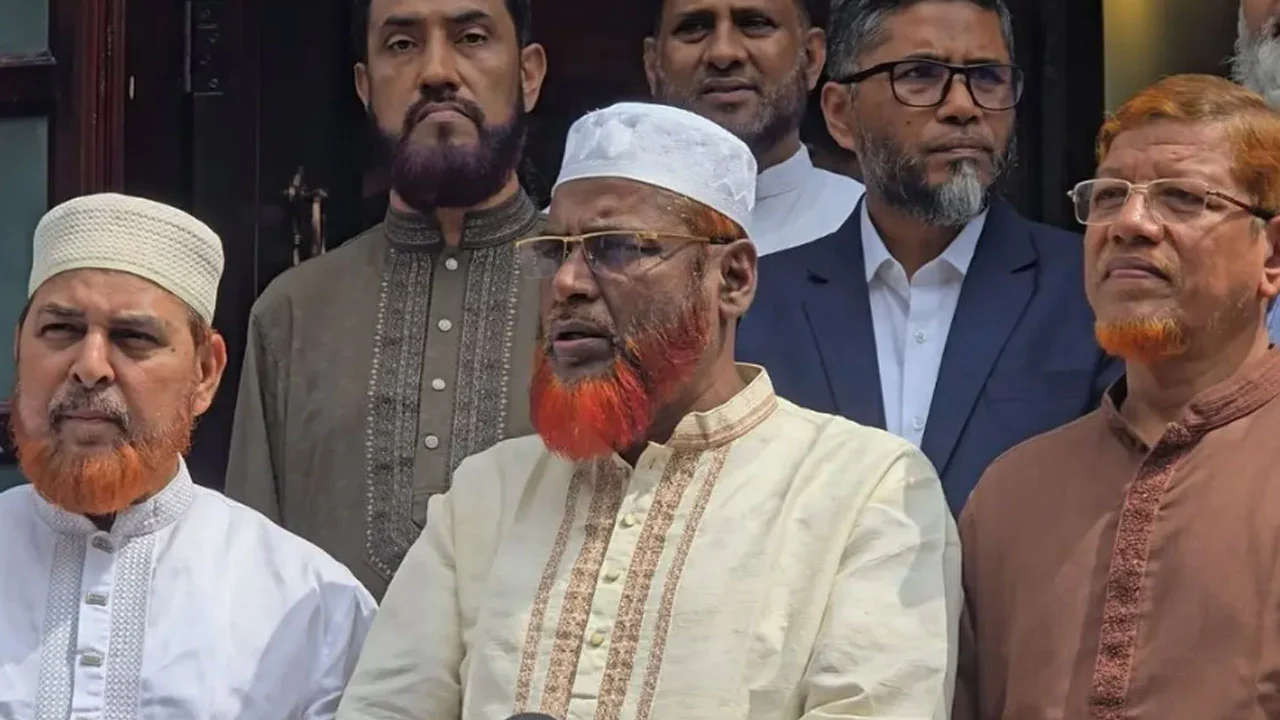
Bangladesh Jamaat-e-Islami Secretary General Mia Golam Parwar has laid out the party’s position on implementing the outcome of the national referendum.
He said 70% of voters cast a “yes” ballot in the referendum, and that the 11-party alliance and Jamaat would show no flexibility on implementing that verdict. There is no bigger issue right now than implementing the referendum result, he said, adding that there would be “not an iota of compromise” on implementing what he called the public’s historic verdict. If parliament fails to act, he said, Jamaat would return to the people directly.
He made the remarks at a press briefing Monday afternoon, following a meeting with editors of daily newspapers at the official residence of the leader of the opposition in the national parliament.
This marked the first time in the six months since the 13th national parliamentary election that Bangladesh Jamaat-e-Islami’s top leadership had held an open exchange with editors of the country’s leading national newspapers. The discussion centered on Jamaat-e-Islami’s role in and outside parliament on behalf of the 11-party alliance, the current national crisis, and the party’s firm position on implementing the referendum held on the basis of the “July Charter.”
Detailing the meeting at the press conference, the party’s secretary general, Professor Mia Golam Parwar, said the absence of a strong, constructive opposition party in Bangladesh’s political culture has deepened a long-standing democratic crisis. Against that backdrop, he said, Jamaat-e-Islami wants to begin a new chapter in national politics, focusing on “justice-based” parliamentary practice rather than the traditional violent, destabilizing politics of the past.
Explaining Jamaat’s “constructive politics,” the secretary general said being an opposition party does not mean opposing for opposition’s sake. He said the core policy of Jamaat-e-Islami and the 11-party alliance is to fully cooperate with the government on welfare-oriented, good work, while constructively protesting anything against the public interest or otherwise harmful. He said Jamaat is determined to break from the country’s past record of negative, failed opposition politics and instead contribute to political stability and democratic transition — a strategic position political analysts believe could put the country’s democracy on a stronger footing.
On the editors’ observations and assessment at the meeting, he said effective interaction between political parties and the media is essential in a democratic state. He said editors present at the meeting shared their observations on Jamaat-e-Islami’s parliamentary and political role. Leading newspaper editors and prominent journalists attended at the invitation of Jamaat’s Amir.
He said that, for the first time in 54 years of independence, editors at the meeting described watching an opposition party play such a balanced, responsible role — supporting good work while protesting bad — as a positive evolution in politics.
He said the editors present had advised that, while street programs may be necessary to press public demands, they should never again take the intolerant, destabilizing or violent path of the past. They urged Jamaat to remain steady on a peaceful, lawful course in the interest of the country and its people. The editors welcomed the opportunity for such a formal, open discussion after six months and stressed the importance of keeping it up.
Golam Parwar said the editors’ positive assessment would encourage Jamaat-e-Islami to play an even more responsible role going forward.
He said the historic absence of an effective opposition in parliament, and the suppression of the public’s voice, represents a deep national crisis. In that context, he told the editors, Jamaat-e-Islami and 11-party alliance lawmakers in parliament have faced what he called discriminatory treatment. He said opposition members’ rights are being curtailed in the allocation and distribution of development funds, that opportunities to speak on the floor of parliament are being limited, and that the conduct of the speaker and the treasury bench in lawmaking and handling important public notices has not been fair.
The meeting also highlighted for editors the severe power and gas crisis, unbearable price hikes on daily essentials, and what Jamaat described as the government’s failure to protect the rights of expatriate workers.
He said the government is dragging its feet on implementing the verdict delivered when 70% of the country voted “yes” in the referendum held on the basis of the July Charter. He said the law minister had agreed on three-and-a-half of the referendum’s four issues, but disagreement on the remaining half-issue has created the current crisis. Jamaat made clear it would give “not an iota of compromise” on implementing what it called this historic public verdict, and sought editors’ cooperation through their writing and journalism in resolving the crisis and presenting the real facts to the public.
Asked by reporters about the absence of some editors, the Jamaat secretary general said there was no rift with the media. He said many editors attended, and those who could not gave their reasons by phone, adding that the meeting itself was proof of a good relationship.
Asked about government claims that Jamaat’s long marches, rallies and other movement programs lack any basis, Golam Parwar said those making such claims lack any real capacity for political analysis and are simply flattering the government. He said the referendum verdict is currently the country’s central issue.
As part of its efforts to build public opinion and continue its street programs, the 11-party alliance has announced a new program: a large long march and vehicle convoy set to depart Dhaka’s Shapla Chattar for Chattogram at 7 a.m. on the 5th.
On the purpose of the program, the Jamaat secretary said it is aimed at enforcing the referendum verdict and securing the public’s rights. Ordinary people along the route have been invited to join spontaneously. Jamaat has sought the strong cooperation of journalists and people from all walks of life to make the program a success.
Also present were Jamaat-e-Islami Assistant Secretary and MP Rafiqul Islam Khan; Maulana Abdul Halim; 11-party alliance coordinator and Jamaat assistant secretary A.H.M. Hamidur Rahman Azad; Dhaka Metropolitan South Jamaat Amir Nurul Islam Bulbul and Secretary Shafiqul Islam Masud; and Dhaka Metropolitan North Jamaat Amir Selim Uddin and Secretary Rezaul Karim, among other leaders.
Earlier, from noon to 2 p.m. Monday, Jamaat-e-Islami Amir Dr Shafiqur Rahman took part in a two-hour meeting with editors of various daily newspapers at the opposition leader’s official residence on Minto Road in the capital. Senior party leaders also attended alongside the Amir. Those present at the meeting included Mahmudur Rahman of Amar Desh, Sajjad Sharif, executive editor of Prothom Alo, Mahfuz Anam of The Daily Star, Syed Shah Newaz Karim of Somoyer Alo, Salah Uddin Babar of Naya Diganta, Shafik Rehman of Jai Jai Din, Mustafiz Shafi of Desh Rupantor, Mostafa Kamal of Khaborer Kagoj, Dewan Hanif Mahmud of Bonik Barta, Shafiqul Alam of Daily Wadar, Kamrul Hasan of Ajker Patrika, Harun Jamil of Dhaka Mail, Maruf Kamal Khan Sohel of Protidiner Bangladesh, A.M.M. Bahauddin of Inqilab, Shahidul Islam of Manabkantha, Mostafa Mamun of Agamir Somoy, K.M. Belayet Hossain of Bhorer Dak, Santosh Sharma of Kalbela, Tasmima Hossain of Ittefaq, Matiur Rahman Chowdhury of Manab Zamin, ABM Selim Ahmed of Daily Evening News, Mostafa Kamal Mazumder of Dainik Ediin, and Gias Uddin of Banijjo Protidin.
বাংলায় মূল প্রতিবেদন পড়ুন · Read the original Bengali report