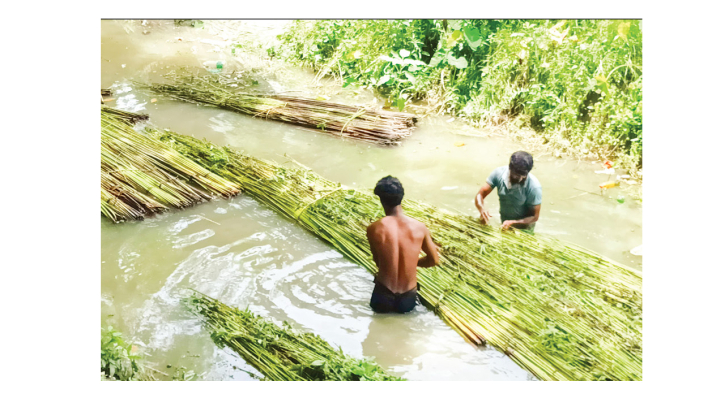
The canal was once all but dead. Silted up over years, it no longer held even monsoon water. With no water, local farmers faced acute hardship each season retting jute; many had to rent ponds several kilometres away or pay extra to use others’ water bodies. That hardship is now largely in the past. After the government re-excavated the canal, it is brimming with monsoon water, and farmers are retting jute in it together, in good cheer, hoping for better fibre and prices.
Near the Barbhag Dakshinpara sluice gate in Togarband union of Faridpur’s Alfadanga upazila, a canal that was choked with weeds and silt only weeks ago is now full of water. Rows of forest and fruit-tree saplings on both banks have given the whole area an attractive look. Bundles of jute lie soaking in rows; some farmers are bringing in fresh jute, others preparing to strip fibre from retted jute. Even village elders express satisfaction at a sight not seen in a long time.
Imdadul Sheikh, a farmer of Barbhag village, said while retting jute in the canal beside his home: “Before, we had to struggle for water and take jute far away to ret it, which cost more. This time I can ret it in the canal right beside my home. It saves time and money. This government initiative has helped us a lot.”
Farmers of the same village said that when there was not enough water, jute often did not ret properly, worsening fibre quality and fetching lower prices; that problem has now largely eased. Kamrul Sheikh, a farmer of Mala village, said: “I grew jute on 1.5 acres this time. Before, I had to rent others’ ponds and sometimes pump water to ret jute, which cost extra. This time I can do everything in the canal, cutting production costs, and I expect good fibre.”
Locals say the benefits will not stop at jute. With monsoon water conserved, irrigation will improve next season, natural fish habitats will form, and the area’s environment and biodiversity will be enriched.
Togarband union parishad chairman Mia Asaduzzaman said the re-excavation had created new possibilities for agriculture, with farmers directly benefiting, and that continuing such work would raise local farm output further. Upazila project implementation officer Sagar Hossen Saikat said that although the project was small, there was no slackness in carrying it out; the work was completed fully on time, ensuring proper use of public money.
Alfadanga upazila nirbahi officer (UNO) Rifat Noor Mousumi said the canal had been properly re-excavated as directed, with farmers already beginning to benefit, and that it would help conserve water bodies, protect biodiversity and maintain environmental balance, with such work to continue in the public and agricultural interest.
Upazila administration sources said a 570-metre stretch of the canal, from the Barbhag Dakshinpara sluice gate to Milon Molla’s house, had recently been re-excavated under the Department of Disaster Management, at an estimated cost of 2,579,148 taka. Because worker attendance and accounts were regularly checked, a surplus of 37,370 taka left from worker absences was returned to the treasury under government rules — cited as a positive example of accountability in managing public money.
বাংলায় মূল প্রতিবেদন পড়ুন · Read the original Bengali report