Equal leave for both parents is a central part of Sweden’s social security system. Parents in Sweden share 480 days of paid parental leave for each child: 240 days for the mother and 240 for the father. Of these, 90 days are reserved for the mother and 90 for the father, and cannot be handed to the other parent.
Parents can divide the remaining 300 days between them as they wish. For 390 days the state pays an allowance based on income, at about 80 percent of full pay. The other 90 days are paid at a fixed minimum rate. Many employers also top up the allowance for their staff.
Within a child’s first 15 months, the mother and father can take up to 60 days of leave at the same time, known as “double days”. Parents can also spread their days over a longer period instead of taking them in one stretch, so the 480 days do not mean staying at home for 16 months in a row.
The aim is not only to give mothers long leave but to involve fathers actively in caring for their children. In 1974 Sweden became the first country in the world to introduce gender-neutral paid parental leave.
The leave reserved for each parent has since been extended step by step: the first reserved month came in 1995, the second in 2002 and the third in 2016. Today each parent has 90 days reserved. Although fathers take parental leave, mothers still use most of the days. In 2023 fathers used an average of 30.9 percent of all leave days.
Is motherhood a barrier to women’s careers?
Must a woman put her working life on hold after having a child? In many countries, motherhood leaves women behind at work: they miss promotions, earn less, or are forced out of their careers for a time or for good. Economists usually call this long-term effect the motherhood penalty.
The problem has not disappeared in Sweden either. A 2024 study by IFAU, the country’s government research institute, found that the negative effect of childbirth on women’s earnings has shrunk over recent decades, but that progress has slowed since the late 1980s.
Another study by the institute in 2025 found that motherhood also harms the labour-market experience of women who are immigrants or children of immigrant families, and that the social and institutional environment plays an important part.
The OECD’s Economic Surveys: Sweden 2025 report also warned that although the gaps between men and women in employment and pay in Sweden are relatively small overall, they have not closed. In 2023, even after accounting for a range of personal and workplace characteristics, women in couples earned about 14 percent less per hour than men.
The report also noted that the drop in women’s earnings when a child is born can last a long time. Even in an advanced welfare state like Sweden, combining motherhood and work remains an open policy challenge.
Mothers and babies in world politics
Politicians in several countries have brought their children to parliaments, international conferences and state events. In 2017 Jytte Guteland, a Swedish member of the European Parliament, spoke in the chamber with her eight-month-old son, Uno. She said at the time that politics needs to represent every experience of life, and that having a baby should not narrow a politician’s chance to carry out parliamentary duties.
The same year Australian Senator Larissa Waters made history by breastfeeding her baby in parliament. In 2018 Jacinda Ardern, then New Zealand’s prime minister, attended the UN General Assembly with her three-month-old daughter, Neve. The baby’s father, Clarke Gayford, was with her. These moments showed that a culture in which a child’s presence in government and policymaking is seen as abnormal can change.
In June 2026 Pourmokhtari’s appearance was reported as the first time a baby had attended an EU ministerial meeting. An EU official said that, to their knowledge, it was a first. But Sweden’s former foreign minister Tobias Billström later said that in 2009, while he was a Swedish minister, he had taken his young daughter to a European meeting in Brussels. So it would be wrong to call it the first appearance of a child in European politics. It is fairer to say that Pourmokhtari’s case drew fresh international attention to children at EU ministerial meetings.
A minister’s duties with a three-month-old
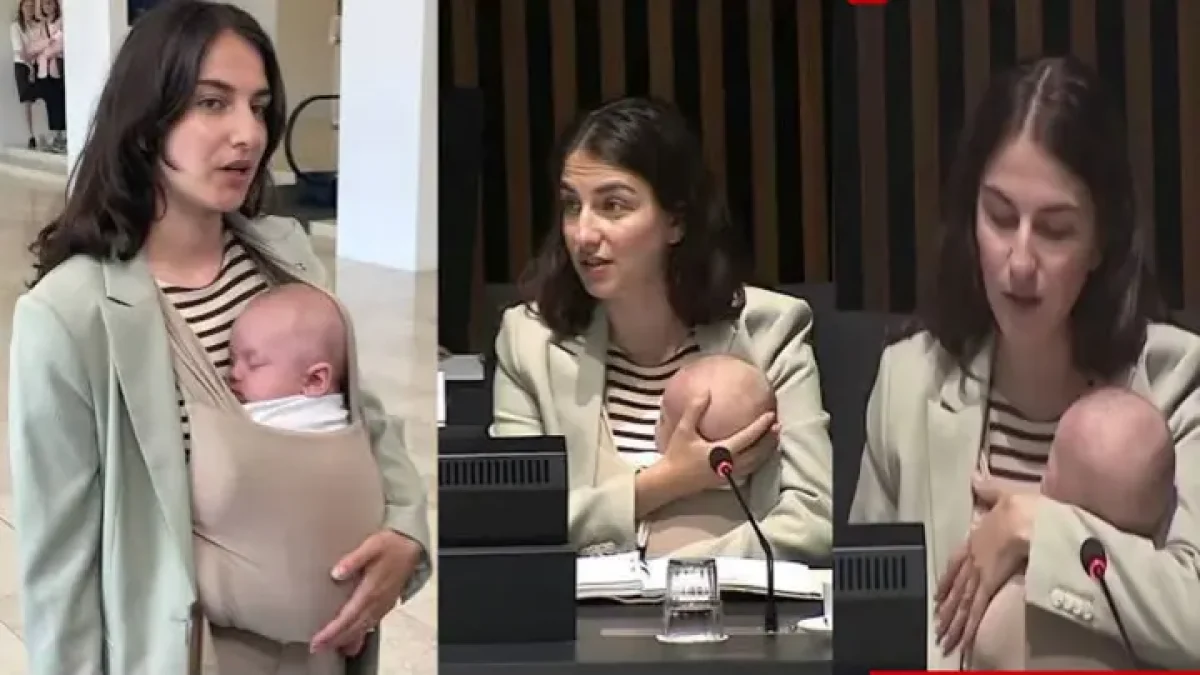
Challenging the idea that a woman must choose between motherhood and her job, Romina Pourmokhtari, Sweden’s minister for climate and the environment, arrived at a meeting of EU climate ministers with her three-month-old son. It was not only one mother’s unusual appearance but an important example of women’s rights at work, fathers’ responsibilities, childcare and the state’s social protection system.
The moment, which drew international discussion, came on 25 June 2026 at a meeting of EU climate ministers in Luxembourg. The 30-year-old Swedish minister joined the meeting carrying her three-month-old son, Adam, in a baby sling on her chest. The baby’s father, the minister’s husband, was with her and looked after the child during the meeting. An EU official said that, to their knowledge, no child had taken part in a ministerial meeting of the bloc in this way before, and the scene drew wide attention in international media.
Pourmokhtari’s husband travelled with her to Luxembourg and cared for the baby during the meeting. He was on parental leave at the time and planned to stay on leave until Sweden’s September election. In the minister’s words, her husband taking on this role and support at work freed her from the pressure of choosing between motherhood and her ministry.
Pourmokhtari said she wanted to set an example in which a woman does not have to choose between being a responsible minister and a mother who is present for her child. She wanted to be both at once, she said. But a mother’s wish is not enough for that balance; it also takes a supportive workplace, effective social protection and an equal share from the child’s father.
That is where the moment matters. A minister taking her baby to a meeting is not simply news of a personal choice. It points to a social and institutional system in which motherhood is not seen as a barrier to a woman’s career, and in which family and work responsibilities can be shared.
The minister and her political career
To understand the weight of the appearance, it helps to know who Pourmokhtari is. Born in 1995, she is a politician of Sweden’s Liberal Party. When she became minister for climate and the environment in 2022 at just 26, she was the youngest minister in Swedish history. She had earlier led the Liberal youth organisation, represented Sweden at the European Youth Forum and became a member of parliament in 2022. According to her official government biography, her portfolio covers climate, the environment, chemicals, waste management, biodiversity and the marine environment.
She took a break from her duties for the birth of her child. According to a Swedish government announcement dated 15 June 2026, she was on leave to care for her child from 2 March. During that time Employment Minister Johan Britz stood in as acting minister for climate and the environment. Pourmokhtari returned to the ministry on 15 June. The Luxembourg meeting with her baby came soon after she ended her maternity break and returned to work. It was not a sudden trip or a personal publicity move, but a visible example of how a working mother back on duty can combine child and work.
Is bringing a baby only a symbolic step?
Alongside praise for Pourmokhtari, the practical side also needs weighing. Taking a baby to an international meeting does not mean every working mother can do the same. The minister had her husband with her, as well as someone to help look after the child, and the backing of her workplace and the state. Without that support, such a step may not be realistic for many.
A three-month-old baby has its own needs for sleep, feeding, health and safety. International meetings, for their part, demand long discussions, diplomatic etiquette, attention and punctuality. So the main lesson is not that every mother should take her child to work. It is that workplaces should be arranged so that having a child does not unfairly limit a woman’s rights and opportunities at work. Anyone who wants to work with a baby alongside should have the chance; anyone who wants to take leave should be protected too.
Another point matters especially: the father’s responsibility. The idea that a mother’s career stops after a child is born while the father’s life goes on as before harms families and society too. Because Pourmokhtari’s husband took leave to care for their child, the story is not only about one woman’s personal ability; it is also a family example of shared responsibility.
বাংলায় মূল প্রতিবেদন পড়ুন · Read the original Bengali report